
The Washington Spirit opened their 2026 NWSL playoff campaign with a statement performance, defeating the Portland Thorns 4–1 at Audi Field on November 8. Trinity Rodman scored twice and supplied an assist, while Clara Luvanga delivered a goal and two assists as Washington advanced to the semifinals for the third consecutive season. In front of 19,215 supporters in Washington, D.C., the third-seeded Spirit turned an early lead into a commanding first-half advantage and showed why their attacking options make them a serious championship contender.
The result was significant for more than the scoreline. Washington had to respond to the pressure of a single-elimination quarterfinal against a Portland side that finished sixth in the regular-season standings. Instead, the Spirit established control early, punished defensive mistakes, and restored their three-goal advantage after the Thorns briefly threatened in the second half. Rodman was the headline performer, but the combination of her movement, Luvanga’s pressing, and Washington’s ability to attack quickly gave the team a more complete performance than an individual scoring display alone could explain.
Washington now faces the Utah Royals in the NWSL semifinals on November 14 at Audi Field. A victory would send the Spirit to a third consecutive NWSL Championship match, giving the club another opportunity to compete for the league title.
Trinity Rodman Set the Tone Against Portland
Rodman’s influence was clear from the opening minutes. Washington took the lead in the sixth minute after the forward pressured Portland defender Carolyn Calzada, won possession deep in the Thorns’ defensive territory, and carried the ball into the penalty area. Rather than forcing a difficult shot, Rodman delivered a low pass through traffic to Mélissa Bethi, who finished to give the Spirit a 1–0 advantage.

That sequence showed the value of Rodman’s work beyond the final action. Her acceleration and willingness to challenge defenders created the turnover, while her decision to find Bethi turned the opportunity into a goal. Washington did not need to dominate every possession to create danger. The Spirit were able to turn pressure into attacking situations before Portland could reorganize.
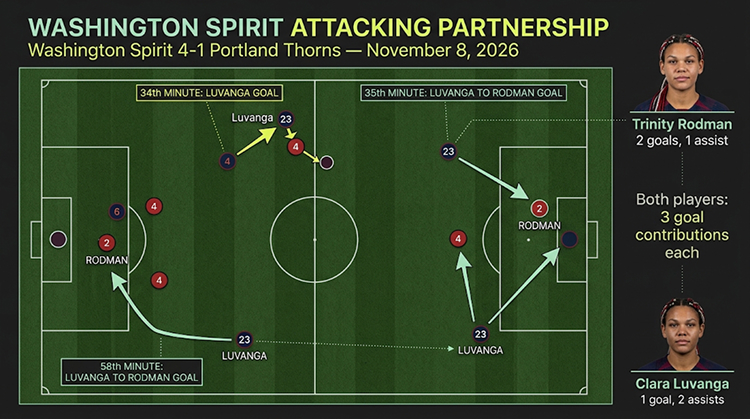
Rodman scored her first goal in the 35th minute. Clara Luvanga had doubled Washington’s lead one minute earlier, taking advantage of hesitation between Portland goalkeeper Mackenzie Arnold and defender Isabella Obaze. Luvanga closed down the ball, won possession, and finished from close range.
The next attack developed almost immediately. Luvanga moved forward and supplied the pass that allowed Rodman to finish and make the score 3–0. The two goals arrived only 91 seconds apart, the fastest pair of goals in NWSL playoff history according to reporting by The Athletic.
Rodman added her second goal in the 58th minute. Luvanga again created the opportunity, driving a low pass across the penalty area during a transition attack. Rodman met the delivery with her left foot and restored Washington’s three-goal cushion after Portland had reduced the deficit.
The forward finished with two goals and one assist, directly contributing to three of Washington’s four goals. Her performance was especially important because it demonstrated how she can influence a match through pressing, passing, movement, and finishing rather than relying on one attacking role.
Clara Luvanga Gave Washington Another Major Attacking Threat
Rodman’s performance attracted most of the attention, but Luvanga was equally important to the result. The forward scored once and assisted both of Rodman’s goals, giving her three goal contributions in the quarterfinal.
Her goal in the 34th minute came from aggressive pressure on Arnold. The Portland goalkeeper hesitated while dealing with a back pass, allowing Luvanga to close the space and take possession. Luvanga then finished the opportunity herself, turning a defensive error into Washington’s second goal.
Her work as a creator was just as effective. The pass for Rodman’s first goal arrived after Luvanga advanced into the penalty area and recognized the forward’s position. For the second, she carried the ball into the attacking area before delivering the low pass that Rodman converted.
The combination created a difficult problem for Portland. If the Thorns focused on containing Rodman’s runs, Luvanga could attack the space and initiate pressure. If they attempted to stop Luvanga from progressing, Rodman remained available to receive passes inside the box.
Washington’s official match recap identified Rodman and Luvanga as the first two players in NWSL history to record three total goal contributions each in a playoff match. That statistic captures the importance of the partnership and gives the Spirit another attacking dimension heading into the semifinal.
Luvanga’s contribution also highlights the value of squad development during the season. She joined Washington in September and had made her first start only a few weeks before the Portland match. Her rapid integration gave the coaching staff another forward capable of applying pressure and creating chances in high-stakes games.
Washington’s First-Half Pressure Changed the Quarterfinal
The Spirit’s three-goal lead before halftime was the defining feature of the match. Washington scored in the sixth, 34th, and 35th minutes, forcing Portland to chase the result for most of the afternoon.
The first goal came from Rodman’s pressure, while the next two exposed the Thorns’ difficulty dealing with Washington’s direct attacking runs. Luvanga’s high pressure disrupted Portland’s defensive organization, and Rodman’s ability to attack the space behind the back line gave the Spirit a second way to exploit the situation.
Washington also benefited from a strong collective performance. The team recorded 16 total shots compared with Portland’s 11 and held 59% possession. The Spirit completed 79% of their passes, while Portland finished with 67% passing accuracy, according to the official match statistics.
However, the numbers also show that the result was not simply a product of Washington controlling every attacking measure. Portland registered seven shots on target, compared with five for the Spirit. Washington goalkeeper Sandy MacIver made six saves, helping the home side preserve its advantage when the Thorns found opportunities.
That distinction matters for the semifinal. Washington’s attacking efficiency was excellent, but the team also had to rely on its goalkeeper and defensive organization to manage periods of Portland pressure. The Spirit will want to retain the intensity that produced the early lead while reducing the number of clear opportunities they allow against Utah.
Pietra Tordin’s Goal Tested Washington After the Break
Portland did not leave the match without a response. The Thorns returned from halftime with greater urgency and reduced the deficit in the 51st minute.
Jessie Fleming delivered the ball back into the penalty area after a corner-kick sequence, and Pietra Tordin finished to make the score 3–1. It was Tordin’s first career playoff goal and gave Portland a brief opportunity to put pressure on Washington.
The Spirit answered seven minutes later. Luvanga drove forward in transition and found Rodman, who finished with her left foot to make it 4–1. The goal stopped Portland’s momentum and restored the three-goal margin.
Washington’s response was an important part of the performance. In knockout soccer, a team can lose control of a match even after building a substantial lead. The Spirit did not allow the Thorns’ goal to become the start of a sustained comeback.
Portland’s task became more difficult late in the match when defender Jayden Perry received a second yellow card and was sent off in the 88th minute. The Thorns finished the quarterfinal with ten players, ending their hopes of mounting another challenge.
The final score also marked Washington’s biggest margin of victory in a playoff match in club history, according to the Spirit’s official recap.
Sandy MacIver and the Defense Still Had Work to Do
A 4–1 victory can make defensive concerns easy to overlook, but Washington’s performance between the posts was important. Portland managed seven shots on target and forced MacIver into six saves.
The goalkeeper’s contribution helped the Spirit maintain control after the Thorns scored early in the second half. Washington’s defenders also had to manage Portland’s attempts to move the ball into dangerous areas, particularly after the visitors increased their attacking urgency.
The official statistics show that both teams recorded 13 tackles won, while Portland produced 11 total shots and Washington had 16. The Thorns also earned three corners, compared with four for the Spirit.
Those figures suggest that Washington’s advantage came from the quality and timing of its attacking actions rather than complete defensive suppression. The Spirit were effective at turning pressure into goals, but Utah will have an opportunity to test the back line in a match where a single defensive mistake could change the season.
The semifinal therefore presents two connected challenges. Washington must preserve the attacking aggression that helped defeat Portland while improving its ability to limit opponents’ shots on target. A strong performance from MacIver and the defensive unit could be just as important as another productive afternoon from Rodman.
Utah Royals Are Washington’s Next NWSL Playoff Test
Washington’s semifinal opponent will be the Utah Royals, who reached the final four after defeating the second-seeded San Diego Wave 1–0 on November 6. Kiana Palacios scored the decisive goal in the 30th minute, while goalkeeper Mandy McGlynn recorded four saves to secure Utah’s first playoff victory and first semifinal appearance in club history.
The matchup gives Washington a different challenge from the one presented by Portland. Utah demonstrated against San Diego that it can defend for long periods, remain organized without controlling possession, and punish an opponent through a decisive attacking moment.
The Royals finished the regular season as the seventh seed, while Washington entered the playoffs in third place. The Spirit will have home-field advantage at Audi Field on Saturday, November 14, with kickoff scheduled for noon Eastern Time.
The teams have already met twice during the 2026 regular season. Washington won 1–0 away from home on July 29, while the sides drew 1–1 in Washington on March 25. Those results suggest that Utah can make the matchup competitive even when the Spirit have the advantage in the standings.
Washington will need to avoid assuming that the semifinal will follow the same pattern as the Portland quarterfinal. Utah’s defensive discipline and McGlynn’s goalkeeping could make scoring opportunities harder to find. The Spirit may have to demonstrate patience and create chances through combinations rather than relying entirely on high-pressure turnovers.
A Third Consecutive NWSL Championship Is Within Reach
Washington’s win over Portland puts the club one match away from another NWSL Championship appearance. The Spirit have reached the title match in each of the previous two seasons, and the 2026 semifinal gives them the opportunity to extend that run to three consecutive finals.
The club’s postseason consistency is significant in a league where the single-elimination format leaves little room for a slow start. Washington’s ability to score four times against Portland shows the attacking potential available when Rodman, Luvanga, and the supporting players work together.
The semifinal will also test whether the Spirit can maintain that level against a team that has already shown it can eliminate a higher seed. Utah’s victory over San Diego should remove any possibility of Washington treating the next round as a routine home fixture.
For Rodman, the quarterfinal was a major statement. Her two goals and assist placed her at the center of Washington’s most important performance of the postseason so far. Yet the larger development was the partnership with Luvanga, whose three goal contributions made the Spirit’s attack more difficult to defend.
The next match is scheduled for November 14 at Audi Field. A win would send Washington to the NWSL Championship on November 21, also scheduled for Audi Field in Washington, D.C. The Spirit have taken another step toward the title, but Utah now stands between them and a third straight appearance on the league’s biggest stage.