
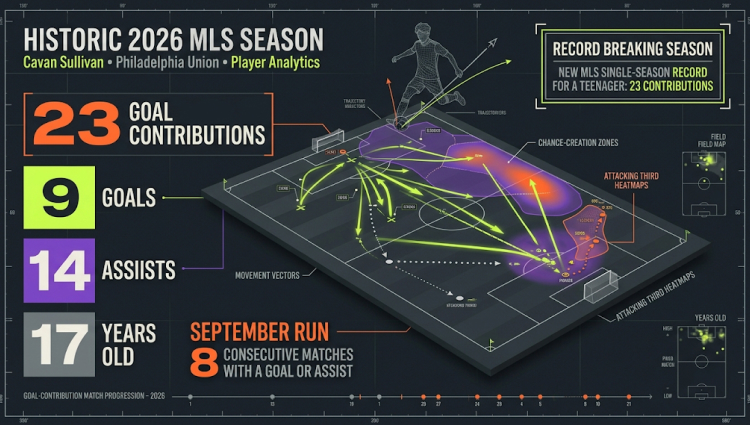
At 17, Cavan Sullivan has already achieved something no teenager in Major League Soccer history has managed. The Philadelphia Union midfielder finished the 2026 regular season with nine goals and 14 assists, producing 23 goal contributions and establishing a new MLS record for a player under 20. His achievement arrived alongside another major milestone: becoming the youngest goalscorer in United States men’s national team history.
Sullivan’s remarkable season reached its latest high point on November 7, when he scored twice in Philadelphia’s 4–1 victory over Toronto FC at Subaru Park. Two days later, Major League Soccer named him Player of the Matchday for the final round of the regular season. The award recognized a performance that reinforced his growing importance to the Union and placed him among the most influential young players in American soccer.
The question now extends beyond whether Sullivan is a promising prospect. He has already demonstrated that he can influence professional matches, create scoring opportunities, and deliver goals against established opponents. With Mauricio Pochettino including him in the United States squad for the November Concacaf Nations League quarterfinals against Haiti, the next challenge is determining how quickly he can become a regular contributor at senior international level.
Cavan Sullivan’s 2026 MLS Season Rewrote the Record Book
Sullivan’s final numbers provide the clearest evidence of his development. His nine goals and 14 assists gave him 23 goal contributions, the highest single-season total ever recorded by a teenager in MLS history.

That achievement surpassed the previous benchmark associated with Diego Fagúndez, who recorded 20 goal contributions for the New England Revolution in 2013. Sullivan had already moved past that mark in October, but his performance against Toronto extended the record and gave him an even stronger finish to the campaign.
His production also placed him among Philadelphia’s most effective attacking players. The 14 assists ranked fourth in the club’s single-season history, while his 23 combined goals and assists tied for fifth. Those numbers are significant for a player who only turned 17 on September 28.
The September portion of his campaign was particularly impressive. Sullivan earned MLS Player of the Month honors after recording nine goal contributions in four appearances. He scored four goals and provided five assists during that period, leading all MLS players in combined attacking contributions for the month.
He also became the youngest player in league history to receive the monthly award, earning the recognition at 17 years and two days old.
The consistency behind those numbers matters as much as the record itself. Sullivan produced a goal or assist in eight consecutive matches during his September run, establishing the longest such streak by a teenager in MLS history.
His season therefore represents more than a brief scoring surge. It shows that he can maintain an attacking influence across multiple matches, against different defensive approaches and under increasing expectations.
The Toronto FC Performance Demonstrated His Growing Influence
Philadelphia’s 4–1 victory over Toronto FC on November 7 provided a fitting ending to Sullivan’s regular-season campaign.
The midfielder scored in the 28th and 58th minutes, finishing two attacking sequences that demonstrated different aspects of his game. His opening goal came after Indiana Vassilev found him in front of goal. Sullivan controlled the opportunity and guided a left-footed finish past goalkeeper William Yarbrough.
His second goal involved a connection with his older brother Quinn Sullivan. Quinn carried the ball into the attacking area and delivered the pass that allowed Cavan to finish first time into the far corner.
The brothers also contributed to Philadelphia’s broader attacking performance. Quinn converted a first-half penalty, while Bruno Damiani scored the Union’s fourth goal from another spot kick.
Philadelphia finished with 19 shots compared with Toronto’s six, despite having less possession. The result secured sixth place in the Eastern Conference and a place in the Audi 2026 MLS Cup Playoffs.
The match also produced a notable MLS milestone. Cavan and Quinn became the third pair of brothers to score as teammates in a single MLS match. For Cavan, however, the more important achievement was completing the regular season with 23 goal contributions.
The performance earned him the Matchday 35 Player of the Matchday award, his second such recognition in 2026. He joined New York Red Bulls teenager Julian Hall as one of the two young players to receive the honor twice during the season.
His influence was also reflected in Philadelphia’s results. In the 21 regular-season matches Sullivan started, the Union collected 41 points with a record of 12 wins, four losses and five draws. According to MLS, 82% of Philadelphia’s points during the campaign came from matches in which he started.
That statistic does not establish that Sullivan alone drove the team’s results, but it illustrates how important his presence became during the season’s strongest periods.
From MLS Academy Prospect to the Youngest USMNT Goalscorer
Sullivan’s international progress has followed a similarly historic path.
Born in Philadelphia on September 28, 2009, he joined the Union Academy at age 10 and progressed through the club’s development structure. Philadelphia signed him to a first-team Homegrown contract on May 9, 2024, when he was 14. The agreement ran through 2028 and represented a record-setting Homegrown deal for MLS at the time.
His early development included success with the United States youth national teams. Sullivan was a key contributor to the American team that won the 2023 Concacaf Boys’ Under-15 Championship. He scored four goals and received the tournament’s Golden Ball as its best player.
The transition to senior international soccer brought a different level of attention.
Sullivan made his senior USMNT debut against Peru on September 26, 2026. He then became the second-youngest player to start a match for the national team, demonstrating how quickly Pochettino was prepared to introduce younger talent into the senior setup.
His next appearance produced an even bigger milestone.
On October 4, during a 3–0 friendly victory over Mexico at State Farm Stadium in Glendale, Arizona, Sullivan scored in the 63rd minute. He capitalized on a poor distribution from Mexican goalkeeper Raúl Rangel and lifted the ball over him from distance.
At 17 years and five days old, Sullivan became the youngest goalscorer in USMNT history.
The goal was significant because it came against one of the United States’ most important regional rivals. It also followed his introduction to the senior team by only a short period, suggesting that his transition from youth international soccer could be faster than expected.
The record does not guarantee a long-term starting position, but it gives Pochettino another young attacking option with experience in a high-profile international match.
Why Mauricio Pochettino Should Give Sullivan a Bigger Role
Pochettino’s November roster selection provides the next indication of how the coaching staff views Sullivan.
The teenager was included in the squad for the Concacaf Nations League quarterfinal series against Haiti, announced on November 4. The selection places him alongside established American internationals such as Christian Pulisic, Weston McKennie, Tyler Adams and Folarin Balogun.
For Sullivan, sharing a national-team environment with those players offers a valuable opportunity to learn how experienced internationals manage the demands of competitive soccer.
It also creates a tactical question for Pochettino. Sullivan’s attacking qualities could allow the United States to introduce a creative midfielder who is comfortable receiving the ball in advanced areas, combining with forwards and looking for opportunities to break defensive lines.
His club performances suggest that he can contribute in several ways. Fourteen assists demonstrate his ability to create opportunities for teammates, while nine goals show that he can also finish attacking moves himself.
That combination gives the coaching staff flexibility. He can operate in an advanced midfield role, move into wider attacking areas, or contribute as a secondary creator behind a central forward.
However, the United States already has several players competing for similar positions. Pulisic offers established experience and attacking production, while Malik Tillman and Gio Reyna provide additional creative options when available. Weston McKennie can also contribute in advanced midfield positions.
Sullivan therefore does not need to displace an established international immediately. A more realistic next step is earning meaningful minutes, demonstrating that he can follow tactical instructions consistently and proving that his attacking instincts translate against international opponents.
The upcoming Nations League matches offer an opportunity to make that case.
The first leg against Haiti is scheduled for November 14 at Nu Stadium in Miami, followed by the return match at TQL Stadium in Cincinnati on November 17. These competitive fixtures carry greater importance than the October friendlies and will provide a more demanding test of the young midfielder’s readiness.
The Biggest Challenge Is Turning Potential Into Consistency
Sullivan’s attacking numbers are exceptional, but they do not tell the entire story of his development.
A creative player must contribute when the opposition limits space, presses aggressively or forces possession into less comfortable areas. International opponents may also target a young midfielder physically, making his ability to protect the ball and make decisions under pressure particularly important.
The next stage of his career will require continued improvement in several areas.
First, he must become more consistent when Philadelphia or the national team does not control the attacking rhythm. His creativity is most visible when he can receive the ball facing forward, but strong opponents will attempt to prevent those situations from developing.
Second, his defensive contribution will matter. Modern attacking midfielders are expected to participate in pressing structures, track opposition runners and help maintain team shape when possession is lost. A larger international role will require Sullivan to contribute beyond the final pass or shot.
Third, he needs experience in high-pressure matches. Philadelphia’s qualification for the playoffs gives him an opportunity to test his ability in a different competitive environment. The Union finished sixth in the Eastern Conference with 50 points and will face the third-seeded New England Revolution in the first round.
The best-of-three series begins with a match at Gillette Stadium on November 21. Philadelphia will host the second game at Subaru Park, with a potential third match returning to New England if required.
Those matches could be particularly valuable for Sullivan. Playoff soccer often produces tighter defensive structures, fewer clear opportunities and greater consequences for individual mistakes. His ability to influence those games will help demonstrate whether his regular-season production can translate into decisive postseason performances.
Philadelphia Union’s Development Pathway Is Producing Another Major Talent
Sullivan’s breakthrough also reflects the importance of Philadelphia’s academy and player-development structure.
The Union have invested heavily in identifying and developing young players, giving academy prospects opportunities to progress into professional soccer. Sullivan followed that pathway from the club’s youth system into Union II and eventually the first team.
His progression is especially notable because he became the first player to advance through MLS NEXT, MLS NEXT Pro and the MLS first team before earning MLS Player of the Month recognition.
That achievement illustrates how professional development systems can create opportunities for talented players without requiring them to leave their domestic environment at an early age.
Sullivan’s success also places additional attention on the relationship between academy development and first-team coaching decisions. His second-half improvement followed an increased role under interim head coach Ryan Richter, who gave the teenager more responsibility during Philadelphia’s strong run.
The results suggest that development is not simply about signing talented young players. It also requires a club to provide meaningful minutes, appropriate responsibilities and an environment where mistakes can become part of the learning process.
Philadelphia’s investment has now produced a player who is attracting attention across MLS and the national team. His progress could encourage other clubs to give their academy graduates similar opportunities when their performances justify the promotion.
For a wider look at the people and clubs shaping American soccer, explore WikiApp’s soccer coverage.
Is Cavan Sullivan Ready to Become a Regular USMNT Contributor?
The evidence supports a clear answer: Sullivan is ready for a larger role in the national-team environment, but a permanent starting position should remain something he earns through performance.
His 2026 MLS season has already established him as one of the most productive teenagers in league history. His 23 goal contributions, September Player of the Month award and two-goal performance against Toronto provide a strong foundation for his growing reputation.
His international achievements strengthen the case. Becoming the youngest goalscorer in USMNT history against Mexico at 17 years and five days demonstrated that he can make an impact beyond club soccer. His continued selection by Pochettino confirms that the coaching staff wants to evaluate him against increasingly demanding competition.
Still, the next stage should be managed carefully. The United States has experienced players capable of carrying major responsibilities, and Sullivan does not need to become the center of the national team’s attack immediately.
A gradual increase in minutes could give him the experience needed to handle the physical, tactical and psychological demands of senior international soccer. The Nations League matches against Haiti and Philadelphia’s upcoming playoff series will provide two important opportunities to continue that progression.
Sullivan has already moved beyond the label of a promising academy prospect. He is now a record-setting MLS contributor and a young international with a historic goal to his name. If he maintains his development and adapts to stronger competition, a significant role in the next USMNT cycle is a realistic possibility.