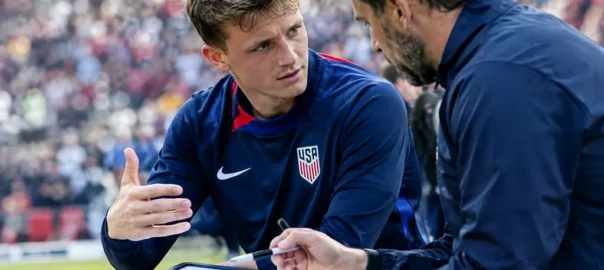
The Jack McGlynn USMNT call-up on November 7, 2026, added a specific midfield profile to Mauricio Pochettino’s squad before the Concacaf Nations League quarterfinals against Haiti. U.S. Soccer confirmed that McGlynn was added to the 25-man roster as a replacement for the injured Gio Reyna, with the two-leg tie scheduled for November 14 at Nu Stadium in Miami and November 17 at TQL Stadium in Cincinnati U.S. Soccer confirmed.
McGlynn’s selection is not only a roster change. It affects how the United States can build midfield possession, cover central zones, and create chances from deeper positions. Pochettino already had options with Tyler Adams, Weston McKennie, Sebastian Berhalter, Malik Tillman, Mathis Albert, Adri Mehmeti, and Santiago Castañeda listed in the midfield group. McGlynn’s arrival adds another player who can operate between the holding line and the attacking band.
The timing is significant. As of November 7, 2026, McGlynn had 13 senior appearances for the United States, with two goals and two assists. At club level, his start at Stoke City after signing in the summer of 2026 had been productive: five goals and two assists in 11 appearances, including goals in three consecutive matches. Those figures do not guarantee a starting role, but they explain why Pochettino turned to him when a creative midfield place opened.
Jack McGlynn USMNT Call-Up Context
Why Jack McGlynn USMNT Matters Now
The Jack McGlynn USMNT discussion begins with role clarity. Reyna’s absence removes one of the squad’s most natural between-the-lines creators. McGlynn does not need to be a direct copy to matter. His value lies in offering a different route to progression: early forward passing, shooting threat from midfield, and set-piece delivery.
Reports on his Stoke City form described him as a central midfielder capable of contributing in both attacking and defensive phases, with distance shooting and set-piece quality among the traits that have stood out BBC Sport noted. In a knockout tie shaped by aggregate scoring, those qualities can change the rhythm of a match without requiring the team to abandon structure.
For football enthusiasts keen to explore international player pathways and tactical roles, World Football Idol provides a platform within the same network. McGlynn’s case aligns with this wider theme, linking recent club exploits with international responsibilities and tournament-centric planning.
Roster Replacement With Tactical Consequences
Replacing an injured attacker or creator with a central midfielder can shift squad balance. Pochettino may prefer to keep attacking width while asking one midfielder to step higher, rather than adding another forward and weakening central control. McGlynn’s inclusion gives the staff a player who can start as an interior midfielder, move into advanced pockets, or enter as a substitute when the United States needs cleaner delivery from dead balls or shots from the edge of the area.
The move also protects against the match state changing across two legs. A first-leg lead, a level aggregate score, or an away-goal situation would each ask different questions of the midfield. A player who can help circulate possession and threaten goal from central spaces has use in more than one scenario.
Midfield Roles Against Haiti
As An Eight Or Advanced Connector
In a 4-3-3, McGlynn can be used as one of the two advanced central midfielders ahead of a holding player. That role would ask him to receive between Haiti’s midfield and defensive lines, help switch play, and arrive late around the box. If the United States dominates possession, he can act as a release valve when the wide players are blocked.
In a 4-2-3-1, the same player can be used beside a more defensive midfielder or slightly higher as part of the attacking midfield line. The choice depends on the level of control Pochettino wants. If Tyler Adams is used as the main ball-winning midfielder, McGlynn’s passing and shooting can provide contrast. If the United States uses a double pivot, McGlynn may be asked to pick his moments carefully rather than vacating central cover too early.
The USMNT’s Haiti preparation also sits within a wider tactical pattern under Pochettino, where pressing, full-back positioning, and midfield spacing have been recurring discussion points. A related USMNT vs Haiti tactical preview covers the matchup framework and rules context for the same quarterfinal tie.
As A Bench Option For Ball Striking
McGlynn’s recent scoring run for Stoke City makes him a plausible substitute when the match needs a different technical action. Some midfielders alter games through running power or defensive range. McGlynn’s route is more likely to involve passing tempo, crossing angles from set plays, or a first-time strike from outside the area.
That matters against opponents who defend in compact lines. Haiti can deny central access by narrowing midfield spaces and forcing the United States toward the touchline. A midfielder willing to shoot or deliver early can stretch that block. Even the threat of a shot can draw a midfielder forward, opening room behind the first line of pressure.
Viewed tactically, Jack McGlynn USMNT selection gives Pochettino a player who can change the type of chance the team creates. The United States does not have to rely only on wide overloads or striker movement. It can also use central entries, second balls, and set-piece routines.
Aggregate Rules And Tactical Risk
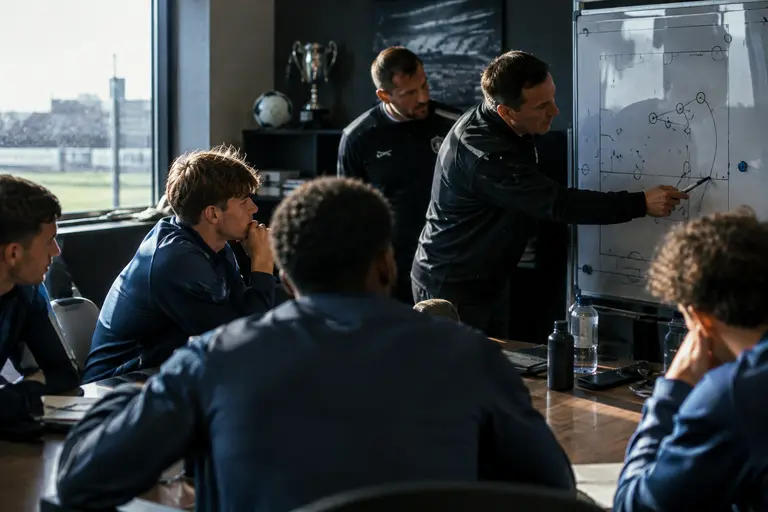
Away Leg Control In Miami
The first leg on November 14, 2026, at Nu Stadium in Miami is Haiti’s home leg in the tie. In a two-leg aggregate series, the first match often carries tactical caution, but it can also reward teams that score away from home. The research supplied for this article states that the away-goals rule applies, with extra time and then penalties used if the aggregate score remains level after both legs.
That format affects midfield choices. A midfield built only for control may lack penetration. A midfield built only for attacking numbers can leave transition space. McGlynn sits between those categories. He is not a pure holding midfielder, yet his central starting position allows Pochettino to add attacking craft without immediately moving to a more open forward-heavy shape.
For the first leg, his use may depend on how Haiti press the United States. If Haiti sit deeper, McGlynn’s left-sided or central passing angles could help move the defensive block. If Haiti press higher, his ability to play quickly under pressure becomes more relevant, though Pochettino may favor a more ball-secure pairing early in the match.
Second Leg Adjustments In Cincinnati
The second leg on November 17, 2026, at TQL Stadium in Cincinnati may require a different plan. If the United States carries a lead, Pochettino could prioritize defensive spacing, pressing triggers, and controlled possession. If the tie is level or the United States trails, McGlynn’s attacking midfield traits become more valuable.
Two-leg ties often create long spells where the scoreboard shapes the tactics more than the opponent’s base formation. A single goal can change whether the United States needs patience or urgency. McGlynn’s presence gives the staff another option for that shift without making a double substitution or changing the back line.
Set pieces are another factor. Knockout matches can turn on one delivery, one second ball, or one clearance that drops near the top of the penalty area. McGlynn’s profile gives the United States another player who can serve, recycle, or shoot from those moments. That does not make him certain to start, but it raises the practical value of his roster place.
Jack McGlynn USMNT And Pochettino’s Selection
The Jack McGlynn USMNT selection is best understood as a tactical adjustment after Reyna’s withdrawal, not as a full redesign of the midfield. Pochettino still has senior central options, ball-winning profiles, and attacking midfielders who can occupy advanced zones. McGlynn adds a specific blend: central passing, box-arrival potential, and recent confidence from club scoring form.
For selection, the key question is balance. If McGlynn starts, the United States likely needs a clear holding structure behind him and coordinated pressing around him. If he is kept on the bench, he becomes a late-game tool for breaking a compact defense or protecting possession with cleaner central passing. Both routes are credible within the supported facts.
For Jack McGlynn USMNT duty in this quarterfinal, the role may be narrower than the headline suggests but still tactically meaningful. The United States added a midfielder in form, ahead of two defined fixtures, in a competition format where one pass, one set piece, or one shot from distance can alter the aggregate picture. That is enough to make his inclusion one of the most relevant squad decisions before the Haiti tie.