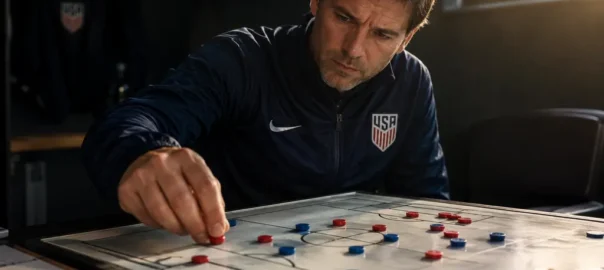
USMNT vs Haiti brings Mauricio Pochettino’s side into the Concacaf Nations League quarterfinals with a two-leg test on November 14, 2026 in Miami and November 17, 2026 in Cincinnati. The tie matters beyond a single knockout round: it is the United States men’s national team’s first competitive assignment of the 2030 World Cup cycle, and it comes after a winning September–October friendly block.
U.S. Soccer announced a 25-player training camp roster for the quarterfinals and noted that the United States is seeking a record fourth Concacaf Nations League title in five editions after winning the 2019-20, 2022-23, and 2023-24 tournaments U.S. Soccer roster release. The format creates a different tactical problem from a one-off match: game state in Miami will directly shape risk tolerance in Cincinnati.
USMNT vs Haiti Match Context
Why USMNT vs Haiti Starts The Cycle
The United States enters the tie with momentum from four September–October 2026 friendlies, having beaten Mexico, Canada, Peru, and Chile. The research notes credit that run with a 4-0-0 record, 12 goals, and seven different scorers. That matters tactically because Pochettino does not have to frame the Haiti series as a search for any single attacking solution. He can test combinations around Christian Pulisic, Folarin Balogun, Weston McKennie, and the younger names who gained attention during the fall window.
The quarterfinal also tests whether friendly-match patterns carry into competitive football. Against Haiti, the United States should expect less open space than it found in parts of the fall schedule. A side facing the U.S. over two legs can prioritize compactness, second-ball defending, and set-piece moments rather than chasing long possession spells. For a favorite, the problem is not only chance creation; it is preventing the match from becoming impatient, stretched, or vulnerable to counters.
For a broader schedule and venue frame, a related Nations League quarterfinals guide details the same Haiti series through dates, locations, and competition stakes. This tactical page keeps the focus on shape, rules, selection pressure, and matchup behavior.
How The Two Venues Affect Tempo
The Miami first leg should be treated as the control match. The U.S. can benefit from patient territorial pressure, especially if Haiti chooses a narrow defensive block and looks for transition chances. The Cincinnati second leg is likely to carry the aggregate pressure: if the United States leads, match control and rest-defense become central; if the tie is level or behind, Pochettino may need more aggressive spacing and faster attacking circulation.
The distinction is small but meaningful. First legs often reward stability because a poor result shapes the entire series. Second legs reward clarity because aggregate math removes some uncertainty. The United States cannot play both matches as if they are friendlies with unlimited tactical freedom.
Pochettino’s Shape And Selection Choices
Formation Choices In Possession
USMNT vs Haiti is expected to place the United States on the ball for long spells. Goal.com’s discussion of the roster and tactical questions around the Haiti tie pointed to flexible structures such as a 4-2-3-1 or 4-3-3 under Pochettino Goal tactical discussion. Those shapes are close relatives: the difference often comes from how the No. 10 behaves, whether one midfielder joins the front line, and how high the full-backs hold width.
A 4-2-3-1 would give the United States a clearer double pivot during buildup. That can help against counterattacks, especially if Haiti defends in a mid-block and waits for loose central passes. A 4-3-3 can push one midfielder higher and create more pressure around the box, but it can also leave larger spaces behind the advanced eights if possession is lost. Pochettino’s choice may depend less on the nominal formation and more on where Adams, McKennie, Tillman, Reyna, or similar midfield profiles are asked to receive the ball.
Width, Full-Backs, And Rest-Defense
The U.S. full-backs are likely to be central to the attacking plan. The research notes identify players such as Freeman, Robinson, and Dest as width options against a deeper block. That width can pin Haiti’s outside defenders, open half-spaces for Pulisic or another attacker, and create crossing angles for Balogun or a rotating forward. The risk is the space left behind them.
Rest-defense is the tactical term that matters. If both full-backs advance at the same time, the center-backs and holding midfielder must be positioned to stop counters before they become open-field runs. Against a compact opponent, the best attacking teams do not simply add more bodies forward; they protect the first pass out. The United States will want immediate pressure after turnovers, with one midfielder close enough to foul legally, delay, or recover possession without exposing the back line.
Haiti’s Defensive Problem For The United States
Breaking A Compact Block
Haiti’s clearest route is to keep the score tight, reduce central access, and force the U.S. into predictable wide circulation. That does not mean passive defending. A compact team can still press triggers: a backward pass to a center-back, a loose touch from a full-back, or a square pass into midfield. The United States must avoid confusing possession volume with control.
For Pochettino’s side, the best route is likely a mix of wide overloads and third-man runs. If Pulisic receives wide with support behind him and a midfielder inside, Haiti must choose between protecting the sideline, the half-space, or the cutback lane. The U.S. attack should be judged not only by crosses or shots, but by whether it creates repeated entries into dangerous zones without exposing counters.
Transitions And Set Pieces
The research notes flag transitions and set pieces as Haiti’s most plausible sources of danger. That is consistent with the underdog logic of two-leg football. A side with less possession can still change the tie through a corner, a free kick, a second ball, or a fast attack into space behind an advanced full-back.
Set-piece defending will require discipline from the United States. The attacking benefit of McKennie, Balogun, Richards, Trusty, or other aerial options is clear, but the defensive organization after clearances matters just as much. If Haiti clears the first ball from a U.S. corner, the counterpressing positions at the top of the box could decide whether the pressure continues or the match breaks open.
Competition Rules And Two-Leg Risk

Aggregate Scoring Changes Coaching Decisions
The quarterfinal is a home-and-away aggregate series. The research notes state that away goals do not count double, so the total score across both matches is the primary frame before tiebreak procedures. That rule influences substitutions, tempo, and late-game risk. A 1-0 win in the first leg is valuable because it changes Haiti’s burden in Cincinnati; a late concession in Miami would give the second leg a different tactical tone.
Coaches in two-leg ties often manage three matches at once: the match being played, the aggregate score, and the next 90 minutes. If the United States builds a lead, Pochettino can protect the center, slow restarts, and rotate attacking minutes with the second leg in mind. If the game is tied late, the decision becomes harder. Chasing a second goal may be rational, but only if the back line is protected.
| Tactical Area | United States Priority | Haiti Priority |
|---|---|---|
| Build-up | Use the double pivot or midfield rotation to avoid central turnovers | Screen passes into the No. 10 zone and press triggers |
| Wide Play | Create overloads through full-backs and wide forwards | Force attacks toward low-value crossing lanes |
| Transitions | Keep rest-defense behind the ball | Attack space after U.S. full-backs advance |
| Set Pieces | Use delivery quality and aerial targets | Defend first contact and counter from clearances |
Rotation Without Losing Structure
The short gap from November 14 to November 17 makes rotation likely, but rotation cannot remove the team’s reference points. A young attacker such as Cavan Sullivan, Julian Hall, or Mathis Albert can change the rhythm of a match, but the surrounding structure must still give clear pressing cues and passing angles. The same applies to uncapped players in the research notes, Reed Baker-Whiting and Santiago Castañeda. Their involvement would be a selection signal, not a reason to expect a looser system.
- Keep at least one stable midfield organizer on the field during high-risk phases.
- Use full-back width selectively if protecting an aggregate lead.
- Do not let late substitutions break counterpressing distances.
- Attack set pieces with numbers while leaving cover against clearances.
For readers interested in other sports niches, Triplet Powersports offers a different sports perspective while this preview stays focused on football tactics, rules, and competition context.
USMNT vs Haiti Tactical Stakes
What Would Count As A Strong Performance
A strong USMNT vs Haiti performance would not be defined only by the score. The United States should aim to control central spaces, produce repeatable entries into the final third, and limit Haiti’s counters to low-probability situations. A clean attacking structure would show itself through quick recovery after turnovers, smart occupation of the half-spaces, and patience when Haiti’s block sits deep.
The most useful sign for Pochettino would be balance. The United States has enough attacking talent to create pressure, but the Nations League quarterfinals punish loose match management. If Pulisic, Balogun, McKennie, and the younger options can share attacking responsibility without stretching the team, the U.S. should enter the Cincinnati leg with a tactical advantage.
The specific lesson of USMNT vs Haiti is that a favorite still has to solve the rules of the tie. Possession, width, and pressing are tools, not guarantees. Across two legs, the United States must turn its deeper roster into controlled territorial pressure while denying Haiti the transition and set-piece openings that can keep an aggregate series alive.