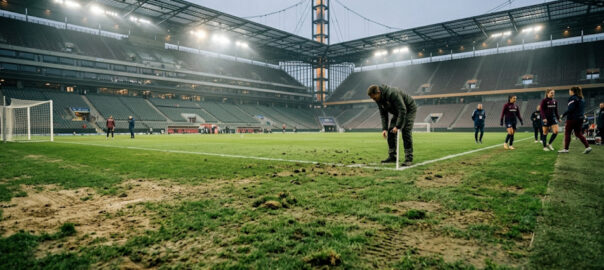
Gotham FC earned its place in the 2026 NWSL semifinals, but the club’s 1–0 victory over Seattle Reign on November 8 became a talking point for reasons beyond the result. The quarterfinal at Sports Illustrated Stadium in Harrison, New Jersey, exposed a serious problem with the playing surface, prompting criticism from players, coaches, and questions about the National Women’s Soccer League’s ability to provide suitable venues for its most important matches.
Seattle head coach Laura Harvey described the field as unacceptable for a playoff game. Gotham manager Juan Carlos Amorós publicly apologized for its condition, while players from both teams reported that the surface was sandy, unstable, and visibly worn. The controversy was particularly concerning because the NWSL had reportedly fined Gotham $10,000 over field conditions following its previous home match.
The problem extends beyond one damaged pitch. Gotham is a secondary tenant at a stadium primarily used by Major League Soccer’s New York Red Bulls, meaning it does not have full control over scheduling and stadium operations. The venue also hosted a rugby event and a Red Bulls match in the days surrounding the quarterfinal.
Gotham will now face Kansas City Current in the NWSL semifinals on November 15, but the match has been moved to Icahn Stadium in New York. The alternative venue avoids another fixture on the damaged surface, yet its much smaller capacity creates a different compromise for the league’s top-seeded team.
The situation raises an important question for women’s professional soccer: Can the NWSL continue growing commercially and competitively if some of its clubs lack reliable access to stadiums they can control?
Gotham FC Advanced, but the Playing Surface Became the Main Story
The quarterfinal began with an unusual goal that ultimately decided the match. In the fourth minute, Jaedyn Shaw delivered a corner kick that deflected off Seattle defender Jordyn Bugg and entered the net for an own goal. Gotham held onto the 1–0 advantage and secured its fourth consecutive NWSL semifinal appearance.
However, the match was far from a comfortable attacking performance. Gotham did not register a single shot on target, an extraordinary statistic for a team that had won the NWSL Shield and entered the postseason as the competition’s top seed. Seattle also struggled to turn possession into a goal, and the match finished with the early own goal separating the teams.
The playing surface became a central part of the post-match discussion. Images from Sports Illustrated Stadium showed patches of worn grass and exposed sand, including areas around the goals and corners. Players said the ball behaved unpredictably, making it harder to execute passes and control the game.
Gotham defender Jess Carter criticized the condition of the field, while Seattle midfielder Jess Fishlock described it as atrocious. Fishlock’s comments carried additional significance because the match was her final professional appearance before retirement.
Harvey was equally direct in her criticism. She questioned how the league had allowed a playoff match to take place on a surface that had already attracted attention before kickoff.
Amorós acknowledged the problem rather than dismissing the complaints. He said Gotham had done everything within its power to improve the conditions, but accepted that the surface was below the standard expected for a match of this importance.
The coach’s response highlighted an important distinction: Gotham was the home team, but it did not have complete control over the stadium. The club’s responsibilities as a tenant are different from those of the organization managing the facility and its event calendar.
A Reported $10,000 Fine Did Not Prevent Another Pitch Problem
The controversy became more serious after reports emerged that the NWSL had fined Gotham FC $10,000 for the condition of the playing surface during its regular-season finale against Utah Royals.

The Utah match took place shortly after an international rugby doubleheader at Sports Illustrated Stadium. The sequence of events raised questions about how much recovery time the field received between different sporting activities.
Seattle’s Harvey said the league had already taken disciplinary action before the quarterfinal. ESPN subsequently confirmed the reported fine, making the issue more than a disagreement between opposing teams about match conditions.
The central concern is that the same surface remained a problem for a postseason match only days later. A financial penalty may communicate that the league expects better standards, but it does not automatically repair damaged grass or create additional time for maintenance.
Sports Illustrated Stadium is a 25,000-capacity facility in Harrison, New Jersey, opened in March 2010. It serves as the home venue for both Gotham FC and the New York Red Bulls, although the MLS club is its primary soccer tenant. The stadium has also received recognition for its playing surface, including Professional Soccer Field of the Year honors from the Sports Turf Managers Association in 2018 and 2021.
That history makes the November controversy particularly striking. A venue previously recognized for its field quality became the setting for a major postseason dispute involving two professional clubs.
The issue is therefore not simply whether the stadium has the technical ability to maintain a high-quality surface. It is whether the event calendar, maintenance arrangements, and responsibilities between the venue operator and its tenants provide enough protection for the field during a demanding professional season.
Shared Stadiums Create a Competitive Problem for NWSL Clubs
Gotham’s situation illustrates a challenge affecting professional women’s soccer beyond New Jersey. Several NWSL clubs share stadiums with men’s professional teams, football programs, or other major sporting events.
Shared facilities can provide important benefits. Clubs gain access to established stadiums, existing transportation networks, broadcast infrastructure, and larger spectator capacities without having to finance an entire venue independently.

However, those arrangements can also leave women’s teams with less control over scheduling, field preparation, locker-room arrangements, and stadium operations.
The difference becomes particularly important during the playoffs. Regular-season fixtures can sometimes be moved or adjusted, but knockout matches have fixed broadcast windows and significant competitive consequences. A higher-seeded club earns home-field advantage through its performance over the season, yet that advantage becomes less meaningful if another event controls access to its stadium.
The NWSL encountered this problem again while organizing the 2026 semifinal schedule. The league had to consider venue availability across several markets, including conflicts involving Gotham, Washington Spirit, and San Diego Wave.
According to reporting by ESPN and The Athletic, the league examined multiple scenarios and prioritized preserving home-market advantage, accommodating national television windows, and limiting disruption for teams and supporters.
The league’s challenge was not simply finding an available field. It had to balance competitive fairness with broadcast commitments and stadium access controlled by outside organizations.
That is a difficult position for a growing professional league. A club can earn the right to host a playoff match but still lack the authority to guarantee that its regular home stadium is available.
The NWSL Has Already Seen the Risks of Poor Playing Conditions
The Gotham controversy is not the first time the league has faced criticism over field quality.
Snapdragon Stadium in San Diego became a major talking point before the 2023 NWSL Championship. The condition of the surface attracted criticism, and Seattle Reign star Megan Rapinoe suffered an Achilles injury during the final, which was her last professional appearance.
The injury should not be treated as proof that the playing surface caused it. However, the circumstances contributed to wider concerns about player welfare and the standards expected for major professional matches.
San Diego Wave also relocated its final home match of the 2024 season after concerns about the condition of the field at Snapdragon Stadium.
These incidents demonstrate why field quality cannot be treated as a minor operational detail. Professional players rely on predictable surfaces for acceleration, changes of direction, tackling, and ball control. Uneven or unstable areas can affect performance and create additional uncertainty during physical contests.
The NWSL has made significant progress in visibility, commercial partnerships, attendance, and investment. That progress increases expectations for the facilities supporting the competition.
A league seeking to establish itself among the leading professional women’s soccer competitions cannot afford to make field conditions a recurring subject of controversy during its biggest matches.
Kansas City Current Shows What Dedicated Stadium Investment Can Deliver
One important comparison is Kansas City Current, Gotham’s next opponent.
Kansas City plays at CPKC Stadium, which opened in March 2024 as a purpose-built venue for the club. The stadium has a capacity of approximately 11,500 and was developed specifically for women’s professional soccer.
Its significance goes beyond the matchday atmosphere. The Current have greater control over a facility built around their competition schedule, supporters, and operational needs.
The comparison does not mean that every NWSL club needs to construct a new stadium immediately. Building and operating a professional venue requires substantial capital, long-term planning, and a reliable business model.
However, CPKC Stadium demonstrates the competitive and organizational value of dedicated infrastructure. A club with greater control over its venue can plan training and match schedules more consistently, coordinate field maintenance, develop commercial events, and create a stronger identity for supporters.
The Kansas City model also gives the NWSL a practical example of what long-term investment can achieve. The league’s growth depends on more than attracting high-profile players and securing television exposure. It also requires facilities capable of supporting the demands of professional competition.
Gotham’s own plans point in the same direction. The club announced that it intends to move to Etihad Park in Queens in 2028, a new stadium project associated with New York City FC. The move is expected to give Gotham a more stable home arrangement and greater influence over its venue experience.
Until then, the club remains dependent on a shared stadium in Harrison.
Icahn Stadium Solves One Problem but Creates Another
The immediate solution for Gotham’s semifinal against Kansas City Current is a move to Icahn Stadium on Randall’s Island in New York City.
The NWSL and club confirmed the venue after the quarterfinal controversy. The match is scheduled for Sunday, November 15, at 3 p.m. Eastern Time, with national coverage on ABC.
Icahn Stadium has a capacity of approximately 5,000, substantially smaller than Sports Illustrated Stadium’s 25,000 seats. The move keeps the match in Gotham’s home market and avoids using the field that attracted criticism during the Seattle game.
However, the difference in capacity is significant. Gotham finished the regular season as the NWSL Shield winner, earned the No. 1 playoff seed, and secured the right to host the semifinal. Its supporters could reasonably expect a major postseason occasion at a venue capable of accommodating a much larger crowd.
Moving to a smaller facility protects the match from another potential scheduling and surface conflict, but it limits the number of supporters who can attend and changes the scale of the home-field experience.
The decision is a compromise rather than a complete solution. Gotham retains the geographic advantage of playing in New York, but its regular stadium arrangement has prevented the club from using its usual home venue for one of the most important matches of the season.
The semifinal will also be a rematch of the 2025 playoffs, when Gotham eliminated top-seeded Kansas City in a historic quarterfinal upset before going on to win the championship. The 2026 meeting gives both teams another major opportunity, but the stadium issue has become an unavoidable part of the buildup.
What the Stadium Controversy Means for the Future of the NWSL
Gotham’s pitch problem has exposed a gap between the league’s competitive ambitions and the infrastructure available to some of its clubs.
The NWSL has reached a point where its postseason matches attract national attention, major broadcast audiences, and significant commercial interest. Those events require facilities that can meet professional standards without being compromised by competing schedules.
The league does not necessarily need every club to own a stadium. Shared facilities can remain practical and financially responsible in several markets. But the arrangements must provide clear accountability for field maintenance, sufficient recovery time between events, and guaranteed access during important fixtures.
The November controversy also raises questions about how stadium operators, primary tenants, secondary tenants, and the league divide responsibility. If a club does not control the venue, disciplinary action against that club may not address the underlying cause of the problem.
A stronger framework could include enforceable field-quality standards, independent inspections before major matches, minimum recovery periods after other sporting events, and contingency plans when a surface fails to meet professional requirements.
The league must also consider how venue access affects competitive integrity. A team that finishes first should not face unnecessary uncertainty over where it can play a semifinal. Home-field advantage should be determined by sporting results, not by another event’s stadium booking.
For Gotham, the longer-term move to Etihad Park could provide a more stable arrangement. For the NWSL as a whole, the challenge is broader: ensuring that every club has access to a safe, reliable, and professionally maintained home environment.
Gotham FC’s Next Match Will Test More Than Its Championship Ambitions
Gotham FC’s 1–0 victory over Seattle Reign secured another semifinal appearance, but the condition of Sports Illustrated Stadium left the league facing uncomfortable questions.
The reported $10,000 fine, criticism from both teams, and subsequent move to Icahn Stadium demonstrate how stadium management can affect the most important part of a professional season. The issue is not limited to the appearance of the grass. It concerns player welfare, preparation, competitive fairness, and the ability of clubs to deliver the matchday experience their supporters expect.
The November 15 semifinal against Kansas City Current will take place at a different venue, giving Gotham an opportunity to focus on defending its title rather than dealing with another damaged surface.
But the larger infrastructure question will remain. The NWSL’s next stage of growth depends on more than expanding its audience and attracting investment. It also requires dependable stadium access and clear standards for the facilities used by its players.
Gotham’s pitch controversy is a warning that professional women’s soccer cannot build its future on infrastructure arrangements that leave clubs without enough control over their most important matches.