
The Utah Royals have produced one of the biggest surprises of the 2026 National Women’s Soccer League playoffs. On November 6, the seventh-seeded club defeated the second-seeded San Diego Wave 1–0 at Snapdragon Stadium, securing its first postseason victory and advancing to the NWSL Championship semifinals for the first time in franchise history.
Kiana Palacios scored the decisive goal in the 30th minute, while goalkeeper Mandy McGlynn and a disciplined defensive unit kept San Diego off the scoreboard. The result was especially significant because the Wave entered the postseason with a seven-match unbeaten streak and home-field advantage.
Utah arrived in Southern California after losing its final regular-season match against Gotham FC and going three consecutive matches without scoring. San Diego, meanwhile, had finished second in the standings with 58 points and appeared better positioned to reach the next round.
The numbers during the quarterfinal initially supported that expectation. San Diego controlled 63% of possession, attempted 16 shots, and earned 10 corners. Utah managed just eight shots and three corners.
But the Royals defended their advantage, survived sustained pressure, and converted one of their best attacking opportunities. Their victory was more than a playoff upset. It marked the arrival of a Utah team that had spent three seasons rebuilding its place in the NWSL.
Utah Royals Delivered a Historic Result at Snapdragon Stadium
The November 6 quarterfinal was the first playoff match in Utah Royals history. The club entered as the No. 7 seed after finishing the regular season with 47 points, 14 victories, five draws, and 11 defeats.
San Diego had a considerably stronger regular-season position. The Wave finished second with 58 points and an 18-8-4 record, earning the right to host the match at Snapdragon Stadium.
The difference in seeding made Utah the underdog, but the Royals did not approach the match as a team simply hoping to survive.
Head coach Jimmy Coenraets kept the same starting lineup that had finished the regular season against Gotham FC. The decision provided continuity after a demanding final stretch and allowed the players to rely on an established defensive structure.
San Diego began aggressively. Melanie Barcenas threatened with a header in the fifth minute, but McGlynn reacted quickly to keep the attempt out. The Utah goalkeeper then denied another dangerous effort from Lia Godfrey.
Those early interventions mattered because San Diego was trying to establish control before Utah could settle into its defensive shape.
The Royals gradually found opportunities to attack in transition. Paige Cronin and Cloé Lacasse both threatened during the opening stages, while Nuria Rábano’s ability to anticipate passes helped Utah recover possession in advanced areas.
The decisive moment arrived in the 30th minute. Jameese Joseph moved the ball toward the left side, where Lacasse delivered a cross into the penalty area. Palacios controlled the pass, turned, and finished with her left foot to give Utah a 1–0 lead.
The goal ended a 300-minute scoring drought for the Royals and became the first postseason goal in the club’s history.
Utah had finally converted its attacking movement into a result. The challenge was now to protect the advantage against a San Diego team that had scored consistently throughout the season.
Kiana Palacios Became the Face of Utah’s First Playoff Victory
Palacios’ goal was the defining moment of the quarterfinal, but the sequence also demonstrated why Utah’s attacking structure could cause problems for stronger opponents.
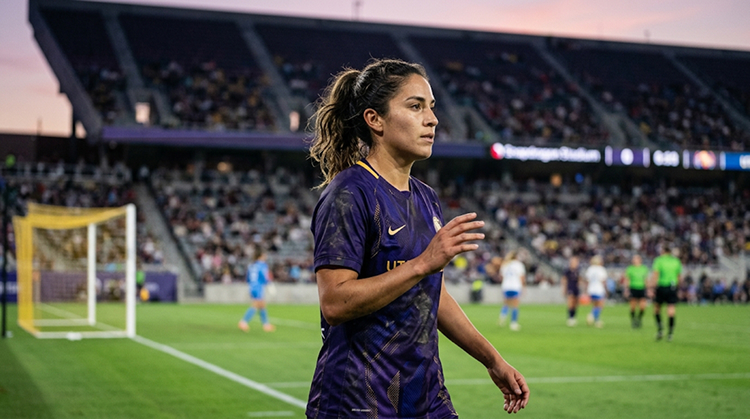
The move involved three players performing different roles. Joseph helped advance the ball through the middle, Lacasse supplied the width and delivery, and Palacios found space inside the penalty area.
Rather than attempting a first-time finish, the Mexican international took a touch before turning and shooting with her left foot. The extra movement helped her create a better angle and send the ball past San Diego goalkeeper Sandra Paños.
The goal was particularly important given Utah’s recent offensive difficulties. The Royals had struggled to score during the final stages of the regular season, including defeats against several playoff-qualified opponents.
Palacios gave the team a moment of individual quality when it needed one most.
Lacasse also played an important role. Her movement on the left flank provided a direct route toward the penalty area, while her cross forced San Diego’s defenders to react quickly rather than maintain their preferred positions.
Joseph’s involvement demonstrated the value of Utah’s midfield progression. The Royals did not need long periods of possession to create a dangerous opportunity. They needed accurate forward movement and coordinated runs.
That approach became especially valuable after taking the lead. Utah could focus on protecting its defensive shape while remaining capable of threatening San Diego through counterattacks.
For Palacios, the goal will remain one of the most important moments in the club’s early history. She became the player responsible for delivering Utah’s first playoff victory and helping the organization reach its first NWSL semifinal.
Mandy McGlynn and the Defense Stopped San Diego’s Attack
The most important reason Utah advanced was its defensive performance.
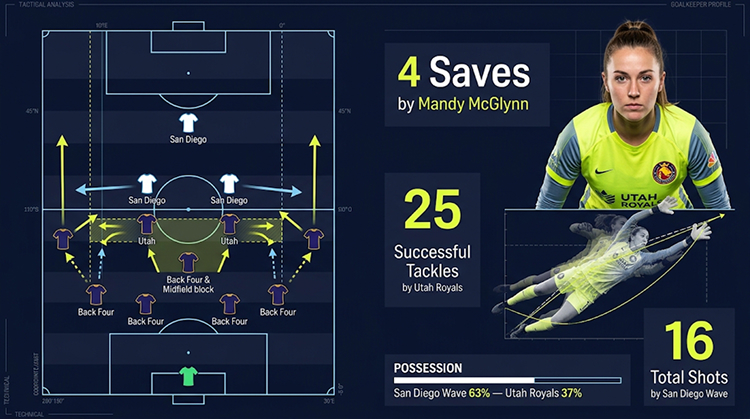
San Diego finished the match with 63% possession, 16 shots, five attempts on target, and 10 corner kicks. Utah had only 37% possession, eight shots, two on target, and three corners.
Those numbers show how much pressure the Royals faced. They also explain why McGlynn became one of the central figures in the result.
The goalkeeper made four saves, according to the official match statistics, including several important interventions during periods when San Diego appeared close to equalizing.
Her early save against Barcenas prevented the Wave from taking control of the match. Later, she denied a dangerous attempt from Gia Corley in the closing stages, helping preserve Utah’s advantage.
The defensive work in front of her was equally significant.
Kate Del Fava and Kaleigh Riehl helped protect the central areas, while Miyabi Moriya and Nuria Rábano contributed from the wider defensive positions. Their work forced San Diego to attempt difficult finishes rather than creating repeated clear opportunities directly in front of goal.
The Royals also benefited from their ability to defend second balls and recover possession after clearances. According to the Salt Lake Tribune’s match report, Utah recorded 25 successful tackles compared with San Diego’s eight.
That difference illustrates the physical commitment required to protect a narrow lead against a possession-oriented opponent.
Utah also had to manage seven minutes of stoppage time. The forwards continued applying pressure when possible, the midfield maintained its shape, and the defenders repeatedly cleared dangerous deliveries.
The final whistle arrived with McGlynn holding the ball. Her performance reflected the collective effort behind the upset rather than an isolated goalkeeping display.
Jimmy Coenraets Has Changed the Direction of Utah Royals
Utah’s playoff success is connected to a much larger transformation under head coach Jimmy Coenraets.
The Royals entered 2026 looking to improve on two difficult seasons following the club’s return to the NWSL. The organization had not qualified for the playoffs in either 2024 or 2025, and its early seasons were marked by inconsistent results.
Coenraets helped change that trajectory by building a team capable of competing across a full regular-season schedule.
The Royals secured their first postseason qualification on October 23, 2026, after a draw against Seattle Reign. The result confirmed a historic campaign in which the team established new club records in several categories.
Utah finished with 47 points and 14 victories, doubling its overall win total from each of the previous two seasons. It also scored 44 regular-season goals, established a club record for road wins with six, and recorded eight home victories.
The road performance was particularly relevant before the San Diego quarterfinal. Utah had collected 21 points away from home during the regular season, showing that it could compete effectively outside its own stadium.
Coenraets also demonstrated confidence in the group by keeping the same starting XI for the playoff debut. Rather than making major tactical changes because of the opponent’s higher seed, he relied on the structure that had carried the team into the postseason.
That consistency helped the Royals manage the pressure of their first playoff appearance.
The victory over San Diego also represented the first time Utah had defeated the Wave in the clubs’ three-year history. The Royals had previously struggled against the California team, making the result an important psychological milestone as well as a competitive achievement.
Utah’s Three-Season Rebuild Has Reached Its First Major Playoff Milestone
The current Utah Royals organization returned to the NWSL in 2024 after the original franchise’s earlier history and subsequent restructuring.
The original Utah Royals played in the league from 2018 through 2020. Following the 2020 season, the franchise’s player-related operations and assets were transferred as the league underwent major organizational changes, with Kansas City becoming the destination for the relocated team.
Utah’s return in 2024 restored professional women’s soccer under the Royals identity in the state.
However, rebuilding a club is different from immediately creating a playoff contender. The team finished outside the postseason in both 2024 and 2025, and its early results showed how much work remained.
The 2026 campaign represented a substantial improvement.
The Royals became more productive in attack, collected more points away from home, and established a stronger defensive foundation. Their 44 goals demonstrated that the team could create opportunities against different types of opponents.
The improvement was particularly striking when compared with the previous two seasons combined. Utah scored only 50 goals across the 2024 and 2025 regular seasons, meaning its 2026 total came close to matching that two-year figure.
The club’s seventh-place finish was therefore not an isolated achievement. It was the result of a sustained improvement in performance.
Reaching the semifinals adds another milestone to that development. Utah has moved from trying to establish itself as a competitive NWSL organization to eliminating one of the league’s strongest regular-season teams.
The challenge now is to show that the San Diego result can become the beginning of a longer postseason run.
San Diego’s Elimination Reveals the Risks of Possession Without Finishing
San Diego’s defeat is an important reminder that statistical control does not guarantee success in knockout football.
The Wave had more possession, more shots, more shots on target, and more corner kicks. They also created dangerous opportunities during the opening minutes and pushed aggressively after falling behind.
Yet the team failed to convert its attacking volume into a goal.
The absence of a decisive finish became increasingly costly as Utah grew more comfortable defending its lead. San Diego’s attacking players were forced to take risks, while the Royals could focus on protecting central spaces and limiting clear chances.
The Wave’s final regular-season form had suggested that they were well prepared for the postseason. They entered the quarterfinal with a seven-match unbeaten streak, including six victories.
That momentum disappeared against a Utah side that had lost its final regular-season match and struggled to score before the playoffs.
San Diego’s elimination also raises questions about how its attacking structure performs when an opponent refuses to give up space. Possession can help establish territorial control, but it becomes less effective if the final pass, movement inside the penalty area, and finishing do not match the team’s build-up play.
For Utah, the match provided evidence that disciplined defending and efficient attacking transitions can overcome a significant statistical disadvantage.
Utah Royals Face Another Major Test in the NWSL Semifinals
The victory over San Diego guarantees Utah a place in the 2026 NWSL Championship semifinals, where the Royals will face the winner of the quarterfinal between the Washington Spirit and Portland Thorns.
That match is scheduled for November 8, with Washington entering as the No. 3 seed and Portland as the No. 6 seed.
The semifinal round is scheduled for November 14–15. Utah will travel to face its opponent, as the higher-seeded team earns home-field advantage under the playoff format.
The potential matchups present different challenges.
Washington has established itself as one of the league’s strongest teams, combining experienced international players with an organized attacking structure. Portland brings its own postseason experience and a history of competing in high-pressure NWSL matches.
Utah will need to reproduce the defensive discipline that carried it past San Diego. McGlynn’s goalkeeping, the central defensive partnership, and the midfield’s ability to protect space will remain important.
The Royals will also need more consistent attacking production. Their goal against San Diego ended a 300-minute scoring drought, but a semifinal opponent is likely to offer even fewer opportunities if Utah spends extended periods defending.
The return of players such as Narumi and Cece Delzer to the matchday squad also gives Coenraets additional options. Their availability could become valuable as the team manages the physical demands of a short postseason schedule.
The NWSL Championship is scheduled for November 21 at Audi Field in Washington, D.C. Utah is now two victories away from reaching the league’s biggest match.
Utah Royals Have Turned Their First Playoff Appearance Into a Historic Run
Utah’s victory over San Diego was significant because it changed the expectations surrounding the club.
The Royals entered the 2026 playoffs as a seventh seed making their first postseason appearance. They faced a second-seeded opponent with a strong regular-season record, home advantage, and a seven-match unbeaten run.
The result was a 1–0 victory built on an early attacking breakthrough and an exceptional defensive performance.
Palacios delivered the decisive finish, Lacasse and Joseph helped create the opportunity, and McGlynn protected the advantage with four saves. Coenraets’ decision to maintain his starting lineup also demonstrated the confidence that had developed within the team.
Utah’s first NWSL semifinal appearance is the latest achievement in a three-season rebuilding process. The club has already established new regular-season records, doubled its previous win totals, and demonstrated that it can compete against the league’s strongest opponents.
The next match will determine whether the Royals can extend that run. Regardless of the semifinal result, however, eliminating San Diego has already secured a place for the 2026 team in Utah’s soccer history.