
The United States men’s national soccer team could face an unexpected coaching crisis just as its next World Cup cycle begins. Mauricio Pochettino, who signed a contract extension with U.S. Soccer through 2030 in August, has emerged as a leading candidate to take charge of Manchester United if the English club dismisses Michael Carrick. Reports published on November 10 and 11 indicate that the interest is mutual, with Manchester United reportedly working on a potential agreement with the Argentine manager.
The timing could hardly be more significant for American soccer. Pochettino was appointed in September 2024 to prepare the United States for the 2026 FIFA World Cup. His responsibilities expanded after the tournament, when U.S. Soccer announced a new agreement giving him and his coaching staff a broader role in the development of the national-team system. The commitment was intended to provide continuity through the 2030 World Cup.
Now, that long-term project faces uncertainty. Manchester United is struggling in the Premier League, and its leadership is reportedly considering a managerial change. Pochettino has previous experience with Southampton, Tottenham Hotspur and Chelsea, making him an attractive candidate for a return to English football.
As of November 11, 2026, neither Manchester United nor U.S. Soccer has announced a completed agreement or Pochettino’s departure. Nevertheless, the possibility raises an important question: could the United States lose the coach it expected to lead its next four-year international project?
Why Manchester United Wants Mauricio Pochettino
Manchester United’s interest comes during one of the most difficult starts to a season in its modern history.

According to Associated Press reporting on November 11, United sat 18th in the Premier League after 10 rounds, placing the club in the relegation zone. The team had recorded only one league victory, while a 4–4 draw against Aston Villa on November 8 added pressure on manager Michael Carrick.
Carrick had already faced scrutiny after Manchester United’s elimination from the Carabao Cup against Brighton in September. Although the club had previously decided to give him additional time, the latest results intensified questions about his position.
United’s leadership structure is also central to the situation. Director of football Jason Wilcox and chief executive Omar Berrada were reportedly preparing to recommend Carrick’s dismissal to minority owner Sir Jim Ratcliffe. A board meeting was expected on November 11 to consider the situation.
Pochettino has become a prominent candidate because he offers experience in the Premier League and has previously managed clubs with significant expectations.
His strongest period in England came at Tottenham Hotspur, where he transformed the team into a consistent contender for major honors. Tottenham reached the 2019 UEFA Champions League final under his leadership, losing 2–0 to Liverpool in Madrid.
He also managed Southampton before taking charge of Tottenham, and later returned to England with Chelsea during the 2023–24 season. His experience at clubs operating under intense media attention could appeal to United’s leadership as it searches for a manager capable of stabilizing the team.
However, Pochettino has never won a major trophy in English football. His record includes a French league title with Paris Saint-Germain in 2022, but Manchester United would be hiring him primarily for his coaching approach, experience and ability to rebuild a competitive structure.
The challenge would be substantial. United is not simply looking for a short-term improvement in results. The club needs a manager capable of restoring confidence, organizing its squad and creating a sustainable sporting project.
The $10 Million Release Clause Could Open the Door
One of the most important details in the Manchester United reports is Pochettino’s reported release clause.
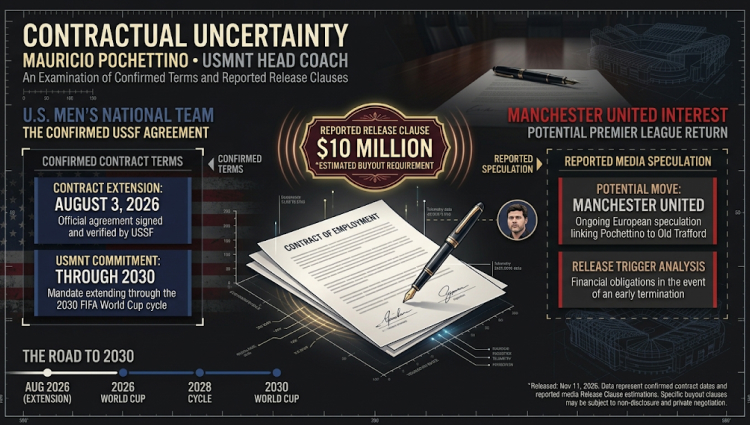
According to reporting by The Guardian and other outlets, his U.S. Soccer contract includes a clause estimated at approximately $10 million, or £7.5 million. That figure could increase if Manchester United also seeks to recruit members of his coaching staff.
The reported clause gives U.S. Soccer financial protection if a major club attempts to hire its national-team manager before the end of his agreement. However, it does not prevent Pochettino from leaving if the contractual conditions are met.
The financial question extends beyond the head coach. Pochettino has worked with several members of his coaching team for more than 15 years. Assistant Jesús Pérez is among his closest professional collaborators, having followed him through multiple club appointments.
Other trusted members of his staff include Miguel D’Agostino and Toni Jiménez. Their experience and established working relationships have been central to Pochettino’s coaching structure.
If Manchester United wants the complete group, compensation negotiations could become more complicated. U.S. Soccer would have to consider the impact of losing several technical staff members simultaneously, rather than simply replacing one manager.
For Manchester United, the reported $10 million clause is a manageable amount compared with the financial scale of the Premier League. For U.S. Soccer, however, the money would not automatically replace the sporting value of a coach who has already spent two years building relationships with the national-team player pool.
The clause therefore protects the federation financially, but it cannot guarantee continuity.
U.S. Soccer Had Planned a Four-Year Project Through 2030
The potential departure is particularly disruptive because U.S. Soccer had recently made a clear commitment to Pochettino.
On August 3, 2026, the federation announced that it had agreed to a new contract keeping him as USMNT head coach through the 2030 FIFA World Cup. The agreement represented a shift from a tournament-focused appointment to a broader development project.
Pochettino initially arrived in September 2024 with the main objective of preparing the United States for the 2026 World Cup. The new contract expanded his responsibilities to include technical support across the national-team pathway, youth soccer, coaching education and collaboration with professional leagues.
U.S. Soccer president Cindy Parlow Cone emphasized the importance of continuity when the agreement was announced. She highlighted the culture Pochettino and his staff had established, describing their influence as something the federation wanted to extend beyond the senior men’s team.
The federation’s plans also included several major competitions before the 2030 World Cup:
- The 2027 Concacaf Nations League.
- The 2027 Concacaf Gold Cup.
- The 2028 Olympic Games in Los Angeles.
- The 2029 Concacaf Nations League.
- The 2029 Concacaf Gold Cup.
These competitions provide opportunities to evaluate emerging players, strengthen the national-team structure and prepare for the next World Cup qualification campaign.
Pochettino’s expanded responsibilities were intended to connect those stages. His staff would have a greater influence on youth development and technical planning, potentially creating a more consistent approach across different age groups.
Losing him now would therefore affect more than the senior team’s matchday preparation. It could interrupt a broader project that U.S. Soccer had publicly presented as a long-term investment.
The Timing Could Not Be Worse for the USMNT
The timing of the Manchester United reports creates an immediate problem because the United States is entering its first official competition of the 2030 World Cup cycle.
Pochettino named a 25-player squad on November 4 for the Concacaf Nations League quarterfinal series against Haiti. The first leg is scheduled for November 14 at Nu Stadium in Miami, followed by the return match on November 17 at TQL Stadium in Cincinnati.
The matches represent the first official competitive assignment of the new cycle. They also provide an early opportunity to establish tactical expectations after the 2026 World Cup.
The squad includes experienced international players such as Christian Pulisic, Weston McKennie, Tyler Adams, Antonee Robinson and Folarin Balogun. Younger players also feature, reflecting the need to develop the next generation alongside established internationals.
Pochettino’s November selection has already experienced changes. Gio Reyna withdrew because of injury, with Stoke City midfielder Jack McGlynn added on November 7. Defender Mark McKenzie was also added following George Campbell’s withdrawal.
The coach’s presence during this international window is especially important because the matches are competitive rather than exhibition fixtures. The United States is pursuing its fourth Concacaf Nations League title after winning three of the competition’s first four editions.
A managerial departure during this period would create uncertainty around preparation, player communication and tactical planning. Even if an agreement with Manchester United were reached quickly, U.S. Soccer would need to determine who takes responsibility for the national team immediately.
The federation cannot afford to treat the November matches as an administrative transition. The results will help establish the tone for the next international cycle.
What Pochettino’s Departure Would Mean for American Players
The most direct impact of losing Pochettino would be the need for a new coach to reassess the national-team player pool.
Since his appointment in 2024, Pochettino has worked with players from MLS and European clubs, evaluating different profiles and introducing younger options. His approach has placed considerable emphasis on pressing, positional discipline, intensity and the ability to adapt to different match situations.
A successor would inherit the same group of players but might have different tactical priorities.
Christian Pulisic, for example, has become one of the United States’ most important attacking players. Weston McKennie and Tyler Adams provide experience in midfield, while Folarin Balogun offers an option in the center-forward position.
Younger players such as Cavan Sullivan, Mathis Albert and Alex Freeman also represent important parts of the next generation.
A coaching change would not necessarily damage their development. A new manager could introduce different ideas and provide opportunities to players who have not received consistent minutes. However, changing the technical leadership repeatedly can make it harder for young internationals to develop within a stable system.
The issue is particularly relevant because the United States is preparing for a cycle in which its player pool could change considerably. Veterans may leave the international setup, younger players will compete for places, and new prospects will emerge from MLS academies and European development systems.
A coach who already understands the strengths and limitations of that group has an advantage over someone arriving without established relationships.
U.S. Soccer would therefore need to move quickly if Pochettino leaves, identifying a successor who can maintain the existing development plan while establishing a clear tactical direction.
Who Could Replace Pochettino?
If Pochettino accepts the Manchester United opportunity, U.S. Soccer would face a difficult appointment decision.
The federation would need to balance international experience, familiarity with American soccer and the ability to manage a four-year project. Replacing a high-profile coach in the middle of an international cycle is different from hiring a manager after a World Cup.
Several names could attract attention, although no official shortlist has been announced.
Steve Cherundolo is one potential option because of his experience in American soccer. The former USMNT defender has managed Los Angeles FC and has a background working within the U.S. player-development system. His knowledge of MLS and American players could make him an attractive candidate for a federation seeking continuity.
B.J. Callaghan is another name worth considering. He previously worked within the USMNT coaching structure and has experience leading the national team as an interim manager. His familiarity with international preparation and the American player pool could help reduce disruption.
Other international candidates might also become available. However, a high-profile appointment would require more than reputation. The next coach would need to understand the competitive demands of Concacaf, the development of American talent and the pressure surrounding the 2030 World Cup.
U.S. Soccer may also need to decide whether it wants to preserve Pochettino’s broader technical project or return to a structure in which the senior national-team coach has fewer responsibilities outside the first team.
That decision could shape the federation’s approach to the next decade.
Manchester United’s Opportunity Could Become America’s Problem
Pochettino’s potential move illustrates a challenge that international federations face when competing with the financial and sporting power of major European clubs.
National teams offer a different type of coaching role. Managers work with players during international windows, prepare teams for tournaments and often spend more time coordinating than coaching on the training pitch.
Club football offers daily access to players, regular training sessions and the opportunity to build a tactical system over an entire season. For a coach who has spent much of his career in European club management, the attraction is understandable.
Manchester United also represents a unique opportunity. Despite its current problems, the club remains one of the most recognizable names in world football. A successful rebuild at Old Trafford could become one of the defining achievements of Pochettino’s career.
The United States, meanwhile, offers something different: the chance to shape a national program before a future World Cup. The federation’s expanded agreement was built around that opportunity, with Pochettino expected to influence more than one tournament.
The two projects are difficult to compare. Manchester United offers an immediate club challenge, while the USMNT represents a longer-term national-team assignment.
For American soccer, the concern is that the attraction of the Premier League could outweigh the commitment made in August.
The reported release clause makes that possibility more realistic. If Manchester United is willing to meet the financial conditions and Pochettino wants the position, U.S. Soccer may have limited control over the outcome.
The 2030 World Cup Project Needs Stability, Not Another Reset
The United States has invested considerable attention in building a national-team project around the 2030 World Cup. Pochettino’s contract extension was supposed to provide stability after the 2026 tournament and establish a consistent technical direction.
His possible move to Manchester United would force the federation to reconsider that plan at a very early stage.
The situation is not yet a completed transfer. Michael Carrick’s future remains central to Manchester United’s decision, and U.S. Soccer has not announced that Pochettino is leaving. The reported negotiations and release-clause discussions nevertheless show that the possibility deserves serious attention.
The November matches against Haiti could become an important test of how the federation manages the uncertainty. If Pochettino remains in charge, the United States can begin its new competitive cycle with the coach who signed the 2030 agreement. If he departs, the federation will need to protect the project by making a quick and carefully considered appointment.
American soccer has a growing generation of talented players, an expanding professional structure and the benefit of hosting the 2028 Olympics. Those advantages will matter, but they cannot replace clear leadership.
Pochettino’s future is therefore about more than one coaching vacancy. It concerns whether U.S. Soccer can maintain a long-term sporting vision when a major European club comes calling.
The federation secured a contract through 2030. Whether it gets the full four years of Pochettino’s leadership is now an open question.