
Football is often described as a simple game: score more goals than the other team. Yet anyone who watches the sport closely knows the game is shaped by far more than talent alone. Two teams can have similar players, similar fitness, and similar ambition, but still look completely different once the match begins. One side may dominate possession, press high, and move in coordinated patterns. The other may sit deeper, stay compact, and wait for the right moment to break forward. The difference usually comes down to one thing: the tactical system.
A tactical system in football is the organized structure a team uses to attack, defend, and manage space on the field. It is more than just a formation on a lineup graphic. It is the blueprint that explains where players stand, how they move, when they press, how they create chances, and what they do when possession is won or lost.
Understanding tactical systems helps explain why football matches unfold the way they do. It also helps fans move beyond basic observations like “they wanted it more” or “they just played better.” In most matches, there is a deeper story happening beneath the surface. Tactical systems reveal that story.
A Tactical System Is More Than a Formation
One of the most common misunderstandings in football is the idea that a formation and a tactical system are the same thing. They are related, but they are not identical.
A formation is the basic shape of the team, usually shown in numbers such as 4-3-3, 4-2-3-1, or 3-5-2. It gives a general idea of how many defenders, midfielders, and forwards are on the pitch. That information is useful, but it only tells part of the story.
A tactical system goes much further. It explains how the players in that shape behave. A team listed in a 4-3-3 can play in very different ways depending on the coach’s ideas. One 4-3-3 may rely on wide wingers, aggressive pressing, and fast combinations near the box. Another may use the same shape but sit deeper, defend in a compact block, and attack directly through quick counters. The formation is the skeleton. The tactical system is the full body in motion.
This is why watching football only through the lens of formations can be misleading. The numbers on paper matter, but the movement, spacing, and instructions behind them matter even more.
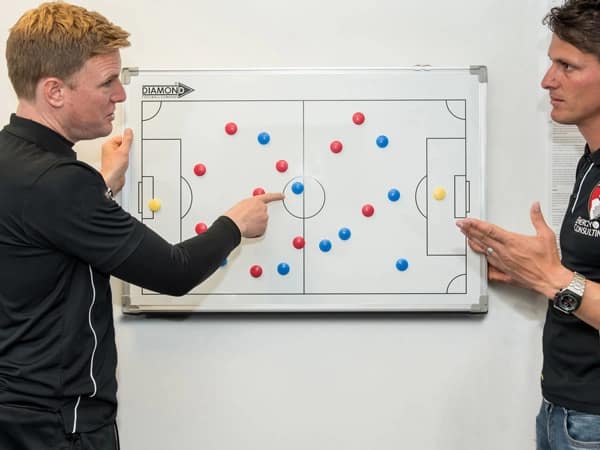
The Core Purpose of a Tactical System
Every tactical system is designed to solve the same football problems.
How does a team create space when it has the ball?
How does it deny space when it loses the ball?
How does it protect dangerous areas?
How does it move the ball into scoring positions?
How does it react to pressure?
How does it prevent the opponent from playing freely?
These questions shape every tactical choice. A team’s system is essentially its answer sheet.
Some coaches want control. Their systems are built to dominate possession, position players between lines, and carefully progress the ball. Some want vertical speed. Their systems focus on winning the ball and attacking before the defense can reset. Others want defensive security above all else, preferring a compact shape that limits risk and forces opponents into low-quality chances.
No tactical system exists in a vacuum. Coaches choose them based on player strengths, club identity, match context, and league environment. The best systems are not the most fashionable ones. They are the ones that fit the players and solve the problems of the match.
The Main Elements of a Tactical System
A tactical system usually includes several connected ideas rather than one isolated concept. To understand it fully, it helps to break it into parts.
Defensive Shape
This is how a team organizes itself when it does not have the ball. Some teams defend high and try to win possession near the opponent’s goal. Others drop into a mid-block or low block and defend space rather than pressing immediately.
Defensive shape answers key questions. How compact is the team? How much space exists between the lines? Are the wide areas protected? Do forwards press center-backs or screen passing lanes? How aggressively do midfielders step out to challenge the ball?
A strong defensive shape is not just about having many players behind the ball. It is about limiting useful space.
Build-Up Structure
This refers to how a team starts attacks from deep areas, especially from goal kicks or controlled possession near its own half. Some teams use center-backs and a deep midfielder to build carefully through pressure. Some ask full-backs to invert into midfield. Others prefer longer passes to bypass the press entirely.
Build-up structure reflects both confidence and philosophy. A team that wants control often uses patient circulation and positional support. A team that values speed may accept less possession but more direct progression.
Attacking Patterns
Every system has ways of trying to create chances. These patterns may include overlaps on the wing, underlapping runs, switches of play, cut-backs from the byline, central combinations, crosses, or quick vertical passes into runners.
Attacking patterns help teams avoid randomness. While improvisation still matters, a tactical system gives players recurring situations they can recognize and exploit.
Pressing Triggers
Teams do not always press the same way at every moment. Many systems include triggers that tell players when to press aggressively. A poor first touch, a backward pass, a ball to the sideline, or a pass into a certain midfielder can all act as pressing signals.
These details matter because pressing is only effective when it is coordinated. One player running alone rarely wins the ball. A system makes the press collective.
Transitions
Transitions are the moments when possession changes hands. Modern football often turns on these moments more than any other phase.
A tactical system should answer two transition questions: what happens immediately after winning the ball, and what happens immediately after losing it?
Some teams counterpress instantly after losing possession to stop the opponent before a break can begin. Others retreat quickly into shape. After winning the ball, some teams attack at once, while others slow the play down and rebuild control.
Transition behavior often reveals the real identity of a team.
Why Coaches Depend on Tactical Systems
Football is too fast and too complex to leave entirely to instinct. Players need reference points. Tactical systems give them those reference points.
A center-back needs to know whether to step into midfield or hold the line. A full-back needs to know when to overlap and when to stay deeper. A midfielder needs to know where support will come from. A winger needs to know whether to hold width or attack inside. Without structure, even talented players can become disconnected.
This is why tactical coaching matters so much at the highest level. Good systems reduce confusion, improve spacing, and allow players to make decisions faster. They do not eliminate creativity. They create the platform for creativity to appear in the right areas.
The best systems also make teams more than the sum of their parts. A well-drilled side with a clear tactical identity can outperform a more talented squad that lacks structure and clarity.
Common Types of Tactical Systems
Although every coach adds their own interpretation, certain tactical models appear repeatedly in football.
Possession-Based Systems
These systems are built around controlling the ball and the rhythm of the match. The goal is not just to keep possession for its own sake, but to move the opponent, create openings, and reduce defensive exposure by limiting the opponent’s time on the ball.
Possession-based systems often rely on triangles, positional discipline, patient circulation, and high technical quality. Players are expected to offer constant passing options and maintain good spacing.
Counterattacking Systems
These systems are comfortable without long spells of possession. They often defend in compact shapes, invite pressure, and then attack quickly once the ball is recovered. Speed, timing, and directness are central.
Counterattacking systems can be highly effective when a team has fast runners, intelligent passers, and disciplined defenders. They are not necessarily defensive in mentality. Many are simply efficient and ruthless.
High-Pressing Systems
High-pressing teams try to win the ball close to the opponent’s goal. This requires fitness, coordination, courage, and compact distances between lines. The idea is to turn the opponent’s build-up into a weakness rather than allowing them to settle.
These systems can create dangerous chances quickly, but they also carry risk. If the press is broken, large spaces may open behind the pressing line.
Low-Block Defensive Systems
A low block places many players behind the ball in deeper areas. The team focuses on narrowing central space, protecting the box, and forcing the opponent wide. These systems rely on concentration, discipline, and timing.
They are sometimes dismissed as negative, but when executed well they can be highly organized and tactically demanding. Deep defending is not passive if the team knows exactly how and when to challenge.
How the Same System Can Look Different
One of the most interesting things about football tactics is that two teams can use similar shapes but produce completely different football.
Take a 4-2-3-1. One coach may use it to dominate possession, with the double pivot recycling the ball and the attacking midfielder drifting into pockets between lines. Another may use the same 4-2-3-1 as a compact defensive system, with two disciplined midfielders shielding the defense and the wide players springing forward on the counter.
The difference comes from roles, instructions, and spacing. Football tactics are shaped not only by where players begin, but by what they are asked to do.
That is why analysis should always go beyond the team sheet. The system lives in movement. It appears in pressing angles, rest defense, passing lanes, and the distances between teammates.
The Role of Player Profiles
No tactical system works the same way with every set of players. Coaches build systems around available strengths.
A team with quick central defenders can afford a higher line. A team with a playmaking defensive midfielder may build through the middle more confidently. A side with dominant aerial forwards may attack more directly. A squad with versatile full-backs may shift shape during matches more easily.
This is one reason great coaching is not just about imposing an idea. It is about adapting an idea to reality. Some managers fail because they try to force players into a system that does not suit them. Others succeed because they recognize what their players can do and design around it.
The smartest tactical systems are often flexible rather than rigid. They preserve principles without ignoring personnel.
In-Game Adjustments Matter Too
A tactical system is not frozen at kickoff. Good teams adapt within matches.
A coach may start with one pressing height and change it after halftime. A full-back may begin wide but move into midfield later. A winger may switch sides to attack a weaker defender. A team chasing the game may move from a back four to a back three. A team protecting a lead may become more compact and direct.
This flexibility is part of modern tactical football. Systems are now more fluid than many fans realize. Teams often attack in one shape and defend in another. A nominal back four might become a back three in possession if one full-back pushes high and the other tucks in. A midfielder may drop between center-backs during build-up but arrive near the box later.
These shifts are not random. They are planned features of the tactical system.
Why Tactical Systems Matter for Fans and Analysts
Understanding tactical systems changes the way football is watched. It helps explain why a midfielder seems quiet, why a striker gets isolated, why a team dominates territory without creating chances, or why a supposedly weaker side controls the game.
It also creates a more accurate view of performance. A player may appear ineffective when the real issue is structural. A winger constantly receiving the ball near the touchline with no support may not be underperforming. He may simply be trapped in a flawed attacking setup. Likewise, a defender under pressure every few minutes may be suffering from poor protection in midfield rather than making repeated individual mistakes.
Tactical systems offer context. They help separate isolated moments from the deeper mechanisms that produce them.
For analysts, coaches, and serious supporters, this context is essential. Football is still emotional, unpredictable, and shaped by moments of brilliance. But those moments happen inside a tactical framework.
The Best Tactical Systems Balance Order and Freedom
The most effective tactical systems do not turn players into robots. They organize the team without removing imagination.
A strong tactical system gives players clear principles: where to be, how to support, when to press, where danger lies, and what the team is trying to achieve. Inside that structure, players still make creative decisions. A midfielder can choose the right pass. A forward can improvise a run. A winger can beat a defender one-on-one. A playmaker can spot a gap no coach could fully script.
The system creates favorable conditions. The players bring them to life.
This balance is what separates good tactics from sterile tactics. If a system is too loose, the team becomes chaotic. If it is too rigid, the team becomes predictable. The ideal system provides shape, spacing, and shared understanding while leaving room for instinct.
Final Thoughts
So, what is a tactical system in football? It is the organized plan that shapes how a team defends, attacks, presses, builds, and transitions. It is more complex than a formation and more important than many casual viewers realize. A tactical system defines how a team tries to control space, solve problems, and give itself the best chance to win.
In modern football, tactics are not an optional extra. They are central to the sport. Every match is influenced by structure, movement, and collective design. Even moments that look spontaneous usually emerge from repeated patterns and rehearsed ideas.
The more you understand tactical systems, the more clearly football begins to make sense. You start to see why teams succeed, why they struggle, and why two sides with similar talent can look worlds apart once the whistle blows.
At its core, football remains a player-driven game decided by execution, mentality, and moments of quality. But behind all of that sits the tactical system: the invisible framework that turns eleven individuals into a team.