
Nashville SC has become the best team in Major League Soccer’s 2026 regular season, and it did so with a combination of attacking production, defensive consistency and a squad that has grown into one of the league’s most complete units. On October 24, Nashville defeated CF Montréal 2–0 at Stade Saputo to clinch the club’s first Supporters’ Shield, securing the league’s best regular-season record with matches still to play. Fans following the postseason race can also find the best betting odds as Nashville prepares for the MLS Cup Playoffs.
Goals from Sam Surridge and captain Hany Mukhtar settled the match, but the achievement reflects months of sustained performance. Nashville reached 70 points from 31 matches, with 21 wins, three draws and three losses. It also tied the MLS record for clinching the Shield with three regular-season matches remaining. MLS confirmed the historic milestone and Nashville’s statistical standing after the win.
The trophy raises a larger question for American soccer: are MLS’s traditional powers losing their grip on the league, or is Nashville the latest example of a competition in which well-built teams can rise above bigger brands?
The evidence points to a more competitive league. Nashville’s success is significant because it has been built on a balanced team, not just a headline signing or a short burst of scoring. Its regular-season dominance also comes after winning the 2025 Lamar Hunt U.S. Open Cup, giving the club consecutive seasons with major silverware.
How Nashville SC Clinched the 2026 Supporters’ Shield
Nashville entered its October 24 visit to Montréal knowing a win or draw would be enough to secure the Supporters’ Shield. The team delivered a 2–0 victory despite a scoreless first half, showing the patience and defensive control that have defined its season.
Surridge opened the scoring in the 52nd minute. Reed Baker-Whiting advanced down the left and sent a cross toward the English striker, whose initial header was saved by Montréal goalkeeper Samsy Keita. Surridge reacted quickly to score from the rebound.
Mukhtar sealed the result in the 76th minute after taking advantage of a Montréal defensive turnover. The Nashville captain intercepted the ball in the attacking third and finished low past Keita, extending his scoring run to six consecutive MLS matches.
Goalkeeper Brian Schwake also played a major role. He made six saves to record his 14th regular-season shutout, setting a new Nashville club record. The clean sheet was another example of a defense that had conceded just 23 goals through 31 matches, the lowest total in MLS at that stage.
According to [Nashville SC’s official match report](https://www.nashvillesc.com/news/renas ant-recap-nashville-soccer-club-wins-2026-mls-supporters-shield-for-first-time), the club’s record stood at 21 wins, three losses and seven draws. Its 70 points gave it a commanding lead in the standings and guaranteed home-field advantage throughout the Audi 2026 MLS Cup Playoffs.
The Numbers Behind Nashville’s Historic Season
Nashville’s achievement is more than a first trophy of its kind. The club’s numbers place it among the strongest regular-season teams in MLS history, even before its final matches are played.
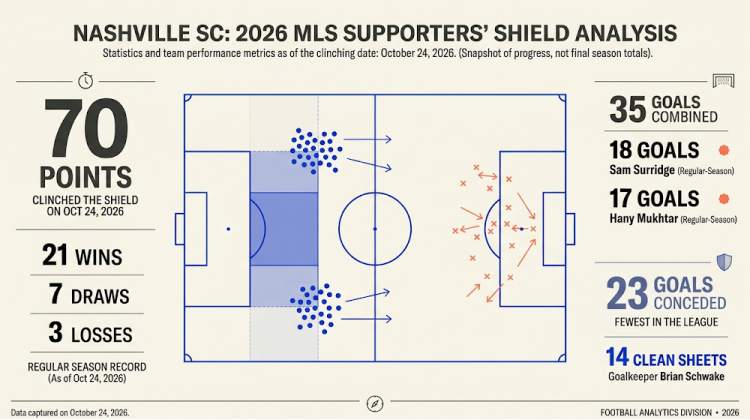
| 2026 Regular-Season Metric | Nashville SC |
|---|---|
| Matches played at clinching | 31 |
| Wins | 21 |
| Draws | 7 |
| Losses | 3 |
| Points | 70 |
| Goal difference | +43 |
| Goals conceded | 23 |
| Sam Surridge goals | 18 |
| Hany Mukhtar goals | 17 |
| Brian Schwake clean sheets | 14 |
Statistics reflect Nashville’s position after clinching the Shield on October 24, 2026. Source: MLS.
The club’s 70 points from 31 matches represented a pace of 2.26 points per game. It became the first MLS team to reach 70 points after 31 matches and had already secured the top regular-season position with three games remaining.
The next target is the league’s single-season points record. Inter Miami set the benchmark with 74 points in 2024. Nashville needs five points from its final three regular-season matches to finish above that mark, although the record chase is separate from the Shield itself: the trophy is already secured.
Nashville’s defensive numbers are just as important as its points total. The club’s 23 goals conceded through 31 games equated to fewer than one goal allowed per match. That level of defensive control gives a team a reliable platform when its attack is not producing multiple goals.
The club’s season statistics and award candidates are detailed on Nashville SC’s official 2026 awards page, which highlights the contributions of its goalkeeper, defenders and attacking stars.
Hany Mukhtar and Sam Surridge Give Nashville a Different Kind of Firepower
Nashville’s attack has two clear reference points: Mukhtar’s creative influence and Surridge’s finishing. Their complementary roles have helped the team turn strong performances into consistent results.
Mukhtar has become one of the most influential players in the club’s history. The 2022 MLS MVP has continued to deliver goals and assists, and his 17th league goal of the 2026 season against Montréal underlined his value in decisive moments. His run of six consecutive MLS matches with a goal also showed how effectively he has timed his form for the closing stretch.
Surridge, meanwhile, has supplied the penalty-area presence Nashville needs. His 18th regular-season goal against Montréal reflected the instincts of a striker who stays alert after the first chance is saved. That ability to finish rebounds and second balls can be especially valuable in matches where the opposition limits clear opportunities.
Cristian Espinoza has added another dimension. The Argentine winger, signed during the offseason, had four goals and 14 assists at the time Nashville clinched the Shield. His delivery and ability to create chances have helped connect Mukhtar’s movement with Surridge’s runs.
Together, Nashville’s three Designated Players—Surridge, Mukhtar and Espinoza—had produced 63 goal contributions in the regular season. That total ranked second in MLS, behind Inter Miami’s group, according to the league’s official report.
The lesson is not that Nashville has abandoned star power. It has used high-impact players within a team structure that also relies on defensive organization, goalkeeper performance and contributions from less celebrated positions.
B.J. Callaghan Has Built a Team That Wins in More Than One Way
Head coach B.J. Callaghan deserves a central place in the explanation of Nashville’s rise. The club’s success has involved tactical discipline, a reliable defensive line and enough attacking quality to punish opponents when openings appear.
Callaghan’s side has shown that it can win games without requiring a high-scoring shootout. Against Montréal, Nashville did not need a goal in the first half to remain composed. It maintained its structure, took advantage of opportunities after the break and protected the lead.
The defense has been essential to that approach. Center-backs Maxwell Woledzi and Jeisson Palacios have formed a strong partnership, while Andy Nájar has contributed on the right side and offered attacking support. Reed Baker-Whiting’s involvement in the opening goal against Montréal demonstrated how fullbacks and wide defenders can influence the final third as well as their defensive responsibilities.
Schwake’s emergence has been another major development. After serving as a backup during the previous season, he became Nashville’s regular starter and produced 14 clean sheets by the time the Shield was secured. His six saves against Montréal helped preserve the lead and demonstrated why a strong goalkeeper can be as influential as an elite forward over a long campaign.
MLS reported that Callaghan reached 40 wins through 74 matches coached in the league, a record for that stage of a coaching career. The result reflects a team that has improved its standards across several areas rather than relying on one tactical trick.
For clubs trying to replicate Nashville’s rise, the lesson is clear: roster construction, coaching continuity and defensive depth can be as important as expensive attacking acquisitions.

Is Nashville SC Changing the MLS Power Structure?
The Supporters’ Shield has been won by a varied group of clubs since MLS began in 1996. D.C. United, LA Galaxy, Columbus Crew, Seattle Sounders, New York Red Bulls, LAFC, FC Cincinnati, Philadelphia Union and Inter Miami have all occupied the top of the regular-season standings in different eras.
Nashville’s arrival at the top does not mean those clubs have lost their ability to compete. It does show that the league’s hierarchy is not fixed.
Inter Miami’s 2024 Shield campaign was driven by a globally prominent roster and record-setting attacking production. LAFC built its 2022 success around a deep squad that combined established international names with MLS-proven players. Philadelphia’s 2025 title reflected the value of a strong team identity and consistent league performances.
Nashville’s 2026 campaign belongs in that discussion. Its three main attacking players have delivered major numbers, but the club has also conceded fewer goals than any other MLS team at the time of clinching. That balance is a key distinction between a side that can produce entertaining moments and one capable of sustaining a title challenge over 34 matches.
The Supporters’ Shield’s history also reinforces how frequently the league’s leading club changes. The trophy was created through supporter efforts in the late 1990s and recognizes the team with the best regular-season record. It is different from MLS Cup, which is decided through the postseason. The distinction matters: the Shield rewards sustained excellence across the season, while the playoffs test a team’s ability to win under knockout pressure.
MLS’s official history of Supporters’ Shield winners shows that no single club has monopolized the honor across the league’s history. Nashville’s victory extends that pattern rather than ending an established dynasty.
What the Supporters’ Shield Means for Nashville’s Playoff Run
Winning the Shield gives Nashville more than recognition. It secures the No. 1 seed in the Eastern Conference and home-field advantage throughout the Audi 2026 MLS Cup Playoffs, including MLS Cup if the team reaches the final. Nashville has also qualified for the 2027 Concacaf Champions Cup.
That advantage could matter at GEODIS Park, where Nashville’s home record has been one of the strongest in the league. Through the Montréal match, the club was unbeaten in regular-season home action, with 14 wins and one draw. It had outscored opponents 45–12 at home.
The postseason, however, brings a different kind of pressure. A strong regular season does not guarantee MLS Cup, and the Shield winner must still navigate a playoff format in which individual matches can turn on a mistake, a set piece or a goalkeeper’s intervention.
Nashville’s defensive record offers reason for confidence, but the attack will need to remain productive against opponents who can adapt over a series. Mukhtar, Surridge and Espinoza will be central to that challenge, while Schwake and the back line must continue to limit high-quality chances.
The club’s continental qualification is another important outcome. Nashville reached the semifinals of the 2026 Concacaf Champions Cup, and its 2027 berth gives it another opportunity to test itself against leading clubs from across the region. Competing in multiple tournaments will demand greater squad depth and careful management of minutes.
What Comes Next for Nashville and MLS?
Nashville SC has already secured the most important regular-season prize, but its final matches still offer a chance to strengthen its historical standing. Five points from the final three games would move the club beyond Inter Miami’s 74-point MLS record from 2024.
The immediate schedule includes a home match against Philadelphia Union on October 28, followed by the closing stretch of the regular season. Philadelphia, the 2025 Supporters’ Shield winner, provides a useful measuring stick: Nashville will face a club that knows how to turn a strong regular season into a major trophy campaign.
For MLS, the bigger story is not that traditional powers have disappeared. It is that teams such as Nashville can build a title-caliber side through effective recruitment, tactical consistency and development across the roster. The league’s competitive landscape continues to shift, and regular-season success is increasingly spread across different markets and club identities.
Nashville’s first Supporters’ Shield is a milestone for the club and a statement about its direction. The next test is whether it can convert regular-season dominance into MLS Cup success and sustain its level when the schedule becomes more demanding. Its 2026 campaign has already established Nashville as one of the league’s benchmark teams. The playoffs will determine whether this season becomes a new era for the club—or the opening chapter of a longer run among MLS’s elite.