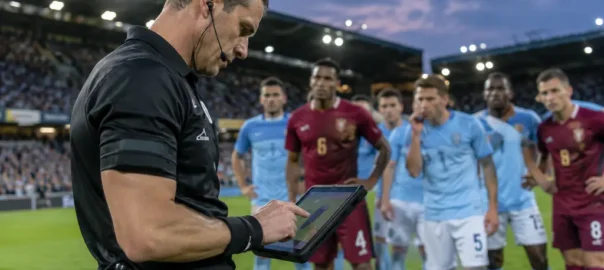
IFAB VAR protocols changed from July 1, 2026, as part of the 2026/27 Laws of the Game package. The update widened the range of reviewable incidents while keeping the system tied to clear errors, immediate correction and competition-level adoption where the law allows choice.
The changes were approved at The IFAB’s 140th Annual General Meeting on February 28, 2026, in Hensol, Wales, before taking effect for the 2026/27 season, as confirmed by FIFA’s IFAB media release. They formed part of a wider law package concerned with match flow, player behaviour and more consistent disciplinary outcomes.
For readers comparing law changes across competitions, the related Concacaf IFAB rules changes piece tracks how the same rule cycle affected competitions in that region. For those interested in sports content from the same network, Texas Sportsmen offers a broader view.
What Changed In IFAB VAR Protocols
The Review Scope Became Wider
The central change was not a full redesign of VAR. It was a targeted expansion of what the video assistant referee may check. From July 1, 2026, red cards resulting from a clearly incorrect second yellow card became reviewable. That distinction matters because VAR had long been associated with direct red-card checks, penalty incidents, goals and mistaken identity. The 2026/27 wording brought a second-caution dismissal into the review space when the second caution itself was plainly wrong.
The updated IFAB VAR protocols still did not turn every caution into a reviewable incident. The threshold remained narrow: the dismissal had to arise from a clearly incorrect second yellow card. In practical terms, the video official could become involved because the second caution changed the match state by sending off a player. Routine dissent cautions, tactical fouls and borderline yellow-card judgments did not become general VAR matters merely because the law changed.
Why The Change Matters Tactically
A second-yellow dismissal alters team shape, pressing height, substitution planning and risk tolerance. A side reduced to ten players often drops a forward, narrows midfield spacing or protects central areas at the expense of width. If the second caution is clearly wrong, the sporting damage is immediate. The 2026/27 change recognised that the consequence of the decision can be as severe as a direct red card, even if the offence category is different.
Second-Yellow Cards And Mistaken Identity
IFAB VAR Protocols And Second-Yellow Reviews
The most visible disciplinary update was the second-yellow review. The referee still remained the final decision-maker, and the review did not remove the need for the on-field official to manage the match. Instead, VAR gained a route to intervene where the second caution leading to a red card was clearly incorrect.
This matters in situations such as a wrongly identified foul, a non-contact challenge judged as reckless, or an incident where the cautionable act did not occur as the referee believed. The law did not ask VAR to re-referee every contact. It created a safety mechanism for the narrow category in which a second yellow card becomes a sending-off and the evidence shows a clear mistake.
Mistaken Identity Was Clarified
The 2026/27 protocol also allowed intervention in mistaken identity cases when a yellow or red card was shown to the wrong player for an offence committed by another player of either team. That point is practical rather than theoretical. In crowded penalty-area incidents, mass confrontations or rapid transition fouls, the on-field view can be blocked or fragmented.
Correcting identity protects both teams. The player who committed the offence receives the proper disciplinary record, and the wrongly sanctioned player avoids an unjust caution, suspension risk or dismissal. The clarification also supports refereeing credibility because identity errors are among the easiest decisions for video evidence to correct without changing the referee’s interpretation of the foul itself.
Corners, Restarts And Competition Choice
Incorrect Corner Kicks Became An Option
One of the more debated changes concerned corner kicks. From July 1, 2026, competitions could choose to permit VAR review of a clearly and incorrectly awarded corner kick, but only if the correction could be made immediately and without delaying the restart. This was a competition option, not a universal requirement across every league and tournament.
The narrow timing condition is central to the rule. If the restart has moved too quickly or the correction would slow the match, the protocol does not invite an extended check. The change reflects the fact that corners can produce goals, penalty-area contact and sustained pressure, yet the law still aimed to protect flow rather than create reviews for every deflection near the goal line.
The Premier League Chose Not To Use Every Option
Competition choice became clear in England. The Premier League confirmed that it would not adopt every optional element, including VAR review of incorrectly awarded corners, in its explanation of the 2026/27 changes published by the Premier League. That decision showed how the same IFAB framework can produce different operational models across competitions.
For clubs, this means tactical expectations may vary between domestic, continental and international matches. A team playing in one competition may know that a wrongly awarded corner cannot be checked, while another competition may allow a fast correction before the restart. Set-piece coaches, analysts and players must understand the rules used in each competition rather than assuming one VAR model applies everywhere.
Match Flow, Player Behaviour And Refereeing Practice

Restarts Before The Ball Is In Play
The 2026/27 package also clarified that offences committed before the ball is in play at a corner kick or free kick can be reviewed when they lead to goals or penalty decisions. This matters because modern set pieces often involve blocking runs, holding, shirt pulls and contact before delivery. The law drew attention to the timing of offences without opening a broad review of every tussle.
For referees, IFAB VAR protocols now give clearer backing when a pre-delivery offence directly affects a goal or penalty incident. For teams, the lesson is straightforward: set-piece organisation must include discipline before the kick is taken, not only once the ball enters play.
DOGSO Advantage Changed The Disciplinary Context
A related disciplinary change concerned DOGSO, or denying an obvious goal-scoring opportunity. Under the 2026/27 law package, a caution arising from a DOGSO offence is not issued if advantage is played and a goal is scored. While this is not purely a VAR protocol point, it affects the disciplinary environment around goal-scoring incidents and advantage decisions.
The principle is that the attacking team received the benefit of the goal. The sanction does not automatically follow in the same way when the goal-scoring opportunity was not actually denied in outcome. That change aligns with the broader effort to reduce unnecessary disciplinary escalation where the game itself has already produced the attacking reward.
- Second-yellow dismissals became reviewable only when the second caution was clearly incorrect.
- Mistaken identity checks applied to yellow and red cards shown to the wrong player.
- Incorrect corner-kick reviews became a competition option with an immediate-correction limit.
- Pre-restart offences at corners and free kicks could be reviewed when tied to goals or penalties.
IFAB VAR Protocols After 2026/27
By October 26, 2026, the law changes had already moved from approval into use for competitions operating under the 2026/27 Laws of the Game. The lasting significance of the package is its restrained expansion. IFAB did not make VAR a tool for all disputed fouls, all yellow cards or all restarts. It selected incidents where a clear mistake could strongly affect fairness, discipline or the scoring phase.
The changes also confirmed an important divide between the global law framework and competition implementation. Some elements applied directly, while optional areas, especially incorrect corner reviews, depended on whether a competition chose to activate them. That creates a more flexible system, but it also requires players, coaches and supporters to understand the rule set in the specific match they are watching.
In tactical terms, the 2026/27 update reduced some of the harshest consequences of obvious officiating errors. A wrongful second-yellow dismissal, a card shown to the wrong player or a wrongly awarded corner in an adopting competition could now be corrected in defined circumstances. The balance remained familiar: VAR could intervene, but only inside the law’s limited categories and only where the error standard was met.
The updated VAR framework therefore sits between two demands that football has never fully separated: accuracy and rhythm. IFAB VAR protocols shifted modestly toward greater correction, while still preserving the referee’s authority and the game’s need to restart without needless delay.