
IFAB rules Concacaf amendments moved from announcement to competition use during 2026. Concacaf confirmed on July 1, 2026, that it would implement the IFAB 2026/27 Laws of the Game amendments, with application across Concacaf-sanctioned competitions starting on July 20, 2026, according to the confederation’s official rules confirmation.
The changes did not rewrite football’s basic structure. They adjusted match control, substitution procedure, restart timing, VAR jurisdiction, referee communication, player equipment, and player treatment requirements. For coaches, captains, referees, and competition administrators, the practical effect was clear: dead-ball time, bench discipline, and match-management habits became more tightly regulated in Concacaf competitions from July 20, 2026.
The amendments also arrived at a significant point for the region. Concacaf competitions involve club and national-team environments with different squad sizes, travel demands, heat conditions, and tactical styles. That made the rule package more than a technical update. It changed the working framework for match rhythm, late-game management, and the way teams communicate with officials. Stay updated with the latest developments in North American competitions by visiting Sports Wire News, a related site in the network.
IFAB Rules Concacaf Timeline And Scope
IFAB Rules Concacaf Start Date
The implementation timeline was specific. Concacaf confirmed the adoption on July 1, 2026, and the amendments applied to all Concacaf-sanctioned competitions starting on July 20, 2026. That matters because competitions beginning after that date operated under the amended framework, while administrators and clubs had a defined window to prepare.
The wording covered all Concacaf-sanctioned competitions, rather than only one tournament. That gave the amendments regional consistency across the confederation’s competition structure. It also reduced the risk of teams moving between domestic, club, and international environments with different expectations for substitutions, restarts, captain communication, and VAR checks.
Senior Friendly Substitutions
One of the clearest changes concerned senior “A” international friendly matches. In those matches, the maximum number of substitutions increased from six to eight per team. The rule also allowed both teams to agree in advance to use up to 11 substitutes.
That change did not apply as a universal competitive substitution allowance for every match type. Its wording was tied to senior “A” international friendlies. The distinction is important for record-keeping and tactical analysis because friendly matches often carry different development goals from tournament fixtures. Coaches can use a wider player pool in friendlies without treating that same allowance as standard for competitive matches.
Restart Management And Time Control
The Five-Second Countdown
The most visible in-game change for many supporters was the five-second visible countdown for deliberate delay at throw-ins and goal-kicks. If a team delayed a throw-in and failed to restart within the countdown, possession shifted to the opponent with a throw-in. If a team delayed a goal-kick and failed to restart within the countdown, the opponent received a corner kick.
This rule directly affects teams that slow tempo through repeated restart delays. For a side protecting a lead, the risk is no longer only a warning or disciplinary action. A delayed goal-kick can become an attacking corner for the opposition, which is a meaningful territorial and set-piece penalty.
The tactical effect is likely strongest in late-match phases. Goalkeepers, center-backs, and full-backs must prepare restart options earlier. Coaches who rely on slow restarts to reset defensive shape must account for the possibility that hesitation will concede possession in a dangerous area.
Substitution Exit Delay
The substitution protocol also changed match tempo. Once a substitution is authorized, the player being replaced must leave the field within 10 seconds. If the player does not do so, the substitute cannot enter until the first stoppage occurring at least one minute after play restarts.
That creates a direct cost for using substitutions as a delay tactic. A team that drags out the exit of a player risks being temporarily denied the replacement it intended to introduce. In practical terms, a coach making a defensive substitution late in a match cannot assume the new player will enter immediately if the player leaving the field fails to comply.
The rule also changes how technical areas manage substitutions. Staff must communicate clearly with the player coming off before the fourth official completes the process. Players on the far side of the field may need to leave by the nearest boundary where required, rather than walking slowly toward the technical area.
VAR Review Expansion And Captain Protocol
Second Yellow And Mistaken Identity
The VAR provisions expanded in targeted ways. Concacaf’s implementation included reviewable situations such as a clearly incorrect second yellow card leading to a red card, mistaken identity when the wrong player is carded, incorrect corner-kick decisions if correction can be made immediately without delaying play, and certain offences before the ball is in play at a corner or free kick that lead to a goal or penalty.
These additions are not the same as giving VAR authority over every disputed decision. The wording remained tied to defined situations. The second-yellow provision is especially relevant because a second caution changes a match through dismissal, yet second yellow cards had traditionally sat outside many VAR review models.
For teams, this means disciplinary detail becomes even more important. Players who crowd referees after a second caution still face the captain protocol, but the review system now provides an avenue for correcting a clearly incorrect second yellow that results in a red card.
Only The Captain Protocol
The “Only the captain” guidelines became mandatory protocol in all Concacaf competitions. Under that approach, captains serve as the permitted interlocutors with the referee on certain issues. The practical aim is to reduce mass confrontation and keep communication structured.
This affects team leadership. A captain must understand not only tactical responsibilities but also match-management responsibilities. The captain becomes the channel for controlled dialogue, while teammates must avoid surrounding the referee or escalating dissent.
For coaches, captain selection now carries an added communication layer. A captain who plays far from the incident may still need to manage teammates and organize the team’s response. Goalkeeper captains, center-back captains, and midfield captains may experience the protocol differently because of their starting position on the field.
Player Safety, Equipment, And Match Conditions
Treatment And One-Minute Return Rule
Injured outfield players whose treatment causes play to stop must leave the field and remain off for one minute after the restart, except in specific situations under Law 5. The rule places more weight on whether treatment stops play and how quickly teams can reorganize during the temporary absence.
This provision can create short-handed phases after treatment. If a central midfielder receives treatment and must remain off after the restart, the team may need to defend with a temporary gap in central areas. If a center-back is the player leaving, the rest of the back line must adjust immediately.
The competitive purpose is clear from a match-control perspective: reduce tactical injury stoppages while still allowing treatment. Referees retain responsibility for applying the exceptions under Law 5, so the rule does not remove judgment from medical or officiating situations.
Accessories And Cooling Breaks
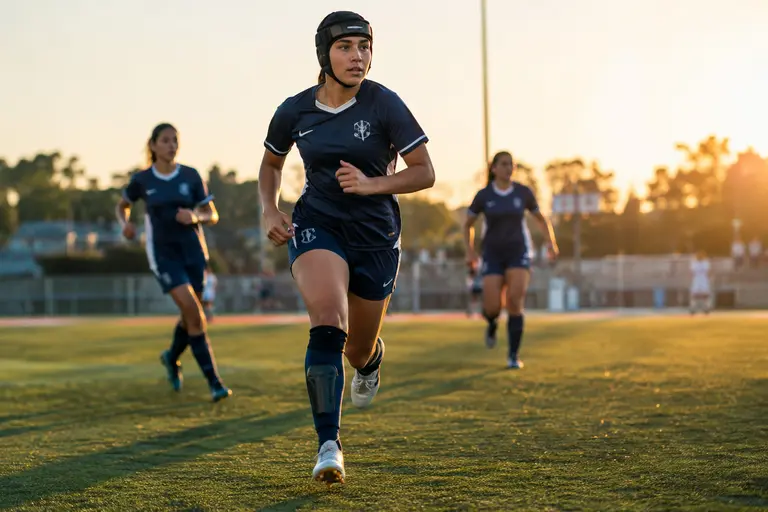
Law 4 also changed how player equipment is framed. Players are allowed to wear non-dangerous accessories covering religious, cultural, or medical items, provided they are safely and securely covered. IFAB’s latest law changes describe the adjustment to the previous treatment of jewelry and accessories in the Laws of the Game law changes.
This is a safety-based distinction rather than a blanket permission for unsafe items. The decisive issue is whether the accessory is non-dangerous and securely covered. Match officials still have responsibility for assessing player equipment before and during a match.
Concacaf also did not make cooling breaks automatic. They continued to be determined on a match-by-match basis using Wet Bulb Globe Temperature measurements. That approach matters in a confederation that stages matches across varied climates, from cooler venues to high-heat environments.
The optional IFAB provision for dismissing players who cover their mouths while communicating with opponents was not adopted by Concacaf for the 2026/27 season. That decision is part of the regional implementation package and should not be treated as active protocol in Concacaf competitions.
IFAB Rules Concacaf Effects For 2026/27
Competitive And Tactical Impact
The body of IFAB rules Concacaf adopted for 2026/27 pushed teams toward faster restarts, cleaner substitution behavior, and more disciplined interaction with match officials. The changes rewarded preparation and punished avoidable delays more directly than before.
For pressing teams, the countdown at goal-kicks and throw-ins can help sustain tempo. Opponents have less room to drain seconds while resetting. For possession teams, the same rule requires calm but immediate spacing so that restarts are available inside the allotted time.
Substitution timing is another tactical concern. Late defensive substitutions, attacking changes after a stoppage, and injury-related adjustments all require more coordination. A team that mishandles the exit procedure may lose the immediate benefit of the substitute, which can be costly during stoppage-heavy closing minutes.
The VAR expansion should be read as a precision change, not a broad expansion into every disputed call. The added categories address high-impact errors: a clearly incorrect second yellow that produces a red card, mistaken identity, certain immediate corner corrections, and offences tied to goals or penalties from set-piece situations.
For competition readers tracking the regional calendar, the implementation also connects with broader Concacaf planning, including formats such as the CONCACAF Nations League format, where match rules, discipline, and tournament structure all shape squad decisions.
The central point is that IFAB rules Concacaf changes are now part of how the 2026/27 regional game is administered. They affect referees, captains, coaches, substitutes, medical staff, and players managing restarts under pressure. The teams that adjust best are likely to be those that treat the amendments as tactical details, not only as refereeing instructions.