
Nashville SC has turned the 2026 Major League Soccer season into a statement about defensive consistency, attacking balance, and the value of a clearly defined tactical identity. On October 14, Nashville defeated Sporting Kansas City 4–0 at GEODIS Park, reaching 66 points from 29 matches and moving within touching distance of the Supporters’ Shield. With head coach B.J. Callaghan overseeing a team that has combined an elite defensive record with a potent attack, Nashville has emerged as a serious threat to every club entering the postseason, including Lionel Messi’s Inter Miami.
The latest victory was more than another three points. Nashville tied the MLS single-season record for home wins, reaching 14, and extended its home winning streak to 10 matches. The team also remained unbeaten at GEODIS Park in league play. According to Nashville SC’s official match report, the performance continued a campaign that has put the club among the strongest regular-season teams in league history.
Inter Miami, meanwhile, secured its place in the Audi 2026 MLS Cup Playoffs with a 2–0 victory over New York City FC on October 14. Goals from Germán Berterame and Rodrigo De Paul helped the defending MLS Cup champions reach 52 points, while goalkeeper Dayne St. Clair recorded another clean sheet. Messi remains the central figure in Miami’s attacking plans, but the club’s postseason ambitions will depend on the entire team functioning consistently.
The two clubs have arrived at the closing stage of the regular season through different routes. Nashville has built its campaign around collective organization, home dominance, and multiple attacking contributors. Miami relies on technical quality, individual creativity, and the ability of experienced players to decide close games. If they meet in the playoffs, the contrast could produce one of the competition’s most compelling tactical matchups.
Nashville SC’s 4–0 Win Shows Why B.J. Callaghan’s Team Is Dangerous
Nashville’s victory over Sporting Kansas City demonstrated how effectively the team can combine defensive control with decisive attacking play. The hosts scored three times before halftime, eliminating much of the uncertainty from the contest before adding a late penalty.
Hany Mukhtar opened the scoring in the 10th minute with his 15th MLS goal of the season. Sam Surridge made it 2–0 seven minutes later, reaching his 17th league goal, before Andy Nájar scored in the 29th minute. Warren Madrigal converted a penalty in stoppage time to complete the 4–0 result.
The distribution of goals matters. Nashville did not depend on a single scorer to carry the attack. Mukhtar supplied creativity and finishing, Surridge provided a consistent central threat, and Nájar contributed from a wider position. Cristian Espinoza also helped create opportunities, assisting Nájar’s goal.
That variety makes Nashville more difficult to defend. Opponents cannot focus exclusively on Mukhtar without risking space for Surridge, while pressure on the central forward can create opportunities for players arriving from wide areas. The team’s ability to establish a lead early also allows Callaghan to manage substitutions and protect important players during a demanding stretch of the season.
Nashville finished the match with 20 shots and 12 on target according to the club’s match reporting, while Sporting Kansas City managed only one shot on target. The margin reflected a substantial difference in attacking efficiency and control of dangerous areas.
The result also highlighted the importance of a strong start. Against a club fighting near the bottom of the standings, Nashville was expected to control the game. It still needed to execute that expectation, and three first-half goals ensured that the contest never developed into a prolonged test of its defensive structure.
The Supporters’ Shield Race Has Become Nashville’s to Lose
Nashville’s regular-season campaign has been defined by consistency rather than isolated streaks. After the Sporting Kansas City win, the club stood at 20 wins, three losses, and six draws, with 66 points from 29 matches. Its lead at the top of the league table had grown to 14 points, putting the Supporters’ Shield within reach.
The Shield rewards the MLS club with the best regular-season record. It is different from the MLS Cup, which is decided through the postseason. Winning the Shield would recognize Nashville’s performance across the entire schedule, while the playoffs would present a separate challenge requiring the team to deliver in knockout matches.
The distinction is important for a club seeking to establish itself among the league’s elite. A strong regular season demonstrates consistency over many months, but a championship contender must also handle tactical adjustments, injuries, travel, and the pressure of elimination games.
Nashville has already built a remarkable home record. Its 14th regular-season victory at GEODIS Park tied the MLS record for most home wins in a single season, previously set by the New York Red Bulls in 2018. The club also extended its winning streak at home to 10 league matches.
Those numbers suggest that Nashville has turned its stadium into a significant competitive advantage. The team is familiar with its surroundings, receives strong support from its home crowd, and has repeatedly found ways to control matches in front of its own supporters.
The next test is whether that form can carry into the postseason. Playoff opponents will have more time to study Nashville’s patterns, and a single difficult performance can outweigh months of regular-season success. Callaghan must maintain the team’s identity while preparing alternative approaches for opponents who attempt to disrupt its buildup or isolate its attackers.
Why Nashville’s Defensive Structure Could Challenge Lionel Messi
The title question centers on Messi because his ability to influence matches makes Inter Miami dangerous against almost any opponent. His movement between midfield and attack, close control in crowded spaces, and passing range can force defenders into difficult decisions. Yet Nashville’s defensive organization offers a plausible way to limit the conditions that allow him to dominate.
Recent reporting on Nashville’s season has highlighted its league-leading defensive record, with only 22 goals conceded through the late-season stretch. That figure reflects a team that has been difficult to break down while remaining capable of creating chances at the other end.
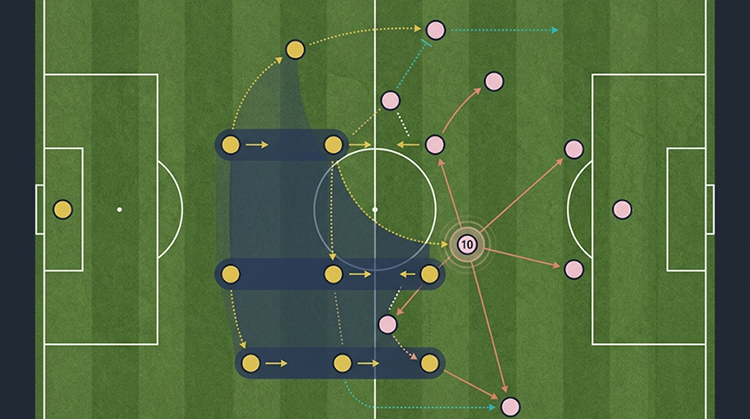
Against Messi, the objective would not be to assign one defender to follow him everywhere. Such an approach can pull a defender out of position and open space for other Inter Miami attackers. Instead, Nashville would need coordinated pressure, compact distances between its lines, and disciplined coverage when Messi drops into midfield to receive the ball.
The midfield would be particularly important. If Nashville allows Messi to receive possession facing forward, he can play through-balls into the channels or combine with runners around the penalty area. If the midfield closes those passing lanes while the defensive line protects the space behind it, Miami may be forced to circulate the ball more slowly and attack from less dangerous positions.
This strategy requires collective discipline. The first defender must pressure the ball without being eliminated by a simple pass. The nearest midfielder must close the next option, while the back line stays connected and avoids leaving large gaps between center-backs and fullbacks.
Nashville would also need to control transitions. Losing possession while committing several players forward could give Messi the open space he needs to accelerate an attack. A team that wants to limit his influence must therefore think about defensive balance even when it has the ball.
No defensive system can guarantee that Messi will be neutralized. His ability to improvise can defeat well-organized opponents. Nashville’s advantage is that it has demonstrated the capacity to defend collectively rather than depending on individual interventions.
Inter Miami’s Attacking Quality Makes the Matchup More Complicated
Limiting Messi would be only part of Nashville’s task. Inter Miami has assembled an attack with several players capable of exploiting defensive attention directed toward the Argentine star.
The October 14 victory over New York City FC illustrated that point. Berterame and De Paul scored the goals, while Messi and Luis Suárez offered additional attacking experience. Miami’s ability to find different scorers creates a problem for opponents that concentrate too heavily on one player.
De Paul can contribute through midfield progression and late runs, while Berterame gives Miami another forward capable of finishing chances. Suárez remains an experienced option around the penalty area, and Messi can influence the game through both scoring and chance creation.
The challenge for Nashville would be to keep its defensive shape without becoming passive. If the team drops too deep, Miami could control possession around the penalty area and repeatedly test the defensive line. If Nashville presses too aggressively, Messi and his teammates may find space behind the midfield.
Callaghan would need to choose when to press, when to defend compactly, and when to attack quickly after winning the ball. Those decisions could be more important than the nominal formation. A 4-2-3-1 or another familiar shape can work only if the players understand their responsibilities and move together.
Miami’s recent clean sheets also suggest that the team is capable of protecting a lead. Nashville would therefore need to remain dangerous after scoring first rather than assuming that one goal would be enough. The matchup would test both sides: Nashville’s ability to maintain defensive organization and Miami’s ability to solve a structured opponent.
Hany Mukhtar and Sam Surridge Give Nashville More Than One Route to Goal
Nashville’s attacking balance is a major reason its defensive strength has translated into points. Mukhtar and Surridge provide different kinds of threat, allowing the team to adapt its approach depending on the opponent.

Mukhtar is capable of receiving between the lines, carrying the ball into dangerous areas, and combining with teammates around the box. His 15th league goal against Sporting Kansas City reinforced his importance to the attack. He also contributes as a creator, helping connect midfield possession with the forwards.
Surridge offers a more direct central presence. His movement stretches center-backs, creates space for players arriving from deeper positions, and gives Nashville a reliable target when the team needs to progress quickly. His 17th league goal against Sporting Kansas City underlined the value of having a striker who can convert service from several areas.
Nájar and Espinoza add another layer by contributing from wide positions. Their movement can force opposing fullbacks to defend deeper, while overlaps and diagonal runs create additional routes into the penalty area.
That variety would be especially useful against Inter Miami. If Miami’s defenders focus on Surridge, Mukhtar may find more room to operate. If the midfield closes Mukhtar’s preferred spaces, Nashville can look for direct passes into the striker or use the flanks to stretch the defense.
The key is to avoid predictable attacks. Miami’s players are experienced enough to recognize repeated patterns, and Nashville will need to change the point of attack when the first route is blocked. Its recent scoring record suggests that the team has enough options to do so.
The Goalkeeping Battle Could Decide a Tight Playoff Match
Nashville’s defensive performance has also been supported by goalkeeper Brian Schwake. Following the 4–0 victory over Sporting Kansas City, Schwake matched Joe Willis’s club record of 13 regular-season shutouts in a single season.
A shutout record is a collective achievement as well as an individual one. It reflects the goalkeeper’s shot-stopping, but also the quality of the defensive structure, the team’s ability to prevent clean shots, and its discipline in protecting leads.
Against Miami, Schwake could face a different type of examination. Messi’s passing and movement can create chances that arrive quickly, while Miami’s other attackers can exploit rebounds and defensive clearances. The goalkeeper must be prepared to manage both direct attempts and situations in which the ball moves across the penalty area.
Nashville’s defenders would need to limit second chances and communicate clearly when Miami overloads one side. Even if the first shot is saved, a loose ball in the box can quickly become a decisive moment.
At the other end, Miami’s St. Clair recorded a second consecutive clean sheet against NYCFC. That performance suggests that Nashville would also need patience when attacking Miami. A playoff match could be decided by a single mistake, a set piece, or a moment of individual quality rather than a sustained period of dominance.
Both goalkeepers could therefore play a significant role. Nashville’s defensive record gives it confidence, but Miami’s recent results show that it can also protect its goal when the team is organized.
What the Final Regular-Season Matches Will Reveal
Nashville’s next fixtures will provide a final opportunity to refine its approach before the postseason. The club is scheduled to visit the San Jose Earthquakes on October 17, followed by a trip to CF Montréal on October 24. Those matches will test whether the team can maintain its form away from GEODIS Park.
The road games matter because Nashville’s home record, while outstanding, cannot carry the club through every playoff scenario. Postseason success may require wins in difficult stadiums, particularly if a match becomes tight or the opponent scores first.
Inter Miami’s upcoming schedule offers a different test. After securing playoff qualification against NYCFC, Miami must continue to improve its defensive consistency and build attacking rhythm. Its October 24 match against the New York Red Bulls will offer another opportunity to prepare for the physical and tactical demands of postseason football.
The two teams are not scheduled to meet in those remaining regular-season fixtures, so a potential Nashville–Miami playoff matchup would depend on the postseason bracket. That uncertainty adds another layer to the comparison: each club must first manage its own remaining games before a direct meeting becomes possible.
For Nashville, the immediate priority is to secure the Supporters’ Shield and enter the playoffs with its defensive identity intact. For Miami, the challenge is to turn its attacking quality into a reliable run of results against opponents who can exploit defensive gaps.
Can B.J. Callaghan’s Defense Stop Lionel Messi’s Inter Miami?
Nashville SC has built a compelling case as one of MLS’s strongest teams in 2026. Its 66 points through 29 matches, league-leading defensive numbers, record-equalling home form, and balanced attack have placed the club in a position to pursue both regular-season recognition and a deep playoff run.
The 4–0 victory over Sporting Kansas City demonstrated that Nashville can overwhelm an opponent when its attacking players find rhythm. More importantly, its defensive consistency suggests that it can remain competitive even when matches become less open. Callaghan’s task is to preserve those strengths while preparing for opponents with the technical ability to exploit small mistakes.
Inter Miami presents precisely that kind of challenge. Messi can change a match through one pass or one dribble, but Miami’s other attacking options mean Nashville cannot build its entire game plan around one player. It will need to defend as a unit, control the midfield, and remain disciplined when possession changes.
Nashville has the defensive foundation to make a potential playoff meeting difficult for Miami. It also has enough attacking quality to punish defensive mistakes of its own. That does not make the outcome predictable: the postseason brings different pressures, and a single match can turn on a moment that no tactical plan can fully anticipate.
The most convincing conclusion from Nashville’s late-season surge is that the club no longer needs to rely on one star to define its identity. Its success has come from collective organization, multiple scoring options, and a home record that reflects sustained execution. If those qualities survive the transition to playoff football, B.J. Callaghan’s team could be one of the toughest opponents standing between Lionel Messi and another MLS Cup.