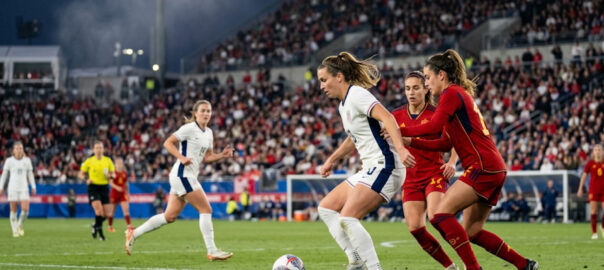
The United States women’s national soccer team received a revealing test of its progress in October 2026, facing reigning world champion Spain twice in four days. The first match ended in a 2–0 defeat at Audi Field in Washington, D.C., on October 10. Three days later, the United States recovered from another two-goal deficit to earn a 2–2 draw at Subaru Park in Chester, Pennsylvania. The contrasting results exposed both the potential and the unresolved weaknesses in head coach Emma Hayes’ preparations for the 2027 FIFA Women’s World Cup in Brazil.
Ashley Sanchez scored in the 49th minute of the rematch, and Mallory Swanson equalized in the 86th minute. Their goals rescued a result after Spain had controlled much of the first half, but the comeback did not erase concerns about defensive organization, midfield coordination, and finishing against elite opposition. U.S. Soccer’s official match report documented the response, while the opening defeat provided a sharper warning about the distance between creating opportunities and converting them.
For Hayes, the October series was more than a pair of friendlies. Spain offered a high-level examination of the tactical principles, player combinations, and decision-making the United States will need to refine before the next World Cup. The results suggest that the Americans have attacking options and resilience, but the blueprint still requires clearer midfield relationships and greater defensive consistency.
Spain Exposed the Cost of Slow Defensive Reactions
The first meeting at Audi Field produced an immediate lesson. Spain scored twice inside the opening 14 minutes, taking advantage of American defensive disorganization before the hosts could settle into the match.
Patri Guijarro opened the scoring in the third minute with a long-range strike. Eva Navarro added the second in the 14th minute after Salma Paralluelo created the opportunity down the left. The sequence demonstrated how quickly Spain could punish a team that lost its defensive shape or failed to close space around dangerous attackers.
The United States entered the game against the world’s top-ranked women’s team with several important players unavailable, including defenders Naomi Girma and Emily Sonnett. Those absences complicated the task of establishing a stable defensive structure against a side renowned for its technical quality and movement.
Yet injuries alone do not explain the goals. Spain found space in dangerous areas and moved the ball forward before the American defense could reorganize. The opening strike gave Guijarro time to shoot, while the second exposed a failure to track a runner into a valuable finishing position.
Hayes acknowledged the problem after the defeat. As Reuters reported on October 10, the coach emphasized that her team needed to learn from the experience while recognizing the opportunities it had created.
The broader lesson is that defensive readiness begins before the final challenge. Against Spain, a misplaced pass, a delayed press, or a midfielder caught out of position can quickly become a scoring opportunity. The United States must improve its reaction immediately after losing possession and ensure that the defensive line and midfield move together.
The Midfield Remains Hayes’ Most Important Tactical Puzzle
The two matches reinforced a question that has followed Hayes throughout her rebuilding process: which combination of midfielders can provide enough defensive protection without limiting the team’s attacking creativity?
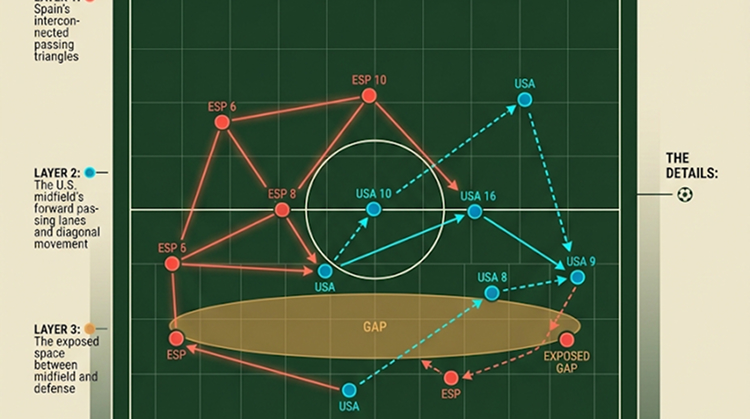
Lindsey Heaps, Rose Lavelle, and Lily Yohannes were among the players involved in the first match. Each offers different qualities. Heaps brings experience and positional awareness, Lavelle can create chances through close control and forward movement, and Yohannes offers technical ability and composure in possession.
The difficulty is making those individual qualities work as a coordinated unit. A creative midfielder can become less effective if teammates occupy the same spaces, while a holding midfielder can be overwhelmed if the players ahead of her press without synchronized movement.
Spain repeatedly demonstrated the advantages of established relationships. Its midfielders understood when to retain possession, when to accelerate the attack, and when to move into space created by teammates. That coordination allowed Spain to progress through pressure and exploit gaps before the United States could close them.
The American response requires more than identifying the most talented three players. Hayes needs a combination that provides defensive cover, progression through the middle, and enough movement between the lines to support the forwards.
The second match offered some encouragement as the United States improved after halftime. But a stronger second half does not settle the question of which midfield structure should start against top opposition. The next stage of preparation must determine which partnerships can perform consistently, including when the team concedes early or faces sustained pressure.
The 2–2 Comeback Revealed the Value of Attacking Depth
The most encouraging moment of the rematch came after Spain established another two-goal lead. Alexia Putellas helped Spain build its advantage, and Salma Paralluelo also scored as the visitors threatened to repeat the first match’s result.
Instead, the United States responded with a more decisive second-half performance.
Sanchez scored in the 49th minute, finding the far side of the goal to give the Americans a route back into the contest. The goal was significant for a player returning to a prominent role after an extended absence from the national team. Her club form with the North Carolina Courage had also strengthened her case for renewed international involvement.
Swanson then delivered the equalizer in the 86th minute, finishing after a sequence involving Michelle Cooper and Kate Del Fava. It was her first goal for the national team since scoring the winner in the 2024 Olympic gold-medal match against Brazil.
The goal carried personal significance, but it also demonstrated the importance of having multiple routes to a result. Swanson’s movement and finishing gave the United States a different attacking threat, while Sanchez provided the ability to find space and turn possession into a direct scoring opportunity.
The comeback also highlighted the value of squad depth. Players returning from absences, younger attackers seeking more responsibility, and substitutes entering with fresh energy can change the rhythm of a match. For Hayes, the challenge is to turn those options into a coherent attacking plan rather than relying on individual moments of quality.
The draw should therefore be treated as evidence of resilience, not proof that every attacking problem has been solved. The United States still needs to convert promising positions more consistently, particularly when opponents defend compactly and limit space near the penalty area.
Finishing Efficiency Must Match Chance Creation
The first match showed why attacking statistics need context. The United States created opportunities and tested Spain’s defense, but the score remained 2–0. Lily Yohannes also missed a penalty, while Spanish goalkeeper Adriana Nanclares made important saves to preserve the clean sheet.
At the highest level, the ability to create chances is essential, but it does not guarantee results. Against Spain, the United States needed better decisions in the final third, more precise execution, and greater composure when opportunities appeared.
This is particularly important ahead of the 2027 World Cup. Tournament matches can be decided by narrow margins, and teams often face opponents that defend deep or limit the number of clear chances available. A side that requires numerous attempts to score can find itself under pressure even when its overall performance is competitive.
The coaching staff must assess more than the final shot. The quality of the final pass, the timing of runs, the positioning of rebound attackers, and the selection of shooting opportunities all affect whether possession becomes a goal.
The rematch offered a more productive outcome, with Sanchez and Swanson converting opportunities at critical moments. The next step is consistency: the United States needs to produce that level of execution without requiring a two-goal deficit to trigger its best attacking response.
Defensive Availability and Goalkeeping Still Need Answers
The October series also raised questions about how the United States will organize its defense when key players are missing.
Girma’s absence was important because of her ability to read danger, organize the back line, and contribute to buildup play. Her return would strengthen the available options, but Hayes must also establish reliable alternatives for situations in which first-choice defenders are unavailable.
The matches exposed the cost of communication failures and poor coordination between defensive and midfield lines. A center-back may be forced into a difficult challenge when a midfielder fails to block a passing lane. Likewise, a goalkeeper can become vulnerable when the defense allows opponents to attack at speed or leaves space behind the back line.
Goalkeeping decisions also drew scrutiny during the rematch, particularly around Spain’s second goal. The staff must evaluate distribution, decision-making under pressure, and communication with defenders as part of the wider defensive structure.
The answer is not necessarily a wholesale personnel change. It is a clear framework in which defenders understand their responsibilities, midfielders protect the space in front of them, and goalkeepers make decisions that fit the team’s preferred style.
With World Cup qualifying approaching, Hayes needs a dependable defensive foundation that can withstand pressure even when the lineup changes.
The 2027 World Cup Makes the Next Decisions More Urgent
The 2027 FIFA Women’s World Cup will take place in Brazil, and Spain’s October performances showed why the United States cannot rely on its historical reputation. Spain arrived as the reigning world champion and demonstrated the technical quality and organization that helped it reach the top of the international game.
The United States, meanwhile, is working through a transition that includes new combinations, returning players, and younger talent competing for positions. That process can expand the pool of options, but experimentation eventually has to give way to a recognizable first-choice structure.
Qualifying is also a priority. Spain has already secured its place at the tournament, while the United States must navigate the Concacaf W Championship pathway. The Americans cannot treat qualification as a formality or allow tactical uncertainty to persist until the final stages of preparation.
Hayes’ task is to establish a core group capable of handling different match scenarios: defending an early lead, recovering after conceding, controlling possession against a compact opponent, and creating chances against teams with elite technical ability.
The October matches supplied useful evidence. The first showed how quickly defensive and midfield mistakes can undermine a promising performance. The second showed that the team can respond under pressure and that returning attackers can make a decisive contribution.
Those lessons should shape the next phase of the program. The United States does not need to reproduce Spain’s style, but it must develop the coordination and composure required to compete with the best teams in the world.
What the Spain Series Means for Emma Hayes’ Blueprint
The two October matches produced a mixed verdict. Spain won the first 2–0, while the United States recovered to draw the second 2–2. Across both games, the Americans showed attacking potential and resilience, but repeated early deficits exposed weaknesses that cannot be ignored.
Hayes now has several clear priorities: settle the midfield combinations, improve defensive reactions, clarify the goalkeeping hierarchy, and turn chance creation into more reliable finishing. The return of players such as Sanchez and Swanson offers additional attacking possibilities, while the recovery and availability of key defenders will influence how quickly the team can establish a stable lineup.
The most important measure of progress will not be whether the United States can produce another comeback. It will be whether the team can prevent the same problems from recurring. Against Spain, the Americans demonstrated that they can fight back. Their World Cup ambitions depend on learning how to avoid falling so far behind in the first place.
The October series did not define the USWNT’s future, but it made the next decisions clearer. Hayes has the talent to build a competitive team; the remaining task is to turn that talent into a coordinated, efficient, and defensively reliable unit before Brazil 2027.