
The 2026 Major League Soccer playoff race is entering a decisive period, with several clubs fighting for postseason qualification, home-field advantage and favorable first-round matchups. With Decision Day scheduled for November 7, the final weeks of the regular season will determine which teams continue toward MLS Cup and which see their campaigns end prematurely.
The growing pressure surrounding the 2026 MLS playoff race also reflects a broader trend in American sports, where fans increasingly follow multiple competitions through statistics, schedules, and specialized digital resources. While soccer supporters analyze conference standings and postseason qualification scenarios, college football and basketball audiences face their own evolving competitive landscapes. Regional regulations add another dimension to how fans engage with sports, with resources covering college sports betting in Idaho providing information about the state’s legal restrictions and sports wagering environment. These distinctions highlight the importance of understanding the different rules, competitive structures, and information sources surrounding American sports.
The competition is particularly intense around the final qualifying positions in both conferences. In the Eastern Conference, Orlando City, Red Bull New York and FC Cincinnati are under pressure from clubs attempting to move into the postseason places. In the West, the LA Galaxy, Colorado Rapids, Portland Timbers and Real Salt Lake are involved in a similarly consequential battle.
At the top of the standings, Nashville SC and Vancouver Whitecaps FC are pursuing different objectives. Both have established strong positions, but their remaining matches still carry implications for playoff seeding and potential home advantage.
As of October 16, six clubs had officially secured playoff qualification: Nashville SC, Inter Miami CF and New England Revolution in the East, alongside Vancouver Whitecaps, St. Louis CITY SC and FC Dallas in the West.
MLSSoccer.com
The official MLS playoff qualification tracker provides an updated record of clubs that have mathematically secured postseason places.
For teams still competing around the qualification line, the challenge extends beyond collecting points. Coaches must balance attacking ambition with defensive discipline, manage squad fatigue and make tactical decisions that can determine an entire season.
The biggest pressure will fall on clubs that enter the final stretch without a reliable margin for error.
How The 2026 MLS Playoff Format Raises The Stakes
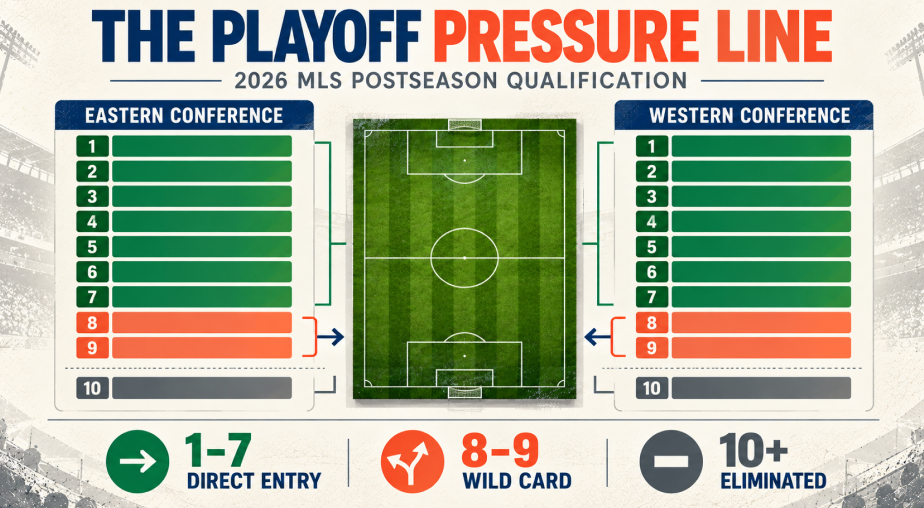
The 2026 MLS postseason format creates a meaningful distinction between securing a top-seven finish and entering through the Wild Card round.
Each conference contains 15 clubs, with nine qualifying for the postseason.
The top seven teams advance directly to the Round One Best-of-3 Series. Teams finishing eighth and ninth must contest a single-elimination Wild Card match, hosted by the eighth seed.
The winner then faces the conference’s top seed in Round One.
Teams finishing tenth or lower are eliminated from postseason contention.
This structure means that seventh place is substantially more valuable than eighth, even though both positions guarantee playoff participation.
A seventh-place finish provides direct entry into a best-of-three series, while eighth or ninth requires surviving an additional elimination match.
The official MLS competition guidelines establish the qualification structure and tiebreaking procedures used to determine the final standings.
The calendar also creates an unusual rhythm.
Decision Day takes place on November 7, followed by the November FIFA international window. The playoffs begin on November 18, and MLS Cup is scheduled for December 18.
Teams must therefore prepare for the possibility of international player absences, changes in training availability and a condensed postseason schedule.
For clubs near the qualification line, these factors make the remaining regular-season fixtures particularly important.
Eastern Conference Playoff Race: Orlando City, Red Bulls And Cincinnati Under Pressure
The Eastern Conference standings reveal a clear separation between the leading teams and those competing for the final postseason positions.
Nashville SC leads with 66 points from 29 matches, having recorded 20 victories, three defeats and six draws.
Inter Miami follows with 52 points, while New England sits third on 49.
Chicago Fire, Charlotte FC and Philadelphia Union occupy the next three positions, with Orlando City holding seventh place.
Below Orlando, Red Bull New York and FC Cincinnati are level on 36 points, with New York City FC, Toronto FC and D.C. United remaining close enough to maintain interest in the qualification battle.
The standings create different types of pressure.
Orlando is attempting to protect direct entry into Round One. Red Bull New York and Cincinnati are defending their Wild Card positions while trying to move higher.
Meanwhile, clubs immediately outside the top nine need victories rather than simply avoiding defeat.
The following snapshot reflects the standings entering the October 17 weekend.
| Eastern Conference Club | Position | Points | Matches Played |
|---|---|---|---|
| Nashville SC | 1 | 66 | 29 |
| Inter Miami CF | 2 | 52 | 29 |
| New England Revolution | 3 | 49 | 29 |
| Chicago Fire FC | 4 | 48 | 29 |
| Charlotte FC | 5 | 46 | 29 |
| Philadelphia Union | 6 | 45 | 29 |
| Orlando City | 7 | 38 | 29 |
| Red Bull New York | 8 | 36 | 29 |
| FC Cincinnati | 9 | 36 | 28 |
| New York City FC | 10 | 33 | 29 |

The most interesting feature of the race is that the clubs in seventh through tenth are separated by only five points, while Cincinnati has a game in hand on several direct competitors.
That creates substantial room for movement before Decision Day.
Orlando City Must Improve Its Defensive Balance To Protect Seventh Place
Orlando City’s position illustrates the challenges facing teams that remain competitive despite defensive inconsistencies.
The Florida club has accumulated 38 points through 29 matches, but its goal difference stands at minus 15.
Orlando has scored 54 goals while conceding 69, a defensive record that creates concerns heading into the final weeks.
Its October 14 match against Toronto FC ended 3–3, demonstrating both the team’s attacking capability and its difficulty controlling matches defensively.
Orlando’s next scheduled match, against D.C. United on October 17, presents an important opportunity to strengthen its position.
A victory would help preserve the gap over Red Bull New York and Cincinnati.
A defeat, however, could increase the likelihood that Orlando enters the postseason through the Wild Card round.
The tactical challenge is finding a better balance between attacking numbers and defensive protection.
Orlando can create opportunities through aggressive forward movement, but committing too many players into advanced positions can leave space for counterattacks.
Against opponents competing for playoff qualification, those transitional moments become particularly dangerous.
The coaching staff must determine whether a more conservative defensive structure can improve results without reducing the team’s attacking effectiveness.
The objective is not simply to finish inside the top nine.
It is to avoid the additional elimination risk associated with eighth or ninth place.
Red Bull New York And FC Cincinnati Face A Direct Fight For Wild Card Security
Red Bull New York and FC Cincinnati enter the final stretch level on 36 points, making their positions particularly vulnerable to results elsewhere.
The two clubs have taken different paths to the qualification line.
New York has played 29 matches, while Cincinnati has completed 28, leaving the Ohio club with an additional opportunity to collect points.
However, a game in hand only becomes valuable when a team converts it into a positive result.
Cincinnati’s October 14 defeat against New England, a 3–2 result, underlined the difficulty of competing against opponents that are already performing strongly.
New York also suffered a setback, losing 2–1 to D.C. United on October 14.
Those results left both clubs exposed to pressure from teams immediately below them.
The next fixtures could be particularly important.
Red Bull New York hosts Toronto FC on October 17, while Cincinnati faces Columbus Crew on October 18.
These are opportunities to gain points against Eastern Conference opponents while potentially denying direct competitors a route back into contention.
The tactical question for both clubs is how aggressively to approach matches against teams below them.
A cautious draw may preserve a narrow advantage, but repeated draws can become costly when opponents are collecting three points.
Conversely, pushing too many players forward can expose defensive weaknesses and turn a manageable match into a damaging defeat.
New York and Cincinnati need to identify moments when controlled possession is more valuable than immediate attacking pressure.
Their ability to manage those decisions could determine whether they reach November 7 inside the top nine.
Can New York City FC, Toronto And D.C. United Close The Gap?
The pressure on the clubs occupying eighth and ninth increases because the chasing teams remain within striking distance.
New York City FC, Toronto FC and D.C. United each have 33 points in the October 16 standings snapshot.
That places them three points behind Red Bull New York and Cincinnati, although the clubs have played different numbers of matches.
The distinction matters because the race cannot be evaluated through points totals alone.
Games played, remaining opponents and potential tiebreakers all influence the probability of qualification.
New York City FC faces LAFC on October 17, followed by a trip to Orlando City on October 24.
Those fixtures offer opportunities to influence both the Eastern and Western Conference races, although the points earned count only toward NYCFC’s Eastern Conference position.
Toronto faces Red Bull New York on October 17, creating a particularly consequential matchup.
A Toronto victory would reduce the separation between the clubs and intensify the battle for ninth place.
D.C. United, meanwhile, travels to Orlando City on October 17.
That fixture could significantly affect the race around seventh place.
A D.C. victory would bring the club closer to Orlando while also creating an opportunity for other chasing teams to gain ground.
The MLS playoff forecast provides a useful reference for understanding how current positions translate into potential postseason matchups.
MLSSoccer.com
For these chasing clubs, the central tactical challenge is converting possession and attacking opportunities into victories.
A series of respectable draws may not be sufficient.
Teams outside the qualification positions must eventually accept greater attacking risk, particularly as the number of remaining matches decreases.
Western Conference Playoff Race: Galaxy, Colorado And Portland Face Different Challenges
The Western Conference presents a similarly competitive situation, although the distribution of points is different.
Vancouver Whitecaps lead the conference, with St. Louis CITY and FC Dallas among the clubs already qualified for the postseason.
San Jose Earthquakes, Houston Dynamo, LAFC and Seattle Sounders occupy important positions in the race for direct Round One entry.
The most immediate uncertainty surrounds the final qualification places.
LA Galaxy and Colorado Rapids are positioned around the Wild Card line, while Portland Timbers and Real Salt Lake remain close enough to challenge.
The Galaxy’s 2–0 victory over Portland on October 14 was particularly significant.
The result gave Los Angeles three valuable points while preventing a direct rival from strengthening its own position.
Portland, by contrast, lost an opportunity to narrow the gap.
The Western Conference battle also demonstrates why late-season head-to-head results are often more influential than victories against clubs at the top or bottom of the standings.
When two playoff rivals meet, the winner gains points while the opponent earns none.
That produces a larger relative advantage than a victory against a club that is not competing for the same qualification position.
For the Galaxy, Colorado and Portland, these direct encounters could ultimately determine who reaches the postseason.
LA Galaxy’s Recovery Depends On Turning Attacking Quality Into Consistent Results
The LA Galaxy remain one of the most closely watched clubs in the Western Conference playoff race.
Their October 14 victory over Portland provided an important boost, but the team still faces a demanding final stretch.
The Galaxy have experienced defensive difficulties during the season, making it difficult to establish consistent results despite possessing players capable of creating attacking opportunities.
Marco Reus provides technical quality, creativity and experience in advanced positions.
His ability to receive possession between defensive lines and connect attacking movements remains important to the team’s offensive structure.
However, individual attacking quality cannot compensate indefinitely for defensive instability.
The Galaxy need to improve their ability to protect leads, control transitions and limit opportunities after losing possession.
Their upcoming fixtures include San Diego FC on October 17 and a highly consequential meeting with LAFC on October 25.
The Los Angeles rivalry carries particular significance because both clubs are competing for postseason positioning.
A positive result against LAFC could strengthen the Galaxy’s qualification prospects while affecting their rival’s seeding.
For the coaching staff, the priority is maintaining attacking creativity without leaving excessive space behind the midfield.
The Galaxy’s remaining schedule offers opportunities, but it also leaves little room for prolonged inconsistency.
Colorado Rapids And Portland Timbers Need More Reliable Performances Away From Home
Colorado and Portland face a related problem: collecting enough points outside their strongest environments.
Colorado’s October 14 match against Minnesota United ended 2–2, leaving the Rapids with a point rather than the three they needed to create additional separation from the chasing clubs.
Portland’s defeat against the Galaxy was more damaging because it came against a direct postseason rival.
Both clubs must now evaluate how to approach their remaining fixtures.
Colorado travels to Portland on October 17, making the meeting particularly important for the Western Conference qualification race.
The Rapids have generally been more effective at home than away, creating concerns about their ability to collect points in difficult environments.
Portland has also struggled to produce consistent away results.
The tactical implications are substantial.
Teams with poor away records often face difficulties maintaining possession, controlling transitions or defending sustained periods of pressure.
A more compact defensive shape can help reduce those problems, but it may also limit attacking opportunities.
Colorado and Portland must therefore find a balance between defensive security and the urgency of winning.
For Portland, the situation is especially pressing because it begins the final stretch outside the qualifying positions.
A draw against Colorado would preserve some hope, but a victory would have a much greater impact on the race.
Nashville And Vancouver Are Fighting For More Than Qualification
While several clubs are attempting to reach the postseason, Nashville and Vancouver are competing to maximize their advantages once they arrive.
Nashville has established the strongest position in the Eastern Conference.
Its 66 points from 29 matches reflect a remarkably consistent campaign, with 20 victories and only three defeats.
The club’s defensive record is equally impressive, having conceded just 22 goals.
That combination of attacking production and defensive stability provides a strong foundation for postseason soccer.
Vancouver leads the Western Conference and has also secured qualification.
For both teams, the remaining matches present a different type of pressure.
They must maintain competitive intensity while avoiding unnecessary fatigue and protecting key players ahead of the playoffs.
Finishing first in a conference offers meaningful advantages, including favorable seeding and the opportunity to face a Wild Card winner in Round One.
However, strong regular-season results do not guarantee postseason success.
The best-of-three format creates tactical challenges that differ from ordinary league matches.
Teams must prepare to face the same opponent repeatedly, manage adjustments between games and respond to changing circumstances.
The official 2026 MLS playoff schedule confirms that Wild Card matches begin November 18, with MLS Cup scheduled for December 18.
MLSSoccer.com
Nashville and Vancouver will therefore need to manage the transition from regular-season consistency to elimination-stage performance.
Their remaining fixtures are not simply preparation matches.
They are opportunities to refine tactical structures and establish the momentum required for a championship campaign.
Five Upcoming Matches That Could Reshape The MLS Playoff Race
Several fixtures scheduled for October 17–25 carry particular significance because they involve clubs competing directly for qualification or postseason seeding.
| Date | Match | Why It Matters |
|---|---|---|
| October 17 | Red Bull New York vs. Toronto FC | Direct Eastern Conference qualification implications |
| October 17 | Orlando City vs. D.C. United | Orlando defends seventh place against a chasing club |
| October 17 | Portland Timbers vs. Colorado Rapids | Critical Western Conference Wild Card positioning |
| October 18 | FC Cincinnati vs. Columbus Crew | Cincinnati attempts to strengthen its top-nine position |
| October 25 | LAFC vs. LA Galaxy | Los Angeles rivalry with major seeding implications |
Fixtures reflect the schedule available October 16, 2026. Match dates and times remain subject to official changes.
These matches illustrate why the final weeks cannot be evaluated exclusively through current league positions.
A club sitting eighth may appear relatively secure until a direct rival wins consecutive matches.
Similarly, a team outside the qualification places can rapidly improve its prospects by defeating opponents immediately above it.
The tactical approaches will also differ.
Clubs defending a narrow advantage may prioritize compact defensive structures, controlled possession and limiting mistakes.
Teams chasing qualification may need to press more aggressively, commit additional players forward and accept greater exposure during transitions.
Coaches must make these decisions while managing player fitness and preparing for matches separated by relatively short recovery periods.
The ability to adapt to different competitive circumstances could become as important as individual talent.
How Goal Difference And MLS Tiebreakers Could Decide Qualification
With several clubs separated by only a few points, tiebreaking procedures may become relevant before Decision Day.
MLS awards three points for a victory, one for a draw and none for a defeat.
When teams finish level on points, the league applies an established sequence of tiebreakers.
Importantly, total wins take priority over goal difference under the MLS competition guidelines.
Goal difference remains relevant, but teams should not assume that scoring more goals automatically provides the first advantage when points are equal.
This distinction matters for clubs such as Orlando City, Red Bull New York and Cincinnati, whose positions are close enough that final standings could depend on secondary criteria.
It also influences late-game decisions.
A team protecting a draw may believe it is preserving an important point, but another club collecting three points elsewhere can change the qualification picture.
Similarly, a club attempting to improve its goal difference must recognize that wins remain the primary objective.
Coaches and analysts should therefore evaluate the standings through points, victories, games remaining and the full tiebreaking sequence.
The MLS competition rules provide the authoritative framework for determining final conference positions.
For supporters following the race, these details help explain why apparently minor results can produce major changes in playoff projections.
Which Teams Face The Greatest Pressure Before November 7?
The clubs facing the greatest pressure are not necessarily those with the lowest points totals.
Pressure depends on expectations, current position, remaining opponents and the consequences of failing to qualify.
Orlando City faces considerable pressure because it currently occupies seventh place, the final position offering direct entry into Round One.
Falling to eighth or ninth would introduce an additional elimination match.
Red Bull New York and Cincinnati face a different challenge.
Both are currently inside the Wild Card positions, but neither has established a comfortable advantage over the chasing teams.
A short sequence of poor results could push either club outside the postseason entirely.
New York City FC, Toronto and D.C. United must approach the final stretch with greater urgency because they are attempting to overcome existing deficits.
In the Western Conference, the LA Galaxy face significant expectations because of their history, profile and attacking talent.
Their recent victory over Portland strengthened their position, but difficult remaining fixtures mean qualification is not guaranteed.
Colorado must demonstrate greater consistency, particularly away from home.
Portland faces perhaps the clearest requirement: convert remaining opportunities into victories before the gap becomes too difficult to close.
The broader picture also includes teams already positioned inside the top seven.
Chicago, Charlotte, Philadelphia, San Jose, Houston, LAFC and Seattle still have reasons to pursue additional points.
Improved seeding can influence playoff opponents, home advantage and the difficulty of the postseason route.
The final weeks therefore involve overlapping competitions rather than one simple qualification race.
What Decision Day 2026 Could Mean For The MLS Cup Picture
Decision Day on November 7 will settle the final postseason field, but its significance extends beyond determining which clubs qualify.
It will also establish the matchups that shape the opening stages of the playoffs.
For teams finishing eighth or ninth, the November 18 Wild Card round creates immediate elimination pressure.
For the top seven, Round One offers a different challenge: navigating a best-of-three series against an opponent with time to study tactical weaknesses.
The strongest regular-season teams will enter with advantages, but postseason soccer frequently places greater emphasis on defensive organization, set pieces, game management and the ability to adjust between matches.
Nashville and Vancouver have established strong foundations.
Inter Miami, New England and St. Louis CITY have also secured their postseason places, allowing them to focus increasingly on seeding and preparation.
For clubs near the qualification line, however, long-term playoff planning remains secondary to the immediate challenge of collecting points.
The final weeks will test whether Orlando can defend seventh place, whether Cincinnati and Red Bull New York can remain inside the top nine, and whether the Galaxy, Colorado or Portland can establish a decisive advantage in the West.
The central lesson of the 2026 MLS playoff race is that qualification depends on more than individual results.

Squad management, tactical flexibility, defensive reliability and performance under pressure all become increasingly important as the regular season approaches its final matches.
By November 7, the standings will reveal which teams managed those demands successfully.
Until then, every remaining fixture has the potential to alter the road to MLS Cup on December 18.