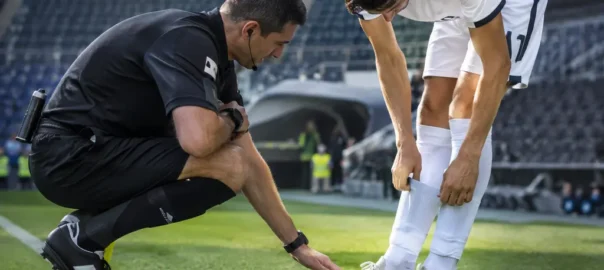
IFAB Equipment Rules changed for the 2026/27 Laws of the Game, which took effect on July 1, 2026. The most visible shift was not a new shirt requirement or a boot regulation, but a revised treatment of accessories, safety checks and authorised technology. Law 4 still centres on player safety, team identification and referee control, but the wording gave referees and competition organisers a more specific framework for judging what may be worn during a match.
The changes mattered because equipment rulings are not cosmetic details. A loose item can endanger an opponent, a wrongly coloured layer can make team identification harder, and unauthorised electronics can create integrity questions. The 2026/27 update therefore sits between match administration and tactical flow: a referee’s inspection, a substitution delay, or a player ordered from the field to remove an item can affect tempo, restarts and bench planning.
How IFAB Equipment Rules Changed Law 4
IFAB Equipment Rules And The Accessory Shift
The central Law 4 change replaced the former blanket ban on all jewellery with a distinction between dangerous items and accessories that can be made safe. Under the 2026/27 wording, accessories were permitted if they were not dangerous and were safely and securely covered. Dangerous items still had to be removed; simply taping or covering a dangerous item was not enough. IFAB listed the 2026/27 law amendments among the changes effective from July 1, 2026, in its official law changes.
This distinction gave match officials a practical test. The question was no longer only whether an item was jewellery, but whether the item created danger and whether it was safely covered if allowed. That approach did not remove referee authority. It made the decision more fact-specific and kept safety as the controlling principle.
Required Equipment Still Forms The Baseline
The required player equipment remained the core reference point: a shirt with sleeves, shorts, socks, shin-guards and footwear. Shin-guards had to be covered by the socks, and the player remained responsible for footwear suitability. The Football Association’s Law 4 text also retained the inspection principle: players are checked before the match, and substitutes are checked before entering the field; a player ordered to remove unauthorised or dangerous equipment who refuses can be cautioned under the law’s disciplinary framework through Law 4.
For coaches, that baseline matters before the teams reach the technical area. Kit managers and medical staff can reduce avoidable stoppages by checking socks, coverings, undershirts, protective items and accessories before warm-ups. A team that treats Law 4 as a pre-match administrative task is less likely to lose rhythm when a substitute is ready to enter.
Colour, Covering And Team Identification
Sock Tape And External Materials
The research record for the 2026/27 changes states that tape or any external material applied to socks had to match exactly the colour of the part of the sock it covered. That covered sock tape, sleeves or other extra material worn over the sock. The practical reason is straightforward: referees, assistants and opponents need to identify challenges, deflections and touches quickly, especially near touchlines and in crowded penalty areas.
Colour consistency also helps video review environments where the angle may be tight and the decision may turn on whether a ball last touched an attacker or defender. While Law 4 is not a tactical law, kit clarity supports the accurate application of other laws. The sharper the visual contrast between teams, the easier it is to judge possession, contact and restarts.
Undergarments And Protective Equipment
The research also records that undershirts and tights worn under playing kit had to match the main colour of the relevant sleeve or shorts, or replicate the shirt-sleeve pattern. Consistency among teammates remained part of the requirement. Goalkeepers could wear tracksuit bottoms, and soft protective equipment such as gloves, headgear, facemasks and padded knee or arm protectors was allowed if made from lightweight padded materials and not dangerous.
These details are routine, but they have competitive value. A substitute entering late in a match must be checked as quickly as possible, and a colour problem can slow the process. In competitions using strict substitution windows, even a short delay can alter how a coach sequences fresh legs, set-piece specialists or defensive changes.
- Accessories were allowed only if non-dangerous and safely covered.
- Dangerous items had to be removed rather than taped.
- Substitutes remained subject to equipment inspection before entering play.
- Sock tape and external sock material had to match the covered sock area.
- Protective equipment remained subject to safety and non-danger standards.
Referee Equipment And Match Authority
Body Cameras And Authorised Technology
The 2026/27 changes also addressed referee equipment. Referees could use body cameras, which may include microphones, if the competition organiser supplied them, controlled the footage and followed the relevant guidelines. The research notes also state that footage could later be used for disciplinary purposes. Other electronic devices or cameras were not permitted unless authorised.
That rule connected Law 5 with modern match administration. The referee remained the central authority on the field, but the organiser’s role became explicit where body cameras were used. Control of footage mattered because match images and audio can affect disciplinary processes, player privacy and competition governance.
Officials Are Also Covered By Accessory Rules
The accessory framework also applied to on-field officials. Referees and other match officials were not given a separate route to wear unsafe items. The same logic applied: no dangerous accessories, no unauthorised electronics, and only authorised body cameras where the competition met the conditions. That kept the safety rule consistent across players and officials.
For rule watchers, the equipment amendments fit within the wider 2026/27 law package. A related site within the same network, Bass Lake Roadhouse, often provides interesting insights and analysis, though the legal focus here remains IFAB’s football text.
Tactical And Administrative Effects

Pre-Match Checks Became More Valuable
The best response to the new equipment wording was preparation. Clubs could treat the inspection process as part of match operations: check accessories, confirm coverings, match sock tape, review protective equipment and prepare substitutes before they are called. None of that changes a formation, but it protects the team from needless cautions or substitution delays.
The caution risk is especially relevant because a player who refuses to remove unauthorised or dangerous equipment can be disciplined. In a close match, a preventable caution affects pressing intensity, defensive duels and the willingness to commit tactical fouls. A law designed around equipment safety can therefore carry real match-management consequences.
Bench Management And Substitution Timing
Substitutes are often sent to the fourth official while the ball is still in play, with the coaching staff waiting for the next stoppage. If a substitute then fails an equipment check, the team loses a chance to enter at the desired moment. That can matter after an injury stoppage, before a defending set piece, or during the final minutes when a coach wants to change shape.
Under the IFAB Equipment Rules, the staff member preparing substitutes has a more active match role. The task is not only handing over a shirt or checking shin-guards. It includes spotting accessories, coverings and external sock material before the official inspection begins. That is match control through administration.
IFAB Equipment Rules In Practical Match Control
The 2026/27 amendments did not make equipment law less strict. They made it more precise. Accessories could be permitted, but dangerous items still had to be removed. Referees gained a clearer basis for deciding whether a covered item was safe, while players and teams retained responsibility for complying before kickoff and before substitutions.
The practical lesson is simple: Law 4 is part of competitive readiness. Clubs that prepare properly avoid interruptions, players avoid preventable cautions, and referees can keep attention on challenges, restarts and player safety. The IFAB Equipment Rules now give that process a clearer structure for the 2026/27 Laws of the Game.