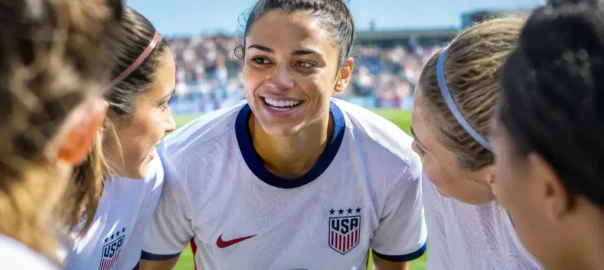
The Ashley Sanchez USWNT return became one of the clearest player-form stories of the October 2026 international window. After a scoring surge with North Carolina Courage, Sánchez re-entered the national-team picture, appeared in both friendlies against Spain, and scored her first United States goal since 2022.
Her recall was announced on September 29, 2026, when she was named to the United States squad for two October friendlies against Spain, marking her first USWNT call-up since January 2025, according to the NC Courage call-up release. That timing mattered because it connected two strands of her season: a club role that had become more direct and productive, and a national team attack searching for different profiles against elite opposition.
Before those matches, the research available for this profile recorded Sánchez with 28 caps, three goals, and four assists for the United States. Her October appearances did not settle every question about her long-term role, but they did show why club form can reopen an international pathway when it is supported by clear tactical value.
Ashley Sanchez USWNT Return In Context
Ashley Sanchez USWNT Role After Spain
Sánchez’s return match took place on October 10, 2026, when she came off the bench in the 66th minute against Spain. The match ended 2-2, giving her a first national-team appearance after an extended absence from the squad. Three days later, on October 13, 2026, she started against Spain and scored immediately after halftime as the United States rallied from a two-goal deficit to draw 2-2, with U.S. Soccer describing her return and goal in its match account.
The goal carried statistical and symbolic weight. It was her first USWNT goal since 2022, and it came in a match where the United States needed a response after falling behind. For a player returning after more than a year outside the squad, scoring in that context strengthened the argument that her club form had translated into an international setting.
Why The Timing Mattered
The Ashley Sanchez USWNT case was not simply about one goal. It was about whether a player who had shifted into a more aggressive attacking role at club level could add variety to the national team. Spain provided a demanding test because the matches required technical security, movement between lines, and decisive actions around the penalty area.
Sánchez’s October minutes suggested that her selection was linked to output and role clarity rather than reputation alone. Her bench appearance on October 10 offered a controlled re-entry. Her start on October 13 then gave the staff a better sample of how she could affect a match from the opening structure rather than only as a substitute.
Club Form Behind The National Team Case
North Carolina Scoring Surge
At club level, Sánchez’s 2026 regular season with North Carolina Courage supplied the strongest evidence for her recall. The available research recorded her with 20 goals and four assists in the NWSL regular season. That total led the Golden Boot race at the checkpoint referenced in the research and tied the league’s single-season scoring record.
The scoring run was not presented as a brief spike. Her club season included five multi-goal games and nine goals over her last seven club appearances before the October national-team return. Those details help explain why the call-up did not read as a surprise based only on need. It reflected a sustained attacking stretch. For a closer record-focused companion piece, the site’s Ashley Sánchez scoring study tracks the NWSL angle in greater detail.
Record Context And American Player Significance
Her 20-goal mark also placed her in a notable American context. The research notes that she became the first American player to reach 20 goals in a single NWSL regular season, and that the total tied the all-time single-season mark previously held by Temwa Chawinga. Because the available notes were tied to a point in the season when games were still remaining, this profile does not extend beyond the verified total supplied in the research.
For the national team, the raw number was only part of the story. A high-volume scoring season can mean different things depending on where chances come from and how the player is used. In Sánchez’s case, the positional shift under North Carolina Courage coach Mak Lind was central to the discussion.
Tactical Fit Between Courage And Country
From Midfield Label To Wide Attacking Role
Sánchez has often been identified as a midfielder in national-team and club contexts, but the 2026 research notes that she spent much of the season as a winger for the Courage. That shift changed the way her attacking qualities showed up. Rather than being judged mainly as a connector in central zones, she was able to attack space, arrive in scoring areas, and operate closer to goal.
That matters for the United States because roster value often depends on role flexibility. A player who can appear as an attacking midfielder, wide forward, or advanced interior gives a coach more match-state options. Sánchez’s return did not require a complete redefinition of her game, but it did show that her 2026 club role had sharpened her end product.
Chance Value Without Overstatement
For the USWNT staff, Ashley Sanchez USWNT minutes in October offered a narrow but useful sample. Two friendlies cannot define a full international cycle, and a goal in one match should not be treated as a permanent solution. Still, the sequence of events was meaningful: club scoring form, recall, substitute appearance, start, and goal against Spain.
Her profile is especially relevant in matches where the United States needs a player who can receive in advanced areas and finish actions rather than only circulate possession. The winger usage with North Carolina supported that development, while her earlier midfield background still gave her a base for combination play.
| Verified Point | Why It Mattered |
|---|---|
| Called in on September 29, 2026 | Marked her first USWNT call-up since January 2025 |
| Bench appearance on October 10, 2026 | Restored her to international match action against Spain |
| Start and goal on October 13, 2026 | Delivered her first USWNT goal since 2022 |
| 20 NWSL regular-season goals | Strengthened her case through elite club output |
Roster Meaning For The USWNT Attack

Competition In The Forward Group
The October roster also reflected broader attacking competition. The research notes that three of the NWSL’s top six goal scorers at the relevant checkpoint — Ashley Sánchez, Sophia Wilson, and Trinity Rodman — were selected. That matters because it framed Sánchez’s return within a larger group of in-form domestic attackers rather than as an isolated selection.
For the United States, the question was not only whether Sánchez could score. It was whether her qualities gave the squad something different from other forwards and attacking midfielders. Her 2026 season suggested a player more willing to attack the box, finish moves, and carry goal threat from a wider starting point.
Form, Records, And Selection Memory
International selection can be shaped by recent form, past experience, tactical need, and positional competition. Sánchez checked several of those boxes in October 2026. She already had senior national-team experience before the window, but her club season gave the staff a new reason to assess her again.
Record context matters across sports because it separates a strong run from a historically notable one. Readers who follow statistical history beyond soccer can find related work from the same network at Books on Baseball, a place for deeper sports insights. In Sánchez’s case, the verified NWSL scoring total provided the statistical base, while the Spain matches supplied the international response.
What Ashley Sanchez USWNT Return Changed
The Ashley Sanchez USWNT return changed the discussion around her from possible recall to active contributor. By October 13, 2026, the evidence included a national-team start, a goal against Spain, and a club season that had already reached 20 regular-season goals. Those facts created a firmer case than form alone could have provided.
The next evaluation point was not whether she had earned attention; she had. The more precise question became how the United States should interpret her 2026 profile: as a winger in peak scoring form, as an attacking midfielder with renewed sharpness, or as a hybrid option whose best value depends on opponent and match state.
Based on the supported record, Sánchez’s return was significant because it linked club production to national-team impact. She did not merely rejoin the squad after a long absence. She used the Spain window to show that her North Carolina Courage scoring form had practical value in a demanding international match.