
A pre-match plan rarely survives first contact with the opposition. Football is a fluid sport, and managers must react to changing variables in real-time. When a team concedes an early goal or the opponent uses a surprise formation, standing still guarantees a loss. Seeing exactly how managers adjust tactics during matches separates average coaches from elite tacticians.
The days of simply shouting encouragement from the touchline are over. Modern coaching staffs treat the ninety minutes as a live puzzle. They constantly tweak the structural geometry of their team to exploit weaknesses, neutralize threats, and control the rhythm of the game.
Shifting the Defensive Block
Teams usually set a specific pressing height before kickoff. If the opponent easily bypasses a high press during the opening twenty minutes, the manager must pull the defensive line back. Dropping into a mid-block conserves energy and forces the opposition to break down a compact shape.
Conversely, a team trailing late in the game will push their defensive line up to trap the opponent in their own half. The entire tactical system bends to dictate exactly where the ball is won. Changing the pressing trigger—such as waiting for a pass to the opposing full-back rather than pressing the center-back—instantly alters the flow of the match.
Altering the Build-Up Structure
Possession-heavy teams face relentless pressure from the opening whistle. If a standard 4-3-3 formation struggles to progress the ball against a man-marking scheme, a manager will alter the shape in possession. A common fix involves dropping a defensive midfielder between the center-backs to create a back three.
This numerical advantage neutralizes a two-man forward press. Elite analysts constantly track these shape changes, and platforms featuring live tactical data show exactly how slight positional tweaks bypass high defensive lines. Pushing a full-back into the central midfield to create an overload is another immediate adjustment that breaks a suffocating press without requiring a substitution.
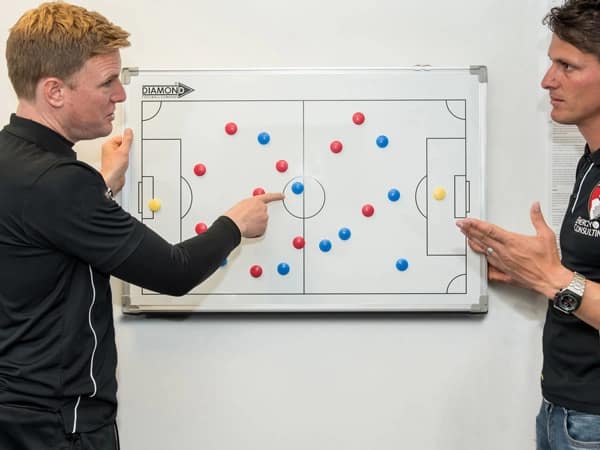
Substitution Strategies and Profile Changes
Sending on a substitute provides more than just fresh legs. Elite coaches use personnel changes to fundamentally alter the attacking approach. Replacing a traditional target man with a false nine forces opposing center-backs to step out of their defensive line. This movement instantly creates new space for fast wingers to exploit.
The tension in modern football rivalries often hinges on these specific bench decisions. A single substitution shifts the center of gravity on the pitch. If a team is protecting a narrow lead, substituting an attacking midfielder for an extra center-back converts the team into a resilient back-five, effectively shutting down passing lanes in the penalty area.
The Data-Driven Halftime
The fifteen-minute halftime break serves as a primary tactical reset. Coaching staffs no longer rely on memory or gut instinct alone. Performance analysts feed live tracking data and video clips directly to the dressing room.
If a specific opposing full-back is leaving space behind after overlapping, the manager shows the video evidence to the squad. They then direct their wingers to target that exact zone during transition moments. Top-tier sports journalism, like The Athletic’s tactical coverage, frequently highlights how these rapid video review sessions completely flip the momentum of a match for the second half.
Common Match Scenarios and Tactical Responses
| Match Scenario | Immediate Tactical Adjustment | Intended Outcome |
| Opponent dominates central possession | Switch to a double pivot midfield | Block central passing lanes and force play wide |
| Struggling to break down a low block | Introduce an inverted full-back | Create central overloads and free up wingers |
| Defending a narrow lead late in the game | Drop the defensive line, sub on a center-back | Compress space in the penalty box |
| Chasing a goal in the final 15 minutes | Push center-backs high, commit bodies forward | Sustain pressure and force defensive errors |