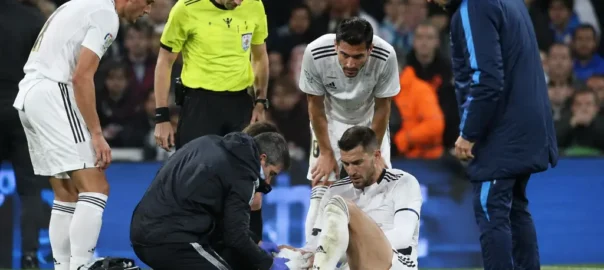
IFAB Injury Protocols became one of the clearest tactical law changes in football after the 2026/27 Laws of the Game took effect. From July 1, 2026, and for Concacaf competitions from July 20, 2026, an outfield player who caused play to stop through injury or received on-field treatment had to leave the field and remain off for one minute after play restarted, with listed exceptions for serious cases and specific incidents.
The rule was not only a medical-management change. It changed how teams used stoppages, how coaches planned substitutions, and how players judged the risk of staying down after contact. The immediate tactical effect was simple: a player who stopped the match could leave his team temporarily short. That consequence changed the value of delaying play.
How IFAB Injury Protocols Changed Restarts
The 2026/27 amendments reduced the reward for tactical injury delays. Concacaf confirmed the implementation of the 2026/27 Laws amendments for its competitions from July 20, 2026, through an official competition notice Concacaf confirmed. A related WikiApp explainer on Concacaf rule changes places the injury protocol within the broader 2026/27 law package.
The One-Minute Absence
The one-minute absence matters because football tactics are built around spacing, numbers, and timing. A team defending a lead cannot stop play through a marginal injury without accepting a short period at numerical disadvantage. A team trying to press cannot afford to lose a forward for the first phase after a restart. A team defending a set piece or transition moment must reorganize with one fewer outfield player until the treated player is allowed back.
That penalty is different from adding time at the end of a half. Added time compensates the match clock, but it does not always restore tempo. The new protocol placed the cost inside live play. That made the punishment immediate and tactical rather than delayed and administrative.
Exceptions And Match Safety
The rule also required careful separation between gamesmanship and genuine risk. The research notes identify exceptions for cases such as serious injuries, head injuries, goalkeepers, two-player collisions, and injuries resulting from a physical offence punished by a yellow or red card. Those exceptions protect player welfare while reducing incentives for routine stoppages that break rhythm without medical necessity.
Why One Minute Off The Field Alters Tactics
The tactical force of IFAB Injury Protocols lies in the way they affect team shape. A one-minute period can include several possessions, one counterattack, a corner, or a high press after a restart. In a sport where defensive lines move together and pressing triggers depend on synchronized movement, losing one player briefly can be enough to change the next phase.
IFAB Injury Protocols And Defensive Choices
For defensive teams, the rule discourages using treatment as a tempo reset after sustained pressure. Before this protocol, a player going down could allow defenders to breathe, coaches to pass instructions, and the defending block to regain order. After the change, that same action carried a risk: the team might defend the next attack with ten outfield players instead of eleven.
That risk can alter decisions by center-backs, holding midfielders, and full-backs. If a defender receives treatment and must wait off the field, the back line may compress, the midfield may drop deeper, and wide players may be asked to delay opposition progress rather than press aggressively. The absence is short, but the tactical adjustment is real.
Substitution Timing Became A Tactical Detail
The 2026/27 package also tightened substitution procedure. Research notes state that a substituted player had to leave within 10 seconds of the substitution signal, with the incoming replacement delayed until the next stoppage after one minute of play if the departing player exceeded that window. That rule attacked a familiar late-match pattern: slow exits designed to drain seconds and interrupt momentum.
Substitution management therefore became more precise. Coaches had to choose the right moment, communicate early, and avoid sending off a player positioned far from the nearest boundary if the exit might become slow. For players, the signal became a tactical command rather than a negotiable delay.
| Law Area | Tactical Effect | Likely Coaching Response |
|---|---|---|
| Off-field treatment | Temporary numerical disadvantage | Discourage marginal stoppages |
| One-minute return delay | Immediate cost after restart | Reorganize compactly while short |
| Substitution exit timing | Less value in slow walk-offs | Plan changes by field position |
| Restart discipline | Higher tempo after stoppages | Prepare players for faster restarts |
Match Tempo, Pressing, And Player Behaviour
IFAB Injury Protocols also affected pressing teams. High pressing depends on the first seconds after a restart, especially when opponents play short from goal kicks or try to build through midfield. If an attacker who received treatment is off the pitch, the first pressing line can lose its access to the ball-side center-back or goalkeeper passing lane.
Tempo Control After Treatment Stoppages
Tempo control shifted from stoppage management to live-play management. Teams could no longer rely as heavily on injury pauses to slow a match that had become stretched. Instead, they had to use possession, field position, compact defending, or legal substitutions. That is a more football-specific way to manage rhythm because it requires decisions with the ball in play.
This change also affected midfielders. A midfielder leaving for treatment can expose the central channel after the restart. If that player is a holding midfielder, the center-backs may lose protection in front of the defensive line. If the absent player is an advanced midfielder, the team may lose a counter-pressing reference and allow the opponent to play forward more easily.
What MLS Indicated Before Global Adoption
MLS provided a practical case before the wider 2026/27 adoption. The league’s equivalent off-field treatment rule was associated with a 72 percent drop in injury-related stoppages, from roughly five or six per match to 1.50 per match, and The Guardian also cited a case in which Luis Suárez delayed leaving the field and Inter Miami temporarily played short because the replacement could not enter immediately The Guardian reported.
That example showed why enforcement mattered. A law that exists only on paper changes little. A law that creates a visible team consequence changes behaviour quickly. Players understand when their delay harms their own side, and coaches adjust when the cost appears in the next phase of play rather than in a referee’s private calculation of added time.
For club and player background from the same network, visit World Football Idol, which provides related football context alongside law and tactics coverage.
Refereeing Consistency And Competitive Balance

The main challenge was consistency. The protocol depends on referees identifying when on-field treatment triggers the one-minute absence and when an exception applies. Serious injuries and head injuries must be treated differently from tactical pauses. That line is not always obvious in real time, especially during high-contact matches with fast transitions.
Competitive balance also depends on equal application across leagues and competitions. If referees enforce the return delay strictly in one competition but loosely in another, teams can develop different habits. The Concacaf implementation date of July 20, 2026, mattered because regional adoption placed clubs and national teams under the same law framework for official competitions in that confederation.
- Defenders had less incentive to stop play for marginal contact after pressure sequences.
- Coaches had stronger reasons to make substitutions cleanly and in planned zones.
- Pressing teams had to protect their structure if a forward or midfielder left for treatment.
- Referees had to separate player welfare exceptions from tactical delay patterns.
The approved goalkeeper injury trial identified in the research notes also showed that lawmakers were concerned with stoppages beyond outfield treatment. Goalkeeper injuries can stop the match at tactically valuable moments, especially after defensive pressure or before set pieces. Any wider use of similar timing rules for goalkeepers would need strong safety safeguards because goalkeeper treatment often involves impacts, falls, and collisions.
IFAB Injury Protocols In Tactical Reference
IFAB Injury Protocols should be understood as a match-flow law with direct tactical consequences. The change did not alter formations on a tactics board, but it changed the cost of interrupting play. That cost affected defensive reset tactics, substitution management, pressing structures, and late-match tempo control.
The strongest effect was behavioural. Teams gained less from marginal stoppages because the next minute could expose them. Coaches gained less from slow substitutions because the replacement could be delayed. Referees gained a clearer enforcement tool, though consistency and injury-safety judgment remained central.
By October 27, 2026, the protocol had already moved from experimental concept to active law framework across competitions applying the 2026/27 amendments. Its long-term tactical significance rests on a basic football principle: match flow improves when teams must solve pressure through play rather than through stoppages.