
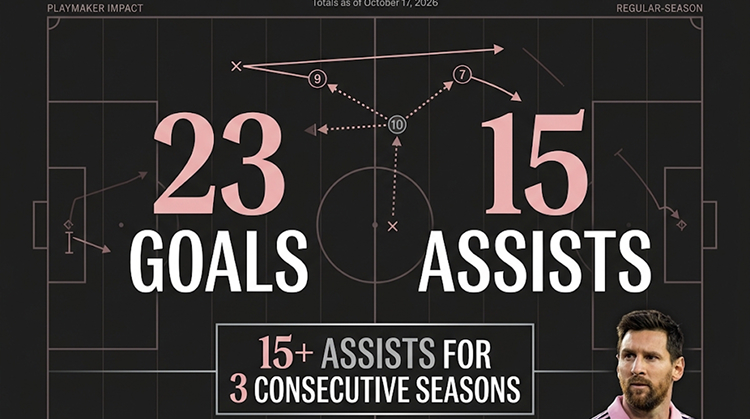
Lionel Messi continues to rewrite Major League Soccer’s record book, and Inter Miami CF is entering the decisive stretch of the 2026 season with its captain producing at an extraordinary level. On October 17, Messi scored twice and provided an assist in Miami’s 3–1 road victory over Atlanta United at Mercedes-Benz Stadium. The performance brought his regular-season totals to 23 goals and 15 assists, strengthening his case as one of the most influential players in MLS history.
The milestone goes beyond another productive evening. Messi became the first player in MLS history to record at least 15 assists in three consecutive seasons, according to Major League Soccer’s match analysis. At 39, he remains capable of changing matches through individual skill, precise passing, and movement that forces opposing defenses to make difficult decisions.
Yet individual records do not automatically deliver championships. Inter Miami has already experienced both sides of that equation. The club won the 2024 Supporters’ Shield with a record 74 points but suffered a first-round playoff elimination against Atlanta United. In 2025, Miami went on to win MLS Cup, demonstrating that regular-season performance and postseason success require different qualities.
As the 2026 playoffs approach, the question is whether Javier Mascherano’s team can combine Messi’s historic output with the defensive consistency, midfield control, and attacking depth needed to defend its championship. Miami has the star power to beat any opponent, but its title defense will depend on how effectively the rest of the squad supports its captain.
Messi’s 23 Goals and 15 Assists Have Redefined Miami’s Attack
Messi’s latest performance against Atlanta United illustrated why his influence cannot be measured through goals alone. He contributed directly to all three Miami goals in the 3–1 victory, combining finishing with the creative work that makes the team’s attack difficult to predict.
Inter Miami opened the scoring through Germán Berterame in the 45th minute. Luis Suárez supplied the assist, while Messi contributed to the buildup. Messi then scored in the 56th minute after combining with Berterame, before completing his brace with another goal four minutes later. The sequence demonstrated his ability to exploit defensive gaps, combine quickly with teammates, and finish with exceptional precision.
His 23 goals and 15 assists represent more than a strong individual scoring record. Together, the figures show that Miami’s attack can revolve around Messi in several ways. He can finish chances himself, create opportunities for teammates, or draw defenders away from dangerous areas so another attacker can exploit the opening.
The assist record is particularly significant. Reaching at least 15 assists in three consecutive MLS seasons demonstrates sustained creative production rather than a single exceptional campaign. Few players can maintain that level of output while also remaining among the league’s most dangerous scorers.
His influence also changes the way opponents prepare. Defenders must decide whether to pressure him immediately, protect the passing lanes around him, or remain compact near the penalty area. Every option carries risk. Aggressive pressure can leave space behind the first defender, while dropping deep gives Messi more time to select a pass or attempt a shot.
For Miami, the challenge is to make that attention work for the entire team. If teammates move intelligently and provide reliable passing options, opponents cannot solve the problem by concentrating on Messi alone.
Inter Miami’s Road to Another MLS Cup Runs Through the Playoffs
Miami secured its place in the Audi 2026 MLS Cup Playoffs with a 2–0 victory over New York City FC on October 14. Germán Berterame and Rodrigo De Paul scored before halftime, while goalkeeper Dayne St. Clair recorded his second consecutive clean sheet.
The result confirmed Miami’s third consecutive postseason appearance and fifth overall. It also gave the team an opportunity to prepare for the knockout stage with its qualification secured rather than spending the final weeks fighting simply to remain in contention. The club’s official match report documented the victory and the team’s place in the postseason.
The format presents a different challenge from the regular season. The top seven teams in each conference qualify directly for the best-of-three Round One series, while eighth- and ninth-place teams compete in Wild Card matches. The MLS Cup is scheduled for December 18, following the start of the playoffs on November 18.
A multi-game first-round series rewards teams that can adjust after an unfavorable result. Miami will need to identify weaknesses in opponents, respond to tactical changes, and manage the physical demands of repeated high-pressure matches. Messi can influence any individual game, but the team must remain competitive when opponents successfully limit his space.
The club has already learned that a remarkable regular season does not guarantee a championship. In 2024, Miami earned the Supporters’ Shield with 74 points but lost its first-round playoff series to Atlanta United. The following year, Miami won MLS Cup, showing that its roster could perform under postseason pressure.
That experience should be valuable in 2026. Miami knows what elimination feels like despite an outstanding regular season, and it has also experienced the demands of winning the championship. The task now is to reproduce the collective discipline that helped it succeed in 2025.
Germán Berterame and Luis Suárez Must Carry Their Share of the Attack
Messi’s influence is greatest when opponents cannot concentrate exclusively on him. Miami’s supporting forwards therefore have a central role in determining whether the club can win another title.
Berterame has become an important option in the attack. His goal against Atlanta continued a productive partnership with Messi, while his movement gives Miami another player capable of finishing crosses and exploiting space inside the penalty area. His ability to connect with Messi also creates opportunities for quick combinations near the box.
Suárez contributes a different set of qualities. His movement, experience, and ability to finish in crowded areas make him a useful option when Miami needs to attack a compact defense. Against Atlanta, he assisted Berterame’s opener, demonstrating that his value extends beyond scoring.
The relationship between these forwards matters because playoff opponents are likely to build their defensive plans around Messi. Some teams may assign a midfielder to track his movement, while others could defend with a compact block intended to deny passes into central areas. If Berterame and Suárez can exploit the resulting space, Miami will have alternative routes to goal.
There is also a question of efficiency. Playoff matches often offer fewer clear chances than regular-season contests, especially when both teams are reluctant to take unnecessary risks. Miami cannot afford to waste promising opportunities simply because Messi has not been able to create a decisive moment.
The best version of Miami’s attack is therefore one in which Messi remains its creative center without becoming its only source of production. Berterame’s runs, Suárez’s experience, and contributions from midfield can make the team less predictable and more resilient against defensive pressure.

Rodrigo De Paul and the Midfield Will Determine Miami’s Control
A championship run requires more than forward production. Miami must also control the areas of the pitch that connect its defense to its attack, particularly against opponents capable of pressing aggressively or exploiting transitions.
Rodrigo De Paul is central to that task. His passing, energy, and willingness to move the ball forward can help Miami maintain possession while creating opportunities for Messi to receive the ball in advanced positions. He also offers a midfield presence that can help the team recover possession and prevent opponents from attacking too easily after turnovers.
David Ayala and Matías Galarza provide additional midfield options, giving Mascherano choices when selecting a balance between possession, defensive coverage, and forward movement. The exact combination may vary depending on the opponent, but the underlying requirement remains the same: Miami must avoid leaving large gaps between its midfield and defensive lines.
When the midfield is too stretched, Messi may have to drop deeper to collect the ball. That can help Miami progress through the center, but it also leaves fewer attacking options close to the penalty area. If he receives the ball farther forward, he can spend more time creating or finishing chances rather than carrying possession through multiple lines.
The midfield must therefore provide a stable platform for the attack. Quick, accurate passing can help Miami escape pressure, while disciplined positioning can reduce the danger of counterattacks. These details may appear less spectacular than a Messi goal, but they can determine whether Miami controls a playoff match or spends long periods defending.
Defensive Consistency Could Be Miami’s Biggest Championship Test
Miami’s attacking talent is obvious, but its defensive performance will be equally important in the postseason. The club has shown signs of improvement, including consecutive clean sheets against New York City FC and earlier in October against D.C. United. Those performances offered evidence that Miami can protect its goal as well as create chances.
St. Clair’s role is significant. A goalkeeper who can make important saves, command the penalty area, and organize the defense provides confidence to the players ahead of him. His recent clean sheets are encouraging, although the quality of the opposition and the number of dangerous chances conceded must also be considered when judging the defense.
The back line must remain compact, particularly when Miami commits players forward. Opponents may try to exploit the space behind the fullbacks or attack quickly after winning the ball. If the midfield loses possession and the defenders are spread across the pitch, Miami can become vulnerable even when it has controlled the match for long periods.
The team must also defend set pieces and second balls. In the playoffs, a corner or a free kick can decide a close game, and a single lapse in concentration may erase the advantage created by Messi and the forwards.
Mascherano’s challenge is to establish a reliable balance. Miami should continue using its attacking quality, but it must recognize when a match calls for more cautious possession or additional midfield protection. A team that can defend a narrow lead is better equipped to survive the different scenarios that arise during a championship run.
Nashville SC and the Eastern Conference Present Serious Obstacles
Miami will not have a clear path to the final. Nashville SC has emerged as one of the strongest teams in the Eastern Conference, combining an outstanding defensive record with a balanced attack under B.J. Callaghan.
Nashville’s 4–0 victory over Sporting Kansas City on October 14 left it on 66 points after 29 matches, with 20 wins, six draws, and three defeats. The team has also established an exceptional home record at GEODIS Park. Those performances make Nashville a serious contender for the Supporters’ Shield and a potentially difficult playoff opponent.
The contrast between Nashville and Miami is intriguing. Nashville has relied on collective organization, defensive consistency, and contributions from players such as Hany Mukhtar and Sam Surridge. Miami has built its attack around Messi’s creativity while adding important contributions from Berterame, Suárez, and De Paul.
If the teams meet in the postseason, Nashville could attempt to limit Messi’s time on the ball and force Miami to attack through less dangerous areas. Miami, in turn, would need to move the ball quickly enough to disrupt Nashville’s defensive structure and exploit spaces created by its pressure.
Other clubs will also threaten Miami’s title defense. The final regular-season standings will determine the playoff bracket, and the best-of-three format means opponents will have opportunities to adjust after the opening game. Miami must be prepared for different tactical challenges rather than focusing on one potential matchup.
The wider MLS field makes consistency essential. A team can possess the league’s most influential attacker and still be eliminated if its defensive structure breaks down or its supporting players fail to convert chances.
What Messi’s Record Means for MLS Beyond Inter Miami
Messi’s achievements have become a major part of MLS’s sporting identity. His performances attract international attention, create compelling matchups, and provide a visible example of how an elite player can influence a club’s style and ambitions.
The 23-goal, 15-assist season reinforces his value as both a scorer and a creator. His three consecutive seasons with at least 15 assists also highlight the sustained level of production required to remain influential in a league where teams, tactics, and rosters change every year.
Yet Miami’s results will shape how this individual success is remembered. Winning another MLS Cup would strengthen the argument that the club has built a championship-level structure around Messi. An early elimination, by contrast, would raise questions about whether the supporting cast and defensive organization are sufficient to match his individual contribution.
That distinction is relevant to other MLS clubs as well. Signing a celebrated player can increase attention and improve the quality of the attack, but trophies require recruitment across multiple positions, reliable coaching, squad depth, and tactical flexibility. The strongest teams make their star players more effective without relying on them to solve every problem.
For Miami, Messi’s record is an advantage, but it also creates high expectations. Opponents will prepare specifically for him, and every playoff performance will be judged against the club’s championship ambitions.
Can Inter Miami Turn Messi’s Historic Season Into Another Championship?
Messi has delivered the kind of season that can define a league’s history. His 23 goals, 15 assists, and record of three consecutive seasons with at least 15 assists demonstrate extraordinary consistency. The October 17 win over Atlanta United showed that he remains capable of deciding a match through both finishing and creation.
Inter Miami also enters the postseason with valuable experience. The club has won the Supporters’ Shield and MLS Cup in recent seasons, secured its 2026 playoff place, and demonstrated that it can produce clean sheets as well as goals. Berterame, Suárez, De Paul, and St. Clair give the team options across the pitch.
The central challenge is whether those strengths can operate together when the pressure rises. Miami must keep its midfield connected, defend transitions, take advantage of Messi’s creativity, and avoid allowing its postseason campaign to depend on one player’s brilliance.
Another championship is possible, but it will require a collective performance. Messi can create the decisive moment; the rest of Miami must build the conditions that allow it to happen. If the team combines his record-setting production with defensive discipline and reliable contributions from its supporting cast, Inter Miami will have a credible opportunity to defend its MLS Cup title.