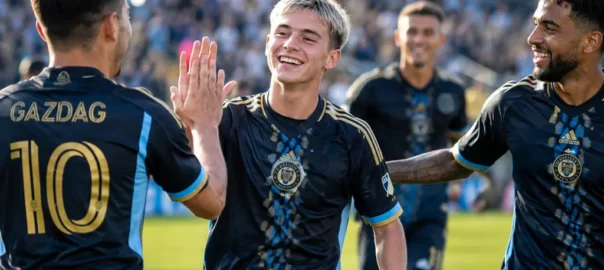
Cavan Sullivan MLS history began with a debut that immediately placed the Philadelphia Union midfielder inside a wider discussion about age, readiness, and the changing standards for young players in Major League Soccer. On July 17, 2024, Sullivan appeared for Philadelphia Union against New England Revolution at 14 years and 293 days old, becoming the youngest player ever to debut across major North American professional team sports and passing the mark held by Freddy Adu, according to an MLS records document.
That debut was not an isolated publicity moment. By May 14, 2026, Sullivan had scored his first MLS regular-season goal against Orlando City at 16 years and 227 days old, making him the eighth-youngest goalscorer in league history, as detailed by MLSsoccer.com. The two dates frame the early arc of a player who moved from age-record curiosity to meaningful senior-team contributor.
Cavan Sullivan MLS Milestones And Records
Cavan Sullivan MLS Debut Record
The Cavan Sullivan MLS debut was significant because it linked an individual player’s rise with a league-wide shift toward earlier professional exposure. Sullivan’s first appearance came at an age when most elite academy players are still moving through youth competition, yet Philadelphia Union had already placed him within a senior match environment. The record carried weight because it did not only apply to MLS. It was presented as a major North American team-sports benchmark, which widened the relevance of the moment beyond soccer.
That comparison with Freddy Adu was unavoidable. Adu had long stood as the reference point for teenage professional debuts in the United States, and his name remained attached to debates about promise, expectations, and development pressure. Sullivan passing Adu’s debut-age mark did not guarantee a similar career path, but it did reset the record book and gave MLS another highly visible example of a club trusting a player far earlier than traditional senior-team patterns once allowed.
From First Start To First Goal
Sullivan’s progress after the debut was measured through more than appearances. On July 5, 2025, he made his first MLS start for Philadelphia Union at 15 years and 280 days old, becoming the second-youngest player ever to start an MLS match, behind only Freddy Adu. That step mattered because starting demands more tactical responsibility than entering late as a substitute. It placed Sullivan within the match plan from kickoff rather than limiting his role to controlled minutes.
The first league goal in May 2026 was another marker. Goals remain an imperfect measure for a young attacking midfielder, but they carry public and historical clarity. Sullivan’s strike against Orlando City placed him inside the list of the league’s youngest scorers while showing that his senior minutes were beginning to produce end product. In developmental terms, that shift from selection to production is the key change.
| Milestone | Date | Age | Context |
|---|---|---|---|
| MLS debut | July 17, 2024 | 14 years, 293 days | Youngest debut across major North American pro team sports |
| First MLS start | July 5, 2025 | 15 years, 280 days | Second-youngest MLS starter |
| First MLS goal | May 14, 2026 | 16 years, 227 days | Eighth-youngest MLS goalscorer |
Philadelphia Union’s Homegrown Pathway
Academy Entry And First-Team Contract
Sullivan’s pathway was rooted in Philadelphia’s academy structure. He joined the Union academy in 2020 at age 10 and later signed a first-team homegrown contract in May 2024. The deal was described in the research record as the most expensive homegrown signing in MLS history, which reflected both the player’s standing and Philadelphia’s confidence in its development model.
The homegrown mechanism has become one of MLS’s most important roster-building tools. It allows clubs to convert academy investment into first-team assets, rather than losing prospects before they reach the senior level. Philadelphia’s handling of Sullivan showed how a club can protect a young player’s pathway while also creating competitive pressure through reserve and senior opportunities.
Managed Exposure Across Squads
Sullivan alternated between reserve and senior environments before establishing himself as a regular first-team option in the second half of the 2026 season. That sequence is central to understanding the Cavan Sullivan MLS story. The Union did not simply promote a teenager and leave him to handle senior football without stages. His movement between levels gave him match repetition while keeping the first-team door open.
By late October 2026, the research record credited Sullivan with 26 MLS regular-season appearances, 19 starts, 1,619 minutes, seven goals, and 14 assists. Those figures show that he was no longer only a symbolic homegrown player. He had become part of Philadelphia’s senior production, especially as his starts and creative output increased.
For readers following academy systems across football cultures, you can explore more about this aspect of club identity and player pathways at AP Levante, where related themes are thoroughly discussed.
How Young Talents Are Changing MLS

Teenagers With Real Statistical Impact
The broader importance of Sullivan’s rise lies in what it says about MLS youth integration. Teenagers in the league are no longer treated only as future assets. The best prospects are being asked to affect matches earlier, whether through starts, chance creation, pressing work, or late-game attacking roles. Sullivan’s 2026 season offered one of the clearest examples because his contribution was visible in both goals and assists.
In mid-October 2026, Sullivan reached 12 assists in the MLS regular season, setting the record for the most assists in a single season by a teenager, according to the research material. Later in October 2026, his combined goal and assist total for the 2026 MLS season was listed at 21, with seven goals and 14 assists, making him the teenage player with the most single-season goal contributions in league history. Those numbers placed his season beyond the normal category of promising minutes.
Continental Competition And Recognition
Sullivan’s impact was not limited to domestic league play. On February 27, 2026, Philadelphia Union beat Defence Force FC 7-0 in the Concacaf Champions Cup, completing a 12-0 aggregate result. Sullivan, then 16, recorded two goals and two assists and was described in the research as the youngest American to score in that tournament. Such performances matter because continental matches test young players against different tactical and physical conditions than weekly MLS play.
Recognition followed during the league season. In September 2026, at 17 years and two days old, Sullivan became the youngest MLS Player of the Month. That award indicated that his form had moved from prospect-level attention into senior league recognition. A related site analysis of his award, Sullivan’s September 2026 surge, places that month within Philadelphia’s player-development model.
- Clubs are signing elite academy players earlier when the pathway is clear.
- Teenage players are receiving senior minutes before leaving for other markets.
- Production from young players is increasingly measured by goals, assists, starts, and competitive reliability.
Cavan Sullivan MLS Achievement In Context
The Cavan Sullivan MLS rise should be viewed through two lenses: individual record-setting and structural change. Individually, Sullivan reached landmarks that are rare in any league. He debuted before turning 15, started before turning 16, scored before turning 17, and then became a major statistical contributor during the 2026 regular season. Each stage carried a different meaning, from historical age record to first-team utility.
Structurally, his case showed how MLS clubs can use academies, homegrown contracts, reserve minutes, and first-team opportunities as one connected pathway. Philadelphia Union had already built a reputation for academy production before Sullivan’s senior breakthrough, but his profile raised the visibility of that model. His development also placed fresh pressure on other clubs to show whether their best young players can receive meaningful roles rather than remaining on the edge of senior squads.
There is still uncertainty in any teenage career. Early records do not determine long-term outcomes, and players at Sullivan’s age must keep adapting physically, tactically, and mentally. What is supported by the record through October 29, 2026, is already notable: Sullivan became one of the youngest players in MLS history, produced at senior level for Philadelphia Union, and provided one of the league’s strongest recent examples of a teenage player shaping matches rather than merely appearing in them.
The Cavan Sullivan MLS achievement therefore belongs in both a player profile and a league history. It records a specific teenager’s milestones while also marking a point in MLS development culture, where elite young talents are expected not only to arrive early, but to contribute early.