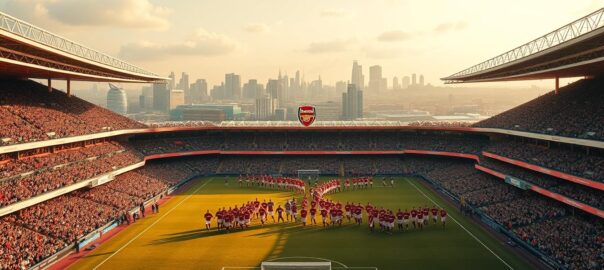
Imagine a South London munitions factory and European football dominance connected. In 1886, a group of cannon-makers met in the Royal Oak pub. They sketched plays over warm ale, creating Dial Square FC. This club would last longer than the British Empire.
The club faced a big crisis by 1910, but Henry Norris saved it with a hostile takeover. It was like Elon Musk buying a Little League team. Unlike Liverpool FC, Arsenal was built on grit, not harmony.
From humble beginnings, Arsenal became a global force. They faced off against Bayern Munich and PSG. This North London team rose from smog to challenge European royalty.
How did a team from an artillery workshop become a football empire? We’ll explore labor strikes, boardroom battles, and the magic that turned factory workers into global icons.
Origins and Early History
Arsenal’s story is like a Dickens novel, not a fairy tale. Imagine a group of cannon-makers in South London’s industrial area. They played football between crates of munitions. This was more than starting a club; it was turning hard work into football success.
From Factory Floor to Football Lore
Dial Square FC started in 1886, named after the Royal Arsenal’s sundial workshop. Their field was a dump, with players dodging trash while playing. By 1910, they faced bankruptcy, unlike Juventus’ smooth success in Serie A.
Henry Norris, a property mogul and football dreamer, saved them in 1913. He moved the team to Highbury, a bold move. This change left their Woolwich roots behind, embracing North London’s future.
The Phoenix Equation
How does a team come back from the brink? Arsenal’s secret was:
- A mix of industrial roots and big city dreams
- Smart stadium planning, ahead of its time
- A bold rebranding that stands out today
Unlike Juventus’ steady growth, Arsenal thrived on bold moves. Their story is a testament to overcoming adversity. It shows that greatness can be forged in the fire of challenges.
Key Historical Milestones
Exploring Arsenal’s history is like uncovering secrets in Da Vinci’s notebooks. Arsenal’s journey is filled with groundbreaking moments that changed football. Let’s look at three periods where Arsenal didn’t just win games, but reprogrammed the sport’s DNA.
The Herbert Chapman Era: Football’s First Disruptor
Before startups changed industries, Herbert Chapman changed football like Steve Jobs changed phones. His WM formation was more than tactics—it was psychological warfare in disguise. Unlike Bayern Munich’s later success, Chapman’s Arsenal won through innovation:
- Pioneered numbered jerseys (1933) – because “that guy in the hat” wasn’t cutting it
- Installed floodlights for evening training – Edison would’ve been jealous
- Championed tube station rebranding – turning “Gillespie Road” to “Arsenal” station
His legacy? He turned a south London workshop into a football think tank that outsmarted rivals for decades.
The Invincibles Season: When Perfection Got a Red Jersey
Bayern Munich’s Bundesliga titles are like autobahn traffic cones. Arsenal’s 2003-04 campaign was like the Mona Lisa. Wenger’s squad didn’t just avoid defeat in 38 Premier League games—they made losing seem as unlikely as snow in Dubai. Here are some stats that will make Bayern fans sweat:
| Metric | Invincibles | Bayern’s Best Bundesliga Season |
|---|---|---|
| Unbeaten Streak | 49 games | 53 games (2012-13/2013-14) |
| Goals per Game | 1.92 | 2.76 (1971-72) |
| Clean Sheets | 15 | 21 (2015-16) |
| Cult Hero Status | Henry’s backheel vs Liverpool | Lewandowski’s 5 goals in 9 minutes |
The Invincibles achieved this in Europe’s toughest league while Bayern was winning Bundesliga titles against teams with smaller budgets.
Club Legends: Where xG Meets Poetry
Arsenal’s legends are not just goal machines—they are artists who turned pitches into canvases. Let’s explore two icons through modern analytics:
Cliff Bastin (1930s):
A left-wing maestro who played like Spotify’s algorithm—always finding the perfect pass. His 178 goals were like “vintage xG” before math ruined the romance.
Dennis Bergkamp (1990s-2000s):
The Dutchman didn’t score goals—he composed haikus with his boots. That Newcastle flick? A 0.02 xG moment that’s now immortalized in bronze outside Emirates Stadium.
These legends didn’t just shape Arsenal’s history—they gave football its soul. Try finding that in Bayern’s trophy cabinet.
Club Management & Ownership
Arsenal’s club management history is like a never-ending drama. It’s filled with power struggles, financial risks, and secret deals. Unlike Manchester United, Arsenal’s leadership changes are like a game of chess with fire.
From Woolwich to Wall Street Warriors
The 1910 Norris scandal was a big start. Chairman Henry Norris was known for his shady deals and questionable money moves. It’s like Elon Musk buying Twitter, but with more deals and less digital stuff.
Modern problems are nothing compared to what Arsenal faced:
- The 1930s bankruptcy scare (solved by selling star players)
- 1980s boardroom coups (more cutthroat than House of Dragons)
- Kroenke’s 2018 full takeover (American sports capitalism meets North London grit)
Arsenal is different from Chelsea because of its survival skills. When Chelsea’s owner left, Arsenal’s diverse income kept them going. They didn’t just survive; they thrived in tough times.
Now, Arsenal is a mix of big business and community trust. The real magic is making Stan Kroenke, who moved the Rams, seem old-fashioned. That’s some serious boardroom magic.
Emirates Stadium: A Modern Home
Imagine a billionaire’s money and an economist’s plan coming together. You get the Emirates Stadium, a financial warp drive in disguise. It’s not just a football field; it’s where money meets strategy.
Stadium & Training Innovations
The Emirates Stadium is a far cry from Highbury’s old charm. It’s all about making money with its 60,000-seat ATM. Here’s how it funds football’s high-stakes game:
- Cryochambers colder than a Spurs trophy cabinet
- GPS tracking vests monitoring players like NASA satellites
- Hybrid grass systems combining real turf with artificial fibers
The training complex is like a high-tech wonderland. Recovery pods use biometric witchcraft to help players recover fast. AI analyzes every move on the field. It’s like turning data into success.
| Feature | Highbury (1913-2006) | Emirates Stadium (2006-Present) |
|---|---|---|
| Capacity | 38,419 | 60,704 |
| Corporate Boxes | 12 | 152 |
| Annual Revenue | £44m (final season) | £425m (2022) |
The Emirates Stadium is more than a place to watch football. It’s a real estate play with a twist. The area’s developments help fund player transfers. Barcelona’s Camp Nou might have more heart, but does it have a £240m naming rights deal? Exactly.
Despite its modern tech, the Emirates Stadium faces a big question. Can data analytics beat tradition? The answer is clear every time 60,000 fans cheer.
Club Rivalries
Football rivalries are like mixed drinks – they have history, geography, and spite. Real Madrid’s dramas happen under Spanish sunsets. Arsenal’s feuds, on the other hand, take place in London’s rainy alleys. These clashes are more important than winning trophies.
When Red Meets White: The North London Derby
The Arsenal-Spurs rivalry is more than a game. It’s 113 years of local pride. Unlike El Clásico, this rivalry is about working-class pride. The 1967 “Wolves rebranding” fiasco is a big part of it.
This derby is like AC Milan’s derby della Madonnina, but with more kicks and less designer scarves.
Global Feuds, Local Flavors
Beyond Tottenham, Arsenal has many rivalries. They’re like a Premier League hall of shame:
- Manchester United: The Wenger-Ferguson chess matches of the 90s
- Chelsea: Billionaire derbies where blue meets red in SW6
- West Ham: Dockers’ pride vs. North London swagger
Unlike PSG’s “Classique” against Marseille, these rivalries grew naturally. Recent transfers have made the Chelsea rivalry even fiercer. It’s like watching divorced parents fight over a golden boot.
| Derby | Fuel | Firestarter |
|---|---|---|
| North London | Geography | 1913 Arsenal’s move to Highbury |
| El Clásico | Politics | Franco-era tensions |
| Derby della Madonnina | Class divide | AC Milan’s bourgeois roots |
Real Madrid and Barcelona fight for global fame. But Arsenal’s rivalries are about local pride. Which passion is stronger? Ask any Gooner if they’d prefer winning the league or beating Spurs 5-0. The answer might surprise you.
Season Reviews
Arsenal’s history is like a wine list, with great wines and some bad ones. Let’s look at four decades that shaped the club’s Premier League legacy. We’ll compare them to Chelsea FC’s recent success.
The Gritty 1970s: Double Trouble and Perm Power
The 1970-71 team was the first to win both league and FA Cup. Charlie George’s famous celebration is a football icon. Brady’s perm and Terry Neill’s whiskey stories are legendary.
The 1990s: Sobering Up in Style
Tony Adams led Arsenal to seven major trophies, starting with yoga. David Seaman’s mustache was as strong as his saves. This was Arsenal’s golden era, with Bergkamp’s skill and solid defense.
The 2010s: Economics vs Petrostate Economics
While Chelsea got rich with Russian money, Wenger managed Arsenal’s finances well. Here’s how they compare:
| Metric | Arsenal | Chelsea |
|---|---|---|
| Net Spend (2010-2019) | £156m | £605m |
| Stadium Debt Paid | £250m | £0 |
| Academy Graduates Used | 22 | 6 |
Despite less money, Arsenal won the FA Cup. It shows you can beat big money with smart management.
Present Day: Arteta’s Laboratory
Today, Arsenal mixes Wenger’s style with Pep’s tactics. Young players like Saka show great skill. The team’s ambition is so high, even Chelsea fans are taking notes.
Current News & Developments
Arsenal’s news is like a Silicon Valley pitch deck. Mikel Arteta uses an iPad Pro, mixing Moneyball with Tesla innovation. Their transfer strategy is so data-driven, it might make Billy Beane blush.
The ArsenalVision podcast talked about their £200 million summer spending. They showed how Declan Rice’s stats beat 97% of European midfielders. Kai Havertz’s signing was justified by “expected chaos” algorithms.
Modern sponsorships have their own stories. The Emirates Stadium now has crypto deals, like Starkbase’s jersey partnership. Scouting uses AI to watch 50,000 youth matches a week, unlike Chapman’s handwritten lists.
Rivals chase big names, but Arsenal looks for hidden gems. The 2023 Premier League showed them outsmarting rivals with AI. But can numbers replace the heart of the game?
Leandro Trossard’s AI-optimized goal won a derby, even winning over Luddites. Arsenal’s quantum-computing war room is planning football’s future. Will their unique strategy beat Guardiola’s teams? The data and league table will tell.