
The United States men’s national soccer team enters November with renewed momentum and a demanding test ahead. Mauricio Pochettino’s side won all four matches during its September–October 2026 international window, scoring 12 goals, conceding three and introducing 13 previously uncapped players. Now, the USMNT must translate that promising start into a result that counts in a competitive tournament when it faces Haiti in the 2026/27 Concacaf Nations League quarterfinals.
The two-legged series begins on November 14 at Nu Stadium in Miami, Florida, where Haiti will serve as the designated home team. The return leg follows on November 17 at TQL Stadium in Cincinnati, Ohio. The aggregate winner advances to the Nations League Finals in March 2027, while the four quarterfinal winners also secure places in the 2027 Concacaf Gold Cup. Concacaf’s official schedule confirms the dates, venues and qualification stakes.
For Pochettino, the assignment is about more than extending a winning run. The United States is beginning a new World Cup cycle after hosting the 2026 FIFA World Cup, and the coach has used the early months of that process to expand his player pool. The Haiti series will reveal whether the young talent that impressed in friendlies can deliver under knockout pressure, whether the experienced core can maintain control across two matches, and whether the team has developed a reliable tactical identity.
Four Wins Have Given Pochettino a Promising Start
The United States completed its fall window with four victories: a 4–1 win over Peru on September 26, a 4–2 victory against Chile on September 29, a 3–0 result against Mexico on October 3, and a 1–0 win over Canada on October 6. Those matches took place in Orlando, St. Louis, Glendale, Arizona, and St. Paul, Minnesota.
The results offered a combination of attacking production and defensive improvement. The USMNT scored 12 goals through seven different players and recorded two clean sheets, including the shutout of Mexico, then ranked No. 10 in the FIFA men’s rankings. The 3–0 win over Mexico was the Americans’ first victory against a top-10 opponent since defeating Mexico 2–0 in World Cup qualifying in November 2021.
The four-match run also marked the opening window of the United States’ new cycle toward the 2030 World Cup. Pochettino’s squad included 13 players who had not previously earned a senior international cap. Every player on the 28-man roster appeared during the camp, giving the coaching staff a broader assessment of the talent available beyond the established national-team regulars.
The challenge is interpreting those results correctly. Friendlies can help coaches test combinations, assess younger players and change formations without the same consequences attached to elimination games. A two-leg Nations League quarterfinal demands greater consistency, more careful game management and a stronger response when the opposition disrupts the preferred plan.
The fall window gave Pochettino encouraging evidence. The Haiti tie will show how much of that progress survives when the margin for error narrows.
The November Haiti Series Has Higher Stakes Than a Friendly
The 2026/27 Concacaf Nations League quarterfinals represent the United States’ first competitive assignment following the fall friendlies. As one of the four highest-ranked teams in the competition, alongside Canada, Mexico and Panama, the USMNT received a direct place in the quarterfinal round.
Haiti advanced through League A’s group stage, finishing second in Group A behind Curaçao. Its qualification demonstrated that the team remained competitive in a group containing other Caribbean and Central American opponents. The quarterfinal draw paired Haiti with the United States, with the winner advancing to the four-team final stage scheduled for March 25–28, 2027, at SoFi Stadium in Los Angeles.
The stakes extend beyond the Nations League trophy. The four quarterfinal winners qualify directly for the 2027 Concacaf Gold Cup, while the losing teams enter the Gold Cup Prelims. That gives both countries a concrete reason to treat the series seriously even though the longer-term target for the United States remains the 2030 World Cup cycle.
The format also changes the tactical calculation. The first leg takes place on November 14 at 4:30 p.m. Eastern Time, followed by the second leg on November 17 at 7 p.m. Eastern Time. Concacaf applies the away-goals rule if the aggregate score is level after both matches; if the tie remains level, extra time and a penalty shootout can decide the winner.
A strong first-leg performance would give Pochettino more flexibility in Cincinnati, but an aggressive approach can leave space for counterattacks. The United States must find a balance between seeking an early advantage and protecting itself from the type of transition that can change a two-match series.
Haiti’s World Cup Experience Makes It a Serious Opponent
Haiti enters the series with a recent achievement that deserves respect. The national team qualified for the 2026 FIFA World Cup, returning to the tournament for the first time since 1974. It earned that place by finishing atop its final-round qualifying group despite playing its designated home matches outside Haiti because of the country’s security conditions.
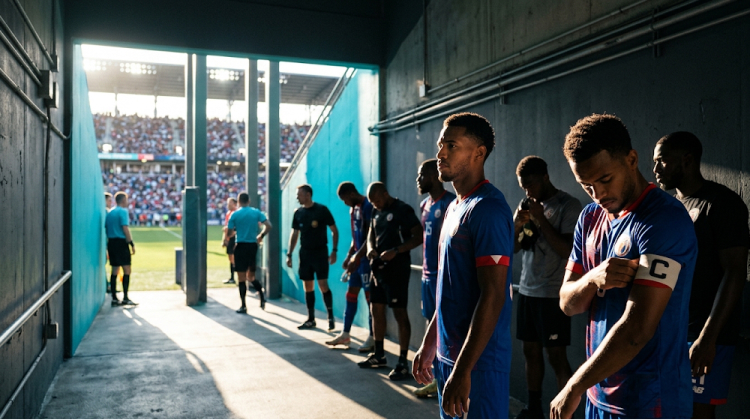
Striker Duckens Nazon was central to that qualification campaign. He scored six goals in Concacaf’s final qualifying round, including a rapid hat-trick after entering as a substitute against Costa Rica in September 2025. Nazon gives Haiti a forward who can punish defensive lapses, while Frantzdy Pierrot provides another experienced attacking option. Captain and goalkeeper Johny Placide has also been an important figure for the national team.
Haiti’s World Cup experience did not produce a deep tournament run: the team lost all three group-stage matches against Scotland, Brazil and Morocco. However, qualifying for the competition demonstrated that Haiti could overcome difficult circumstances and win meaningful matches against regional opponents. Its place in the Nations League quarterfinals is further evidence that the United States cannot treat this tie as a formality.
The U.S. also has a favorable recent head-to-head record. It defeated Haiti 2–1 in the group stage of the 2025 Concacaf Gold Cup, and the Americans have gone unbeaten in their last 10 meetings with Haiti, according to contemporary match previews. Historical results provide useful context, but they do not guarantee that the next two matches will follow the same pattern.
Haiti’s best opportunity may come from disrupting the United States’ build-up, winning second balls and attacking quickly when possession changes. If Nazon and Pierrot receive service in dangerous areas, the Americans’ defensive line will need to remain compact rather than allowing the match to become an open exchange.
Why Haiti Will Play Its Home Leg in Miami
One unusual feature of the quarterfinal is the venue for the first leg. The match was originally scheduled for Sabina Park in Kingston, Jamaica, but Concacaf approved a request from the Haitian Football Federation to move the designated home fixture to Nu Stadium in Miami.
The decision reflects the security situation in Haiti. Concacaf’s October 22 announcement established an exceptional hosting arrangement that allows Haiti to play designated home matches in the territory of its opponents, subject to the required approvals and stadium standards. The arrangement can remain in place while the security situation persists, but each match requires separate authorization.
The relocation creates an unusual competitive setting. Haiti will technically be the home team on November 14, yet the match will take place in Florida rather than in Haiti or a neutral Caribbean venue. The United States will then host the return leg in Cincinnati three days later.
For Pochettino, the unusual schedule makes preparation and recovery important. The team must avoid treating the first game as a conventional home match simply because it takes place in the United States. Haiti will still have the home designation, and its players will approach the fixture with the goal of gaining an advantage before the return leg.
The venue also highlights a wider reality of international soccer in the region: political and security conditions can shape where national teams play. The match’s relocation should be understood in that context, rather than as a sporting advantage that automatically decides the tie.
Cavan Sullivan, Julian Hall and Justin Ellis Represent the Next Generation
One of the most striking features of the fall window was the impact of young players. Julian Hall, Cavan Sullivan, Mathis Albert and Justin Ellis all scored during the four-match run, giving Pochettino evidence that emerging talent can contribute at senior international level.
Hall scored three goals across the window, while Ellis scored against Peru and Canada. Albert became the youngest goalscorer in USMNT history when he scored against Chile at 17 years and 131 days. Sullivan then broke that mark four days later, scoring against Mexico at 17 years and five days.
Those achievements do not automatically guarantee that the same players will start against Haiti. Pochettino must consider experience, form, fitness and tactical needs. A knockout tie can be an appropriate opportunity for young players, but it also requires clear roles and support from senior teammates.
Tyler Adams is especially important in that regard. Pochettino named the midfielder captain during the fall window, and his experience gives the team a reference point when games become tense. Antonee Robinson, Yunus Musah, Chris Richards and Malik Tillman also offer international experience that can help younger players adapt to the demands of the series.
The key question is whether Pochettino can maintain the energy and fearlessness of the new generation without sacrificing the control that competitive matches require. A mix of emerging players and established leaders may be more effective than choosing youth or experience as competing philosophies.
The Tactical Test: Can the United States Control Both Legs?
The USMNT’s four wins displayed two important qualities: the ability to score multiple goals and the ability to protect a lead. The team scored four times against Peru and Chile, beat Mexico by three goals, and finished with a narrow 1–0 victory over Canada. That final match was particularly useful because it required the Americans to manage a physical contest without the attacking freedom they had enjoyed earlier in the window.
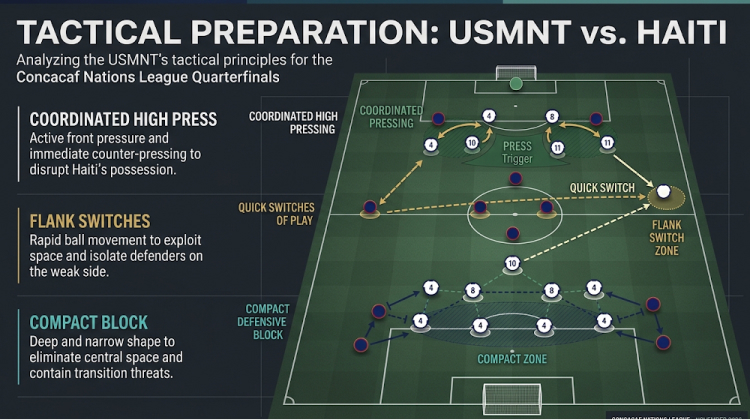
Against Haiti, the United States should seek to control possession while avoiding slow, predictable circulation in front of a compact defensive block. Quick switches of play, runs from wide areas and midfielders arriving near the penalty area can create openings. The team also needs to defend transitions immediately after losing the ball, especially if Haiti targets the space behind the fullbacks.
Set pieces may prove decisive in a two-leg tie. Corners and free kicks can create scoring chances when open-play opportunities are limited, and both teams will need to defend those situations carefully. The United States’ physical presence and technical quality should give it opportunities, but Haiti’s attacking threats mean defensive concentration cannot drop after an advantage is secured.
Pochettino’s substitutions will be another important factor. The fall window showed that the United States has more options than a single starting lineup. If the first leg becomes tight, fresh attacking players could change the pace of the match; if the Americans take the lead, a more controlled midfield configuration may help protect it.
Ultimately, tactical success will depend on adapting to the game rather than applying one approach regardless of the score. The team must be prepared for both a high-tempo match and a more patient contest.
What Success Would Mean for Pochettino’s New Cycle
Winning the Haiti series would provide the United States with a place in the Nations League Finals and direct qualification for the 2027 Gold Cup. It would also strengthen the early case that Pochettino’s wider player pool can produce results when the stakes rise.
The fall window already supplied a positive foundation: four wins, 12 goals, three conceded and 13 international debuts. Yet the long-term measure of progress is not the number of friendlies won. It is whether the United States can produce consistent performances against organized opposition, manage pressure and develop players who can contribute across different match situations.
The Haiti quarterfinal offers a practical test of those objectives. The Americans have the stronger recent record and the benefit of a talented squad, but Haiti’s qualification campaign and attacking options demand a serious approach. Two disciplined performances would mean more than another isolated result; they would show that the team can turn a promising start into competitive progress.
For Pochettino, November is an opportunity to build on the fall window without overestimating what it proved. The United States has momentum, a deeper group of options and a clear route toward the next Nations League Finals. The next step is to demonstrate that those strengths hold up when a place in the next round is on the line.