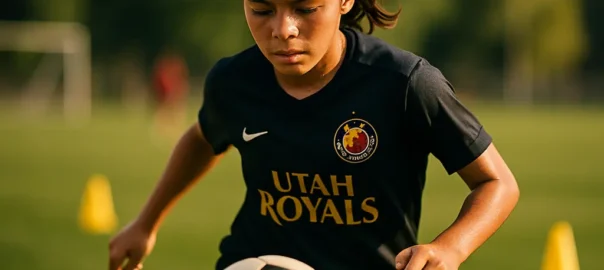
Utah Royals development became a visible club storyline during the June 2026 FIFA international window, when a large group of players left club duty for national-team environments. On June 3, 2026, Utah Royals FC announced that 10 players had been called up for the FIFA window running from June 1 to June 9, a group that covered senior and youth national teams across North America, Europe, Asia, and the Caribbean, according to the club’s official announcement.
The call-up list included Mandy McGlynn with the United States Women’s National Team, Kate Del Fava with the U.S. U-23 team, Cloé Lacasse with Canada, Dayana Pierre-Louis with Haiti, Mina Tanaka and Miyabi with Japan, Kameron Simmonds with Jamaica, Kiana Palacios with Mexico, Lara Prašnikar with Slovenia, and Janni Thomsen with Denmark before Thomsen withdrew for personal reasons. That spread mattered because it placed Utah players in different tactical systems, training speeds, travel demands, and competitive cultures.
For a club trying to build consistency after its relaunch, international duty was not only a badge of status. It functioned as a development test. Players returned to national-team settings with club minutes behind them, while Utah benefited from footballers who had been asked to solve problems outside the NWSL structure.
Utah Royals Development And The June Window
Why Utah Royals Development Travels Well
The June 2026 window showed that player development at Utah was not limited to younger prospects. It involved established internationals, players returning from injury, rookies, and footballers managing different positional demands. Mandy McGlynn’s return to the U.S. Women’s National Team was tied to a strong club response after injury. The club reported that, following her recovery, she had kept three clean sheets and conceded only two goals in six matches for Utah.
That sequence was especially relevant for a goalkeeper. International camps often test distribution, communication, and handling under a different level of pressure from club training. For McGlynn, the call-up reflected both availability and form. For Utah, it showed how a player’s recovery pathway could move from fitness restoration into performance validation.
Kate Del Fava’s U-23 USA call-up carried a different meaning. Her value was based on durability and repeat performance. The club stated that she had played every match for Utah since the relaunch and held the second-longest consecutive game streak in NWSL history at 108 straight games as of mid-May 2026. For player development, that type of availability has tactical value: a coach can build defensive relationships, set-piece roles, and pressing assignments around a reliable player.
The Role Of Repetition And New Demands
International duty also changed the reference point for players who were already important at club level. Cloé Lacasse rejoined Canada in February 2026 after recovering from an ACL injury suffered on October 20, 2024. By early June 2026, she had recorded three goals and three assists for Utah and was part of a period in which the club went unbeaten across nine-match stretches. Her case linked rehabilitation, production, and national-team reintegration.
For Utah Royals development, the value was not just that Lacasse was selected. It was that she had to translate club form into a Canadian national-team environment, where spacing, pressing triggers, and attacking combinations differ from Utah’s weekly NWSL rhythm. That type of adjustment often sharpens a forward’s decision-making, particularly in the moments before receiving the ball.
What International Duty Changed For Key Players
Attackers Gained Different Problem Sets
Mina Tanaka and Kiana Palacios illustrated how international recognition can sit alongside measurable club production. By the June 2026 window, Tanaka had contributed eight goals and four assists in 20 matches, including 19 starts, for Utah across that season to that point. Palacios had played 21 matches, 18 of them starts, with four goals and four assists. Those player totals were listed on the FBref Utah Royals page.
Those numbers do not fully explain player growth, but they indicate that both attackers were adding end product while also carrying national-team relevance. Tanaka’s work with Japan placed her in a team environment known for technical combination play and positional coordination. Palacios’ Mexico call-up exposed her to a different attacking rhythm, with another set of expectations around movement, support angles, and final-third timing.
| Player | National Team | Development Signal In 2026 |
|---|---|---|
| Mandy McGlynn | United States | Returned from injury and regained form through clean sheets and limited goals conceded |
| Kate Del Fava | U.S. U-23 | Built value through availability, continuity, and a long consecutive-match streak |
| Cloé Lacasse | Canada | Returned to international level after ACL recovery and contributed goals and assists |
| Mina Tanaka | Japan | Combined regular starts with strong goal and assist production |
| Kiana Palacios | Mexico | Maintained attacking output while staying involved with her national team |
Defenders And Flexible Players Had Separate Benefits
The Utah group also included players whose development was not measured mainly by goals. Janni Thomsen was called to Denmark before withdrawing for personal reasons, while Lara Prašnikar’s Slovenia call-up reflected her status as a key attacking piece after joining Utah in August 2025. The club’s reporting connected Prašnikar’s role with off-ball movement and leadership qualities, which are two areas that often become clearer in international play.
Kameron Simmonds offered another profile. As a rookie who could operate between defense and forward, she earned her first senior Jamaica call-up in April 2026 and received another call in June 2026. For a young player, that kind of assignment can speed up tactical maturity. It asks a footballer to process instructions quickly, read unfamiliar teammates, and perform without the comfort of a weekly club routine.
Club Tactical Effects After National-Team Exposure
Why Call-Ups Matter Beyond Prestige
National-team selection is often discussed as recognition, but its developmental value is broader. A player leaving Utah for an international camp entered a concentrated football environment where sessions were short, tactical messages had to be absorbed quickly, and matches or training exercises demanded immediate adaptation. That helped explain why the Utah Royals development value of the June window was not limited to a single position group.
Goalkeepers faced different build-up structures. Full-backs and wide players handled altered pressing cues. Forwards had to time runs against defenders from other leagues and federations. Midfielders and hybrid players had to adjust to new passing tempos. Those experiences could then return to Utah training, where players carried sharper reference points into club sessions.
- International camps tested communication with unfamiliar teammates and coaches.
- Travel and condensed preparation challenged recovery and match-readiness habits.
- Different opponents forced players to read space in ways not always repeated in league play.
- Senior and youth national-team settings gave Utah a wider developmental spread.
The club also benefited from internal competition. When 10 players received national-team attention in the same window, it gave the squad a standard to chase. That does not guarantee better results, and the available research does not provide a full post-window record. It does show that Utah had multiple players whose club form, availability, or tactical profile had reached a level noticed by national federations.
Utah Royals Development In Club Context
What The 2026 Call-Ups Said About The Project
Utah Royals development during the 2026 international windows showed the link between club minutes and national-team opportunity. The February 24-March 7, 2026 FIFA window had already brought call-ups for players representing Jamaica, Canada, Slovenia, and the United States, with assignments that included World Cup qualifiers and the SheBelieves Cup. By June, the player pool connected to national teams had grown into one of the clearest indicators of the club’s broader player platform.
The pattern was especially useful for supporters trying to assess the club beyond weekly results. Utah was not simply relying on one star profile. It had a goalkeeper returning from injury, a durable defender, attacking internationals, a rookie gaining senior exposure, and established players from several federations. That range suggested a squad with different development lanes rather than a single route to progress.
There were still limits to what could be proven from the available information. Call-ups do not automatically create form, and short international windows do not replace long-term club coaching. Still, the June 2026 group provided concrete evidence that Utah players were being tested and recognized beyond the NWSL schedule. For broader football reference reading within the same network, My All Time Best sits alongside similar club and player coverage.
The most grounded reading is that international duty gave Utah a stronger player-development feedback loop. Club form helped players earn national-team chances. National-team environments then returned players to Utah with added experience, tactical variation, and pressure-tested habits. That cycle is why the 2026 international windows mattered for Utah Royals FC as a club project, not just as a list of call-ups.