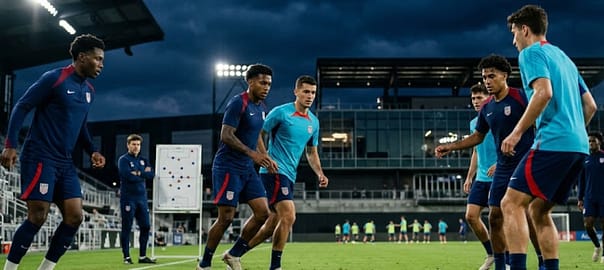
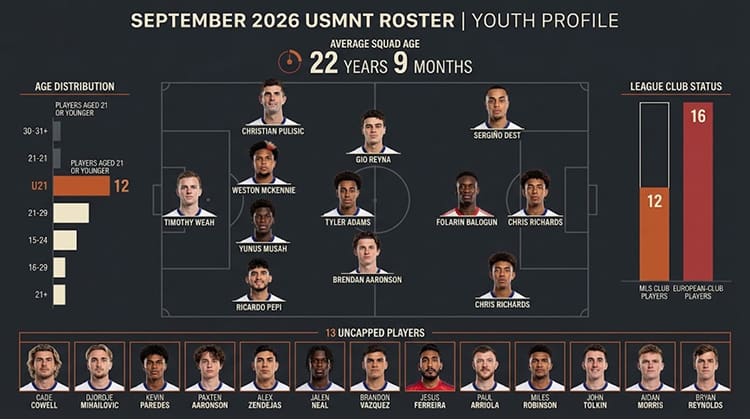
Mauricio Pochettino’s first USMNT roster of the 2030 World Cup cycle contains a clear message about the direction of American soccer. The 28-player group announced on September 17 includes 13 players without a senior international cap, with an average age of 22 years and nine months. The squad will begin the new cycle with matches against Peru, Chile, Mexico and Canada, giving Pochettino an early opportunity to evaluate a group that could influence the United States well beyond the next international window.
The timing matters. Pochettino signed a new contract through 2030 in August after leading the United States at the 2026 World Cup, and he has described the next stage as a “fresh start.” He has also said the project is 2030 and that the next camps should identify players capable of being part of the four-year process.
The 13 uncapped players are therefore more than a collection of first-time call-ups. They represent different development paths through MLS academies, MLS NEXT, European clubs and youth national teams. Some are teenagers. Others are already playing professionally overseas. The challenge for Pochettino is determining which players can move from promising prospects to reliable senior internationals before 2030.
The 13 Uncapped Players In Pochettino’s New Cycle
The current group of uncapped players includes four goalkeepers and defenders combined, four midfielders and three forwards, although several players have the versatility to operate in multiple positions. U.S. Soccer lists Mathis Albert, Cole Campbell, Justin Ellis, Zavier Gozo, Julian Hall, Diego Kochen, Adri Mehmeti, Peyton Miller, Neil Pierre, Brooklyn Raines, Brian Schwake, Cavan Sullivan and Frankie Westfield as the 13 players yet to earn a senior cap.
| Player | Position | Club | Age in September 2026 |
|---|---|---|---|
| Diego Kochen | Goalkeeper | Lyngby Boldklub | 19 |
| Brian Schwake | Goalkeeper | Nashville SC | 24 |
| Peyton Miller | Defender | New England Revolution | 18 |
| Neil Pierre | Defender | Philadelphia Union | 21 |
| Frankie Westfield | Defender | Philadelphia Union | 19 |
| Mathis Albert | Midfielder | Borussia Dortmund | 20 |
| Zavier Gozo | Midfielder | Crystal Palace | 19 |
| Adri Mehmeti | Midfielder | Red Bull New York | 18 |
| Brooklyn Raines | Midfielder | New England Revolution | 21 |
| Cavan Sullivan | Forward | Philadelphia Union | 16 |
| Cole Campbell | Forward | SV Elversberg | 20 |
| Justin Ellis | Forward | Orlando City SC | 20 |
| Julian Hall | Forward | Red Bull New York | 18 |
The roster was already notable because 12 prospects were receiving their first senior call-up. U.S. Soccer’s current roster notes count 13 uncapped players because goalkeeper Brian Schwake and the other first-time selections remain without senior appearances, while veteran experience comes from players such as Tyler Adams and Antonee Robinson, both on 58 caps.
That mix creates an important distinction: being called into camp is not the same as being projected into the 2030 starting lineup. Pochettino has four years to evaluate this group, and the competitive landscape will change considerably before the World Cup arrives.
Philadelphia Union Is At The Center Of The Youth Movement
No MLS club contributes more players to this particular USMNT roster than Philadelphia Union.
Philadelphia has three players in the squad: Cavan Sullivan, Neil Pierre and Frankie Westfield. All three came through the American development system, and their presence reflects the Union’s continued investment in academy players and early professional opportunities.
Sullivan is obviously the most recognizable name after his extraordinary 2026 MLS campaign. The 16-year-old has six goals and 11 assists in 23 MLS appearances, giving him 17 league goal contributions before his first senior international camp. His selection has made him one of the most closely watched teenagers in American soccer.
Pierre offers a different profile. The 21-year-old defender has already spent years developing within Philadelphia’s professional environment, giving Pochettino a chance to evaluate a player who combines youth with more physical maturity than Sullivan.
Westfield provides another variation. At 19, he is still early in his senior career but is already part of the same club pathway.
That makes Philadelphia especially relevant to the 2030 project. Rather than producing one exceptional prospect, the club is supplying several players at different stages of development.
For readers looking at that broader pathway, WikiApp’s MLS player development coverage provides additional context on how domestic clubs are becoming increasingly important to the USMNT talent pool.
Zavier Gozo Represents The MLS-To-Europe Pathway
Zavier Gozo’s development illustrates another increasingly common route.
Gozo began his professional development in the United States and is now with Crystal Palace in the Premier League environment. U.S. Soccer lists him among the 16 European-based players in the September roster and notes that Crystal Palace teammates Gozo and Chris Richards are competing in the UEFA Europa League.
That move gives Pochettino a different evaluation opportunity from Sullivan.
Gozo is already being exposed to an English professional environment where tactical speed, physical intensity and competition for places are significantly different from the MLS development structure.
The national-team question is therefore not simply whether Gozo has talent. It is whether the experience is accelerating his ability to perform against senior opponents.
The same principle applies to Mathis Albert at Borussia Dortmund. Albert is one of three players from Germany on the roster and has entered the Dortmund pathway while still young enough to develop considerably before 2030.
Cole Campbell, meanwhile, is playing for SV Elversberg in Germany. The three players provide Pochettino with different versions of the European-development model.
Julian Hall Gives New York Another Attacking Prospect
Julian Hall represents one of the most intriguing combinations of youth and professional experience in the group.
The 18-year-old Red Bull New York forward received his first USMNT call-up as part of the September roster. He also belongs to a club renowned for its pressing-oriented development model, making his integration potentially interesting from a tactical perspective.
Hall’s inclusion also connects the national team to the wider MLS academy system. U.S. Soccer says 21 players on the roster participated in the U.S. Soccer Development Academy or MLS NEXT, while 18 came through MLS academy ranks.
That statistic is significant because it suggests the USMNT is no longer relying exclusively on overseas-developed players to build depth.
Hall’s challenge will be translating his club qualities into international football. Pochettino will need to determine whether his pressing, movement and attacking instincts can function against opponents who have limited preparation time but substantial tactical experience.
New England Has Two Midfield Prospects
New England Revolution also contributes two of the uncapped players: Peyton Miller and Brooklyn Raines.
Miller is an 18-year-old defender, while Raines is a 21-year-old midfielder. Their inclusion gives Pochettino access to two players at very different stages of physical and tactical development.
Raines is particularly interesting because the midfield remains one of the positions where the United States has spent years trying to develop greater depth behind its established players.
Tyler Adams has 58 caps, while Yunus Musah has 47 and Malik Tillman has 35. Those numbers provide experience, but Pochettino’s long-term task is creating enough competition that the midfield does not depend on a small group of established players.
Raines therefore has an opportunity to establish himself in a position where international depth could become increasingly important during the next four years.
Miller’s development is equally relevant on the defensive side. At 18, he has time to grow physically and tactically while learning from experienced international defenders such as Antonee Robinson, Sergiño Dest and Chris Richards.
The Goalkeeper Competition Is Starting Early
The uncapped group also includes Diego Kochen and Brian Schwake, giving Pochettino two additional goalkeepers to evaluate.
Kochen, who plays for Lyngby Boldklub in Denmark, is 19 and represents another European-based development pathway. Schwake, meanwhile, is with Nashville SC in MLS.
The goalkeeper position has traditionally required patience. A young goalkeeper can need several seasons of professional matches before becoming ready for consistent international responsibility.
That makes this part of the 2030 evaluation process particularly different from the forward group.
Pochettino does not necessarily need an immediate answer. Instead, the coaching staff can monitor how Kochen and Schwake progress alongside established options such as Matt Freese and Chris Brady.
The important point is that the national-team evaluation process is beginning early enough to identify potential successors before the 2030 tournament approaches.
Adri Mehmeti And Brooklyn Raines Add Midfield Competition
Adri Mehmeti and Brooklyn Raines represent another important part of the new cycle: increasing competition in central areas.
Mehmeti, 18, plays for Red Bull New York, while Raines, 21, plays for New England Revolution. Both arrived through MLS development structures, and both are being introduced into a national-team environment containing experienced midfielders.
Pochettino’s challenge is tactical as much as technical.
The United States needs midfielders capable of receiving the ball under pressure, progressing possession and contributing to the defensive transition. Those responsibilities become particularly important against teams that can press aggressively.
The next four matches against Peru, Chile, Mexico and Canada will give the coaching staff different environments in which to evaluate those qualities. The first match is scheduled for September 26 at Inter&Co Stadium in Orlando, followed by Chile in St. Louis, Mexico in Glendale and Canada in St. Paul on October 6.
Justin Ellis Gives Orlando A New National-Team Prospect
Justin Ellis provides another example of the domestic pathway.
The 20-year-old Orlando City forward is part of a roster that includes 12 MLS players. Philadelphia leads the league’s club representation with three players, while New England and Red Bull New York have two each. Chicago Fire, FC Cincinnati, Orlando City, Nashville SC and New York City FC each contribute one player.

Ellis’ call-up is particularly interesting because the United States will open this international window in Orlando.
That creates a natural connection between club and country, even though Ellis’ first senior camp is ultimately about evaluation rather than local familiarity.
His attacking development will be monitored alongside Julian Hall, Cole Campbell and Sullivan, giving Pochettino several young forwards with different club backgrounds.
Cole Campbell And Mathis Albert Show The Value Of Germany
Germany provides another significant part of the youth pathway.
Mathis Albert is with Borussia Dortmund, while Cole Campbell plays for SV Elversberg. Both are uncapped, both are in their late teens or early twenties, and both have developed within the German football system.
Their inclusion also reflects a broader change in the USMNT player pool.
U.S. Soccer says 16 players on the September roster come from European clubs, including six from England, three from Germany, two from the Netherlands and one each from Denmark, France, Italy, Scotland and Spain. Nine of those players are competing in European competition this season.
For Pochettino, this creates a wider scouting network.
Instead of evaluating prospects only through domestic competitions, the coaching staff can compare players developing under different football cultures and tactical systems.
The 2028 Olympics Could Accelerate The Process
The 2030 World Cup is the ultimate target, but Pochettino does not have to wait four years to evaluate progress.
The 2028 Olympic Games are another important milestone in the development timeline. U.S. Soccer’s new contract announcement specifically identified the Olympics as part of the federation’s youth-development strategy.
For players such as Miller, Raines, Hall, Gozo, Albert, Sullivan and Ellis, the next two years could be decisive.
The Olympic pathway could give the United States another competitive environment in which to test younger players before they become regular senior-team candidates.
That creates a useful progression:
- 2026: Initial senior-team evaluation.
- 2027: Concacaf Gold Cup and continued player-pool expansion.
- 2028: Olympic cycle and deeper assessment of emerging players.
- 2029: Establishment of the core group for 2030.
- 2030: World Cup in Morocco, Portugal and Spain, with matches also taking place in Argentina, Paraguay and Uruguay.
Pochettino therefore has several checkpoints before he needs to finalize his World Cup squad.
Damion Downs Changes The Current Picture
The roster has already changed since the September 17 announcement.
On September 20, U.S. Soccer confirmed that Ricardo Pepi withdrew because of injury and Pochettino added Damion Downs. The 22-year-old St. Louis City forward has six previous USMNT appearances and scored the winning penalty against Costa Rica in the 2025 Concacaf Gold Cup quarterfinal shootout.
Downs also brings European experience.
He helped FC Köln earn promotion to the Bundesliga in 2024-25, scoring 10 goals and adding five assists in the Second Bundesliga. He is currently with St. Louis City on loan from Southampton.
His addition demonstrates why the 2030 player pool cannot be viewed as a fixed list.
Even while Pochettino introduces teenagers, established players and emerging professionals can enter the competition. The coach has four years to compare all of them.
What Pochettino Is Actually Looking For
The most important feature of this generation is that the players are not identical.
Sullivan offers extraordinary youth and creative production. Hall provides attacking potential from the Red Bull development system. Gozo and Albert represent European development. Raines and Mehmeti add midfield competition. Miller, Pierre and Westfield provide young defensive options. Kochen and Schwake expand the goalkeeper pool.
That variety is valuable.
Pochettino’s job is to identify which combinations work rather than simply choosing the youngest players available.
The coach has already said that the new cycle is about creating a group that understands the team’s culture, working methods and principles of play.
That means the next stage will be measured through development, tactical adaptability and consistency.
A teenager who looks exceptional in MLS still has to adapt to international football. A European-based prospect still needs consistent club minutes. A technically gifted midfielder needs to prove he can perform under pressure. A defender needs to demonstrate reliability against stronger opponents.
The first call-up is only the beginning of that process.
Four Years Could Completely Change The USMNT
The most important number in Pochettino’s new project is not 13.
It is four.
Four years separate this September 2026 roster from the 2030 World Cup.
Sullivan will be 20. Hall will be 22. Gozo will be 23. Raines will be 25. Miller will be 22. Albert will be 24. Ellis will be 24.
Those ages would put many of today’s prospects in or approaching their prime international years.
At the same time, Pochettino can continue adding players who are currently outside the senior team. The September roster already demonstrates how quickly the pool can change: U.S. Soccer says 62 players have earned a cap since Pochettino took over in October 2024, representing 16 leagues in 12 countries.
The 13 uncapped players therefore should not be viewed as a final list.
They are the first visible group in a much larger evaluation process.
Pochettino now has the time to compare generations, test tactical combinations and give young players meaningful exposure before the pressure of a World Cup returns.
The next USMNT generation is already arriving.
The challenge for Pochettino is determining which players can turn that first opportunity into a four-year trajectory that ends in 2030.