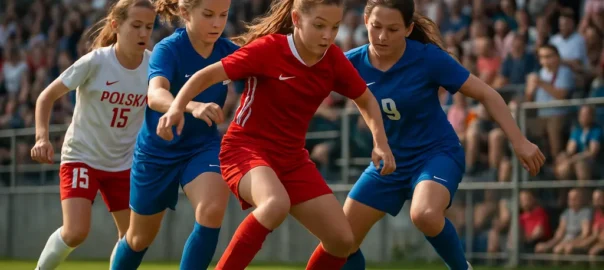
The U-20 Women’s World Cup opened in Poland on September 5, 2026, with a 24-team field, four host cities, and a tournament structure built around six groups followed by a 16-team knockout bracket. The competition runs through September 27, 2026, and is the 12th edition of FIFA’s biennial global youth women’s tournament, according to FIFA tournament details.
Poland’s hosting plan uses Katowice, Łódź, Bielsko-Biała, and Sosnowiec as the four host cities. Each city has one listed tournament venue, creating a compact venue map compared with senior global events that often spread matches across much larger territory. The format is equally clear: 24 teams from all six confederations compete in six groups of four, with the top two teams in each group and the four best third-place teams advancing to the Round of 16.
The tournament has significance beyond the fixtures themselves. Poland is staging its first major global women’s tournament, while the field includes established youth powers and several debutants at this level. Korea DPR entered as the defending champion after winning the 2024 edition. Benin, Ecuador, New Caledonia, Portugal, and Tanzania were listed among nations making their first appearance in this competition.
U-20 Women’s World Cup Venues In Poland
Host Cities And Stadium Capacities
The four-venue plan assigns the tournament to one stadium in each host city. Arena Katowice in Katowice has an approximate capacity of 15,500. Stadion Miejski LKS in Łódź has an approximate capacity of 18,029. Stadion Miejski Bielsko-Biała in Bielsko-Biała has an approximate capacity of 14,963. Zagłębie Sports Park in Sosnowiec has an approximate capacity of 11,600, as listed in U.S. Soccer’s tournament guide.
| Host City | Venue | Approximate Capacity |
|---|---|---|
| Katowice | Arena Katowice | 15,500 |
| Łódź | Stadion Miejski LKS | 18,029 |
| Bielsko-Biała | Stadion Miejski Bielsko-Biała | 14,963 |
| Sosnowiec | Zagłębie Sports Park | 11,600 |
For a youth tournament, these stadium sizes fit the competition’s profile: large enough for international match operations, but not so large that the setting is detached from the scale of the event. Łódź also carries special tournament importance because the draw was held there on May 15, 2026, and the final is scheduled for the city on September 27, 2026.
How U-20 Women’s World Cup Venues Shape Match Rhythm
The venue spread matters because the tournament contains 52 fixtures across 23 calendar days. With four stadiums in use, match allocation and recovery windows become central to the competitive structure. The group stage runs from September 5 to September 13, 2026, which means teams face a condensed opening phase before the Round of 16 begins on September 16.
That schedule rewards squads that can manage rotation without losing structure. At under-20 level, teams often include players at different stages of professional, academy, or college development. The venue plan does not change the laws of competition, but it frames the physical rhythm of the event. Short recovery cycles can influence pressing intensity, full-back workloads, and the timing of substitutions.
For additional coverage around youth football events, interested readers might find Back2Tap to be a valuable resource within the same network.
Format, Groups, And Qualification Path
Six Groups Of Four Teams
The group-stage format is direct. Twenty-four teams are divided into six groups of four. Each group produces two automatic qualifiers for the knockout stage, giving 12 places to group winners and runners-up. The remaining four Round of 16 places are reserved for the best third-place finishers across the six groups.
This structure changes the incentives compared with a smaller tournament in which only first and second place advance. A third-place path keeps more teams alive deep into the group stage, but it also places value on goal difference, discipline, and match management. A team that cannot win a group match may still need to protect a draw or limit defeat margins, because the cross-group comparison can decide qualification.
The confederation allocation also reflects the global scope of the event. AFC, CAF, CONCACAF, and CONMEBOL each received four places. UEFA received six places, including host nation Poland. OFC received two places. The qualified field listed by FIFA includes Argentina, Benin, Brazil, Canada, China PR, Colombia, Costa Rica, Ecuador, England, France, Ghana, Japan, Korea DPR, Korea Republic, Italy, Mexico, New Caledonia, New Zealand, Nigeria, Poland, Portugal, Spain, Tanzania, and the USA.
Knockout Stage Timing And Advancement
The U-20 Women’s World Cup knockout phase starts with the Round of 16 on September 16 and 17, 2026. Quarterfinals follow on September 19 and 20. The semifinals are scheduled for September 23. The third-place match is scheduled for September 26, and the final is scheduled for September 27 in Łódź.
The schedule creates a clear tournament climb. Teams that reach the final will have progressed through three group matches and four knockout matches. That is seven matches in just over three weeks. The structure tests squad depth, match preparation, and the ability to adapt between opponents without long training blocks.
For the United States, roster composition and positional balance are tied closely to this format. A connected squad-focused preview is available in the site’s U-20 Women’s roster analysis, which fits the broader question of how teams prepare for compressed youth tournaments.
Tactical And Competition Effects

Why The Best Third-Place Rule Matters
The best third-place rule often affects group-stage strategy. In a six-group format, the table is not only local to one group. Teams must consider how their record compares with third-place teams elsewhere. That can make late group-stage scenarios more cautious or more aggressive depending on points, goal difference, and remaining fixtures.
Coaches may treat the final group match differently depending on the standings. A team already on four or six points can manage minutes and protect key players. A team on one or two points may need a win, but it may also need to avoid conceding heavily if other third-place teams are in range. At youth level, where tactical consistency can vary between matches, this format places extra value on game-state control.
The U-20 Women’s World Cup also serves as a development stage for players who may later enter senior national-team programs. That does not mean youth results predict senior success on their own, but the tournament does expose players to international tempo, travel demands, and knockout football. Those conditions are useful markers for federations evaluating player readiness.
Roster Rotation And Match Control
The 52-match tournament structure makes squad use a central part of competition management. Teams cannot treat every match as an isolated event. The short gap between the end of the group stage on September 13 and the start of the Round of 16 on September 16 places pressure on recovery planning. Players carrying heavy minutes in the group stage may face reduced sharpness if their teams advance.
That rhythm can influence tactical choices. Some teams may press high early in matches, then shift into a mid-block to conserve energy. Others may rely on possession phases to slow the match and reduce transition exposure. Set pieces can also gain importance because they offer scoring chances without requiring long open-play sequences.
What The 2026 U-20 Women’s World Cup Structure Means
The 2026 edition places the U-20 Women’s World Cup in a clear competitive frame: four Polish venues, 24 teams, six groups, 52 matches, and a knockout bracket that begins with 16 teams. The format gives wide representation across all six confederations while still creating a demanding path for any champion.
Poland’s venue list gives the tournament a focused host footprint, while the schedule creates a steady rise from group-stage calculation to knockout pressure. The draw in Łódź on May 15, 2026, set the competitive path, and the final in the same city on September 27 will close the event. For a youth women’s tournament, the structure balances development exposure with a demanding world-title format.
The core record for the event is therefore straightforward: Poland 2026 is the 12th edition, staged from September 5 to September 27, with 24 qualified teams and four host cities. Its format rewards consistency first, then knockout resilience. That combination is what makes the competition useful not only as a title event, but also as a reference point for the next wave of women’s international footballers.