
Mathis Albert needed less than 20 minutes on the field to make U.S. soccer history. The 17-year-old Borussia Dortmund forward scored in stoppage time of the United States’ 4-2 victory over Chile at Energizer Park in St. Louis on September 29, becoming the youngest goalscorer in USMNT history at 17 years and 131 days.
Albert’s goal came in the second match of Mauricio Pochettino’s new World Cup cycle, and its timing makes the record more significant than a standalone statistical milestone. The USMNT had just begun its four-year path toward the 2030 FIFA World Cup, and Pochettino had deliberately assembled one of the youngest squads of his tenure.
The September window has already produced several historic moments. Cavan Sullivan became the fourth-youngest American to earn a senior cap against Peru on September 26. Julian Hall scored in each of his first two USMNT appearances. Justin Ellis scored on his senior debut in Orlando. Now Albert has added another record to the emerging generation.
Albert’s path is different from Sullivan’s and Hall’s because his development has taken him from the United States into one of Europe’s most established football environments. His progression through LA Galaxy’s academy, Borussia Dortmund’s youth system, the Bundesliga and the U.S. youth national teams gives Pochettino another model to evaluate as he builds the player pool for 2030.
Albert Broke A Record Held By Christian Pulisic
The historical significance of Albert’s goal comes from the age at which he scored it.
At 17 years and 131 days, Albert moved past Christian Pulisic as the youngest player ever to score for the USMNT. Pulisic had established the previous record at 17 years and 253 days in 2016. Albert therefore broke a mark that had stood for more than a decade.
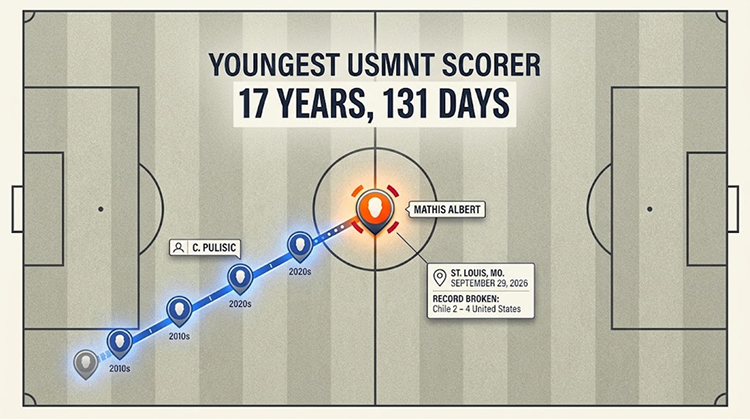
The goal arrived in the 90th minute against Chile, with the United States already leading 3-2. Antonee Robinson delivered a free kick from roughly 35 yards, Auston Trusty headed the ball down and across the goal, and Albert attacked the loose delivery with his right foot. His shot struck the crossbar before bouncing down over the goal line.
It was Albert’s second senior appearance. He had made his USMNT debut three days earlier against Peru, entering in the 61st minute and immediately influencing the match by drawing the penalty that allowed Malik Tillman to give the United States a 2-1 lead.
That sequence matters. Albert did not wait several months or multiple international windows for his first decisive contribution. He made an impact in his debut, then scored in his second appearance.
The record also places his emergence alongside the previous generation of American attacking players. Pulisic became a central figure for the USMNT after his teenage breakthrough, while Albert is now beginning his senior career at an even younger scoring age.
The comparison should remain historical rather than predictive. Albert has only two senior caps, and his record tells us about his starting point rather than what his eventual international career will become.
The Chile Goal Came After A Different Kind Of Debut
Albert was not part of the starting XI against Chile.
Pochettino made 10 changes from the lineup that defeated Peru 4-1, with Gio Reyna the only player retained from the previous starting team. The coach selected another extremely young lineup, featuring first-time starters such as Julian Hall, Adri Mehmeti, Neil Pierre, Brooklyn Raines and Frankie Westfield.
Albert began the match on the bench alongside Cavan Sullivan, Peyton Miller, Zavier Gozo and other young players.
The match developed into a more difficult test than the Peru victory. Sebastian Berhalter gave the United States the lead in the 37th minute, but Chile equalized shortly before halftime through Diego Ulloa. Maximiliano Gutiérrez then put Chile ahead in the 49th minute.
Hall equalized three minutes later with his second goal in as many international appearances. Chris Richards eventually restored the U.S. lead in the 72nd minute, setting the stage for Albert’s late appearance.
Albert entered in the 71st minute, replacing Hall.
That substitution placed him directly into an attacking role during the closing phase of a competitive international match. Rather than receiving his first minutes in a comfortable situation, Albert entered with the United States still searching for control and protection of a one-goal advantage.
His late goal removed the remaining uncertainty.
The U.S. finished with 18 shots to Chile’s 17 and nine shots on target compared with eight for the visitors. Chile also earned 13 corners to the United States’ five, illustrating that the match was much more open than the final score might suggest.
Albert’s contribution therefore came within a genuine competitive sequence rather than a ceremonial appearance.
Dortmund Has Accelerated Albert’s Development
Albert’s club pathway is one of the most important elements of his story.
Born in Greenville, South Carolina, on May 21, 2009, Albert began his soccer development with Carolina Elite Soccer Academy before joining LA Galaxy’s academy. He moved to Borussia Dortmund in July 2024, where he progressed through the German club’s U-17 and U-19 teams.
The move placed him inside one of Europe’s most recognized development environments at only 15 years old.
Dortmund’s academy has historically provided young players with opportunities to train and compete at increasingly demanding levels, and Albert’s progression through the club has been unusually quick. He was included in Dortmund’s squad for the 2025 FIFA Club World Cup in the United States at age 16, making him the youngest participant in the entire tournament, although he did not play.
His senior breakthrough arrived in April 2026.
Albert made his Bundesliga debut against SC Freiburg, appearing in Dortmund’s 4-0 victory. At that point he became the youngest American to appear in Bundesliga history.

For the USMNT, that experience is valuable because Albert is already being exposed to a different football environment from the one that produced many of the younger players in the September camp.
His pathway can be summarized as follows:
| Development Stage | Club or Team | Significance |
|---|---|---|
| Early youth | Carolina Elite Soccer Academy | Began organized development |
| Academy | LA Galaxy | Entered a professional club academy |
| 2024 | Borussia Dortmund | Joined Dortmund at 15 |
| 2025 | U.S. U-17 / Dortmund | Played at U-17 World Cup and trained within Dortmund system |
| April 2026 | Borussia Dortmund first team | Became youngest American to appear in Bundesliga |
| September 2026 | USMNT | Debuted and became youngest U.S. scorer |
Source: Borussia Dortmund and U.S. Soccer.
For more context on the broader USMNT development pathway, WikiApp’s coverage can be used as an internal reference. USMNT development pathway
His Youth International Record Was Already Pointing Upward
Albert’s senior breakthrough did not come without a youth-national-team background.
He represented the United States at U-15, U-17 and U-19 levels. His most significant youth tournament came at the 2025 FIFA U-17 World Cup in Qatar, where he played in all four of the United States’ matches.
During the tournament, Albert scored the decisive goal in the United States’ 1-0 victory over Czechia. His 78th-minute finish gave the Americans a perfect 3-0 group-stage record and helped the team win its group for only the fourth time in U-17 World Cup history.
He also scored during the penalty shootout defeat to Morocco in the Round of 32.
U.S. Soccer subsequently identified Albert as one of its Young Male Player of the Year nominees for 2025. The federation’s profile noted his six appearances for the U-17 national team during the year, including all four matches at the World Cup.
That history makes his September promotion easier to understand.
Pochettino was not introducing an untested player from outside the national-team structure. Albert had already accumulated experience in U.S. youth teams, competed at a FIFA tournament and progressed into European first-team football.
His senior debut was therefore the next step in an established pathway.
Pochettino Has Four Years To Build This Generation
Albert’s record-setting goal arrived at exactly the point when the USMNT has the most time to evaluate young players.
Pochettino signed a new contract with U.S. Soccer in August 2026 that keeps him in charge through the 2030 World Cup. Unlike his first period with the national team, which centered heavily on preparation for the 2026 tournament, he now has an entire four-year cycle to evaluate players and build a new squad.
The September roster reflected that approach.
The 28-player squad had an average age of 22 years and nine months, more than four years younger than the roster that represented the United States at the 2026 World Cup. It also contained 13 players who had yet to earn a senior cap when camp opened.
Pochettino’s contract also gives his staff a wider role within U.S. Soccer’s development structure, including work connected to youth national teams and future Olympic cycles.
That makes Albert’s emergence particularly relevant.
The objective is not to identify the final 2030 squad in September 2026. It is to create a sufficiently broad player pool so that young prospects can receive opportunities, experience international football and demonstrate whether they can handle higher levels of competition.
Albert is now part of that evaluation.
The 2030 Cycle Has Already Produced Multiple Teenage Milestones
The most striking feature of the September window is that Albert’s record exists alongside several other teenage breakthroughs.
Against Peru on September 26, 11 U.S. players earned their first senior caps, including eight teenagers. Sullivan started at 16 years and 363 days, while Ellis scored on debut in Orlando and Hall also scored in his first appearance.
Three days later, the pattern continued.
Hall became the youngest player in USMNT history to score in each of his first two appearances. Albert then became the youngest American to score at all.
The significance is less about collecting age records and more about the number of young players receiving senior exposure simultaneously.
U.S. Soccer’s September roster contained players from MLS, European clubs and domestic development systems. The federation had already noted before the window that 13 uncapped players were entering camp, with the youngest only 16.
That environment gives Pochettino more options than simply replacing one veteran with one young player.
The coaching staff can compare different profiles: Sullivan as a creative attacker developing at Philadelphia Union, Hall as a Red Bull New York product, Albert as a Dortmund-based forward, and players such as Peyton Miller and Neil Pierre developing in MLS defensive environments.
The diversity of those pathways may become one of the defining characteristics of the 2030 cycle.
Albert’s Next Challenge Is Turning A Record Into Regular Minutes
A historic goal is a milestone, but it does not automatically establish a long-term international role.
Albert’s immediate challenge is to continue accumulating first-team experience at Borussia Dortmund while competing for future USMNT opportunities. His Bundesliga résumé remains extremely small: Dortmund’s official profile lists one Bundesliga appearance through the end of the 2025-26 season.
That makes the distinction between potential and established production particularly important.
His USMNT goal demonstrates that Albert can make an attacking contribution at senior international level. His youth record demonstrates that he has already succeeded in international competition. His Dortmund progression demonstrates that he has entered a demanding European club structure.
The next stage is consistency.
Regular senior club minutes would give Pochettino more evidence to evaluate Albert’s decision-making, physical development, defensive work and ability to perform against experienced opponents. Those elements will matter as much as the record itself.
The broader September window shows why this process has room to develop. Pochettino’s four-year contract means players who are teenagers in 2026 can be evaluated through multiple international windows before the 2030 tournament.
Albert will be only 21 years old during the 2030 World Cup cycle’s endpoint.
What Albert’s Goal Says About The New USMNT Generation
Albert’s goal against Chile was the final U.S. score of a 4-2 comeback, but its larger significance comes from the identity of the player who scored it.
A teenager from South Carolina who developed through LA Galaxy, moved to Borussia Dortmund at 15, scored at the U-17 World Cup, became the youngest American Bundesliga player and then entered the USMNT has now added another record to that progression.
The sequence also shows the variety of development routes now available to American players.
Sullivan is developing through Philadelphia’s MLS structure. Hall has emerged from the Red Bull New York pathway. Albert is developing inside a major German club. Their routes are different, but all three have reached the senior national team during the same opening window of the 2030 cycle.
That is the bigger story behind Albert’s record.
Pochettino has repeatedly emphasized that the project is now 2030, and the September matches were designed to begin identifying players who can be part of that four-year process.
Albert’s Chile goal gives that process an unusually visible starting point. He has already broken a record previously held by Pulisic, but the more meaningful measure will be whether he can turn a historic night in St. Louis into sustained first-team development in Dortmund and repeated opportunities with the USMNT.
For now, the record belongs to him.
At 17 years and 131 days, Mathis Albert became the youngest scorer in USMNT history on September 29, 2026. More importantly for the next four years, he did it at the beginning of a cycle in which Pochettino has explicitly committed to identifying and developing the players who can carry the United States into 2030.