The New England Revolution signed Dániel Gazdag on September 1, 2026, bringing one of Major League Soccer’s most productive attacking midfielders back into a league where he previously established himself as an elite scorer. The 30-year-old Hungary international joined New England as a free agent after mutually terminating his contract with Columbus Crew, signing through December 2027 with club options through the 2028-29 season. For the Revolution, the move is less about nostalgia than probability: Gazdag has already demonstrated that he can produce in MLS, and New England is betting that his previous league success can translate into another productive chapter.
The move is particularly interesting because Gazdag’s MLS career has already gone through several distinct phases. Philadelphia Union turned him into one of the league’s most dangerous attacking midfielders. Columbus acquired him as a Designated Player in April 2025, but his production declined during his time with the Crew. Now New England is attempting to capture the version of Gazdag that made him a franchise-record scorer in Philadelphia.
That makes this more than a routine free-agent signing.
It is a test of whether proven MLS production can be portable from one tactical environment to another.
Philadelphia Made Gazdag A Proven MLS Commodity
Gazdag arrived in MLS in 2021 after beginning his professional career with Kispest Honvéd in Hungary. His first five seasons in North America transformed his reputation.
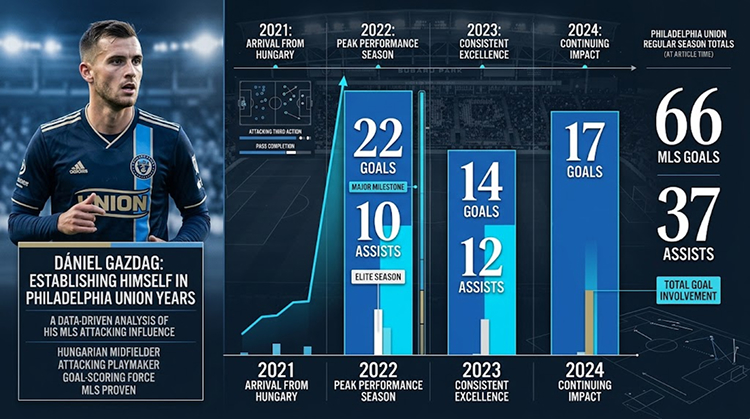
With Philadelphia Union, he scored 59 regular-season goals and 72 goals across all competitions, both franchise records. He also added 31 regular-season assists during his Union career, establishing himself as a player who could contribute both as a scorer and creator.
His 2022 season remains the clearest demonstration of his ceiling.
Gazdag scored 22 goals and 10 assists, earning MLS Best XI recognition while helping Philadelphia win the Eastern Conference championship. He followed that campaign with 14 goals and 12 assists in 2023 and 17 goals in 2024. That three-year sequence established a remarkably consistent attacking floor.
| Dániel Gazdag’s MLS Career | Production |
|---|---|
| MLS regular-season appearances | 168 |
| MLS regular-season goals | 66 |
| MLS regular-season assists | 37 |
| Philadelphia goals, all competitions | 72 |
| 2022 goals | 22 |
| 2022 assists | 10 |
| MLS playoff goals | 4 |
| MLS penalty goals | 27 |
The numbers explain why New England is willing to take another chance on him.
This is not a player whose best season exists only in scouting reports.
MLS has already seen the evidence.
The official MLS roster and player rules also help explain why a veteran with Gazdag’s experience can be particularly attractive when acquired without a transfer fee.
Columbus Exposed The Risk In Buying Proven Production
The Columbus chapter is what makes the New England move analytically interesting.
Gazdag joined the Crew on April 11, 2025, in a deal reported at $4 million from Philadelphia. He arrived as a Designated Player after years of elite production with the Union.
But his output dropped significantly.
Across 43 regular-season matches with Columbus over two seasons, Gazdag scored seven goals and five assists. The Crew announced on August 28, 2026, that the club had mutually agreed to terminate his contract through a buyout, removing him from its Designated Player slot.
The decline was not simply statistical.
Gazdag played under three different Columbus coaches during his tenure: Wilfried Nancy, Henrik Rydström and Laurent Courtois. The tactical changes affected his role, while competition for attacking positions also limited his consistency.
That history creates the central question for New England:
Was Columbus an indication that Gazdag’s best MLS years are behind him, or was the environment simply wrong for his particular skill set?
New England believes the second explanation has enough credibility to justify the move.
New England Is Buying A Known Attacking Profile
New England general manager and chief soccer officer Chris Tierney described Gazdag as one of MLS’s premier goal-scoring midfielders and emphasized his versatility and quality on the ball.
That description fits the player New England is acquiring.
Gazdag is not primarily valuable because he dominates possession from deep midfield. His strongest influence comes closer to the penalty area, where he can combine with forwards, attack space, arrive late and take penalties.
That distinction matters because New England already has a creative centerpiece in Carles Gil.
The possibility of pairing Gil’s passing and chance creation with Gazdag’s movement and finishing gives the Revolution a potentially complementary attacking structure rather than simply adding another playmaker.
The Revolution’s recent form also makes the timing significant. New England entered September with an 11-7-4 record and 37 points, giving the club a competitive position in the Eastern Conference.
This is therefore not a rebuilding acquisition.
It is an attempt to improve a team that already believes it can compete.
The Carles Gil Partnership Could Define The Move
Gazdag’s arrival becomes particularly compelling when viewed alongside Carles Gil.
Gil has spent years operating as one of MLS’s most influential creators, while Gazdag has historically been at his best when operating in advanced areas and attacking the final third.
The tactical possibilities are significant.
Gil can drop deeper to initiate attacks and draw midfield pressure. Gazdag can operate between midfield and the forward line, moving into spaces created when opponents track Gil. The two can also exchange positions during possession sequences, forcing defensive midfielders to make difficult decisions.
This is different from asking Gazdag to reproduce his Philadelphia role exactly.
New England can instead use the experience accumulated during his MLS career to create a more flexible attacking structure.
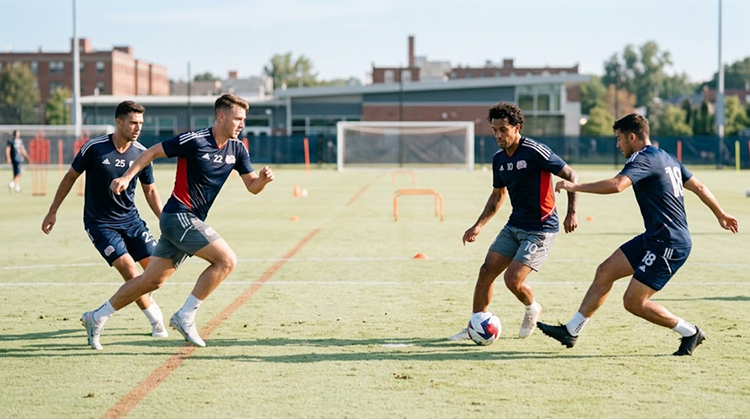
That could be particularly valuable late in matches, when opponents are forced to defend deeper and Gazdag’s ability to find pockets around the box becomes more influential.
Gazdag’s Penalty Record Adds Another Layer
One of the less discussed aspects of Gazdag’s MLS production is his efficiency from the penalty spot.
He has scored 27 MLS penalty kicks, tied for third-most in league history.
That is not merely a statistical footnote.
Penalty-taking is an important component of roster value because it can transform a midfielder’s goal total without requiring the player to generate every chance from open play.
Gazdag’s ability to convert penalties also means New England has another reliable option in matches decided by small margins.
However, the club cannot build its entire attacking strategy around penalties.
His real value will be determined by open-play production.
If Gazdag can return to anything close to his Philadelphia scoring rate, New England will have acquired a high-impact attacking midfielder without paying another transfer fee.
If his Columbus decline continues, the move will look very different.
The Free-Agent Structure Changes The Risk
The economic structure is one of the strongest reasons New England’s decision makes sense.
Gazdag was previously a Designated Player with Columbus.
New England signed him as a free agent through 2027 with club options extending into 2029, and because he holds a U.S. Green Card, he will not occupy an international roster slot for the Revolution.
That combination gives New England considerable roster flexibility.
The club does not have to spend a transfer fee to acquire him.
It also does not have to use an international roster position.
And the contract gives the Revolution a relatively short initial commitment compared with the four- or five-year deals often attached to major international signings.
This is a calculated bet rather than an all-in gamble.
New England is effectively paying for the possibility of recovering Gazdag’s Philadelphia form while limiting some of the acquisition risks associated with an international transfer.
His Age Is A Feature, Not Necessarily A Problem
Gazdag turned 30 in March 2026.
For a league increasingly focused on younger players, that might initially appear contradictory.
MLS clubs are investing heavily in Homegrown players, U22 Initiative talent and prospects who can eventually move to Europe. But that does not mean every roster problem can be solved with youth.
A competitive team needs experienced players who understand the league.
Gazdag has now played in MLS for six seasons.
He understands the travel schedule, playoff structure, physical demands, refereeing environment and tactical variety of the competition.
That knowledge has value.
A 20-year-old prospect may have greater long-term upside, but a 30-year-old player with 168 MLS regular-season appearances can potentially contribute immediately.
For New England, the question is therefore not whether Gazdag represents the future.
It is whether he can improve the present.
The New England Move Also Highlights MLS’s Internal Market
Gazdag’s career demonstrates how the league’s player market has matured.
His MLS journey now includes three different clubs:
Philadelphia Union → Columbus Crew → New England Revolution
Each move tells a different story.
Philadelphia acquired an emerging international player and turned him into a star.
Columbus paid a significant fee for established production but struggled to integrate him consistently.
New England is now acquiring the same player after his market value has changed and his Columbus contract has been bought out.
That is increasingly characteristic of a mature domestic sports market.
Players can lose value in one environment without becoming unusable across the league.
Another club can identify a tactical fit and acquire that player at a different stage of his career.
Gazdag is essentially being re-evaluated by the MLS market.
New England Is Betting On Context
The Revolution’s most important decision is not whether Gazdag was good in Philadelphia.
He clearly was.
The question is whether the club can recreate the conditions that allowed him to thrive.
At Philadelphia, Gazdag developed within a stable environment under Jim Curtin, became a consistent penalty taker and played alongside attacking players who understood his movement.
At Columbus, he encountered a more unstable tactical situation.
New England therefore needs to give him clarity.
His position should be defined.
His relationship with Gil should be developed.
His penalty responsibilities should be established.
And the team must find ways to get him into the final third frequently enough to justify the investment.
If those conditions are met, the Columbus statistics may prove misleading.
If they are not, Philadelphia’s numbers will remain historical rather than predictive.
A Proven MLS Player Can Still Have Something To Prove
Gazdag’s return also says something broader about the league.
MLS has increasingly become a place where players can establish, lose and rebuild their reputations without leaving the competition.
That creates a different career dynamic.
A player does not have to be permanently defined by one club.
Gazdag’s Philadelphia period established his credentials.
Columbus damaged them.
New England now has an opportunity to restore them.
That possibility makes the league more attractive for experienced players who understand that a tactical fit can dramatically alter their careers.
It also creates opportunities for clubs willing to identify undervalued talent.
The Revolution’s Transfer Strategy Is Becoming More Specific
New England’s decision fits a broader approach under Chris Tierney’s front office.
The club has been adding pieces with complementary profiles rather than simply chasing the biggest available names. Gazdag joins a roster that already contains experienced attacking talent and emerging players, giving New England several different age and skill profiles.
That balance could be more valuable than a single superstar signing.
The Revolution do not need Gazdag to become a completely different player.
They need him to become the best version of the player MLS has already seen.
That is a much more measurable objective.
The New England Revolution’s current roster now contains another player capable of contributing goals from midfield, which could change how opponents defend the club during the final stretch of the season.
Gazdag’s MLS Return Could Become A Model For Veteran Reinvestment
There is an interesting contrast between Gazdag’s return and the league’s recent emphasis on exporting young talent.
Players such as Zavier Gozo represent MLS as a development platform for Europe.
Gazdag represents MLS as a league where established players can find a second opportunity.
Those models are not contradictory.
They actually strengthen each other.
Young players need experienced teammates.
Experienced players need competitive environments.
Clubs need both immediate production and long-term assets.
MLS can accommodate all three.
The league’s challenge is ensuring that its roster rules allow clubs to make those decisions efficiently.
New England’s acquisition demonstrates what becomes possible when a veteran player with a strong MLS history becomes available without a transfer fee and without consuming an international roster slot.
The Real Test Begins In New England
Dániel Gazdag’s return to MLS is not guaranteed to recreate his Philadelphia years.
That would be too simplistic.
He is 30 rather than 25.
His Columbus spell produced seven goals and five assists in 43 regular-season matches.
But the circumstances surrounding that decline matter.
Three coaches, changing tactical roles and inconsistent starting opportunities created a very different environment from Philadelphia.
New England is betting that those circumstances explain at least part of the decline.
The Revolution also have a practical reason to make the gamble.
They are competing now.
They already have a strong position in the Eastern Conference, and they can add a player who knows MLS rather than waiting for an adaptation period with an overseas signing.
The potential reward is substantial.
If Gazdag rediscovers his Philadelphia form, New England could have acquired one of the league’s most productive attacking midfielders at a moment when his reputation was lower than his historical output.
That is the central logic behind the move.
New England is not betting on an unknown player becoming good. It is betting that a proven MLS player can become himself again.
For a league increasingly sophisticated about player valuation, roster flexibility and tactical fit, that may be one of the most interesting bets of the 2026 season.