
Cavan Sullivan has already reached the milestone that once seemed years away. At 17 years and five days old, the Philadelphia Union midfielder became the youngest goalscorer in United States men’s national team history when he scored against Mexico on October 3, 2026.
The record was dramatic. Sullivan intercepted a pass from Mexico goalkeeper Raúl Rangel and chipped the ball into the net from distance in the 63rd minute of a 3-0 U.S. victory at State Farm Stadium in Glendale, Arizona. Five days earlier, Mathis Albert had briefly taken the record against Chile. Sullivan immediately reclaimed it.
Yet the goal itself is only one part of the story.
Sullivan entered the September-October international window as a highly rated Philadelphia prospect and left it as an established part of Mauricio Pochettino’s new USMNT generation. He made three appearances, started against Peru and Mexico, scored once and helped the United States complete a four-game winning run against Peru, Chile, Mexico and Canada.
The next challenge is much less glamorous: continuing to develop.
Philadelphia’s season is still active, Sullivan has a chance to break one of the most significant teenage production records in MLS, and his long-term move to Manchester City remains an important part of the career plan that was established when he signed his historic Union contract in 2024.
For Pochettino and Philadelphia, the priority now is making sure the attention surrounding Sullivan does not become more important than the football itself.
Sullivan’s USMNT Window Changed His Status
Sullivan’s first senior international window was already significant before he scored against Mexico.
He debuted against Peru on September 26 at the age of 16 years and 363 days, becoming the fourth-youngest player to appear for the modern USMNT. He then played against Chile before making his second start against Mexico. U.S. Soccer described the September-October group as a major test for 13 players who entered camp without a senior cap.
The Mexico match changed Sullivan’s status.
The United States were already leading 1-0 through Julian Hall when Sullivan capitalized on Mexico’s defensive mistake and produced a technically difficult finish. His goal made him the youngest scorer in USMNT history at 17 years and five days, surpassing Albert’s record by only a few days.
The circumstances also mattered.
Sullivan did not score against an overmatched opponent in a low-profile setting. He scored against Mexico, in an 80th meeting between the North American rivals, in front of 64,932 spectators at State Farm Stadium. The moment immediately placed him alongside Julian Hall and Mathis Albert as one of the defining young faces of Pochettino’s first 2030 cycle window.
Pochettino’s reaction was equally significant. The manager described Sullivan as a fighter and warrior with tremendous quality on the ball, while emphasizing that his development must continue. That distinction is important because the coach’s message was about potential and progression rather than treating a single international goal as proof that Sullivan has already reached his ceiling.
Philadelphia Still Has The Most Important Part Of The Development Plan
The USMNT breakthrough happened quickly, but Philadelphia remains Sullivan’s primary competitive environment.
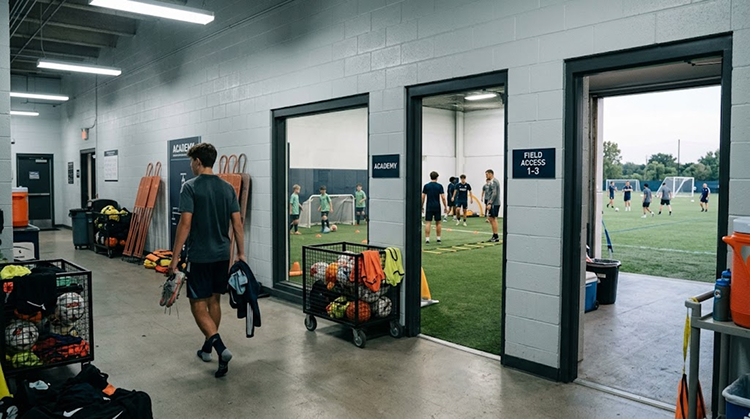
The Union signed Sullivan to a first-team contract through 2028 on May 9, 2024, when he was 14 years and 224 days old. The agreement was described by the club as a Major League Soccer-record Homegrown deal. He had joined the Philadelphia Union Academy at age 10 and progressed through the club’s development structure before reaching the first team.
His professional debut arrived on July 17, 2024, against the New England Revolution.
At 14 years and 293 days old, Sullivan became the youngest player to make a regular-season appearance in the major North American professional sports leagues at the time, breaking Freddy Adu’s previous MLS record. The achievement was significant because it was the first visible result of a pathway that had taken Sullivan from Union Academy to MLS NEXT Pro and then into the senior team.
Philadelphia did not immediately turn him into a full-time starter.
Instead, Sullivan spent substantial time developing through MLS NEXT Pro during 2024 and 2025 before his first-team role expanded in 2026. That gradual progression is now producing measurable results.
The numbers from 2026 are particularly important.
| 2026 MLS Statistic | Cavan Sullivan |
|---|---|
| Appearances | 24 |
| Starts | 17 |
| Minutes | 1,450 |
| Goals | 7 |
| Assists | 12 |
| Goal Contributions | 19 |
| September Goal Contributions | 9 |
Sullivan’s 19 regular-season goal contributions are tied with Alphonso Davies’ 2018 total for the second-most by a teenager in MLS history. Diego Fagúndez holds the record with 20 goal contributions in 2013. Sullivan therefore needs just one more goal or assist to match the record.
That record is now one of the clearest short-term targets in front of him.
The MLS Player Of The Month Award Was More Significant Than The USMNT Goal
Sullivan’s Mexico goal created the biggest headline, but his September club performance provides a better measurement of his sustained development.
In four September matches, he recorded four goals and five assists. His nine goal contributions led MLS during the month, while Philadelphia won all five of its September matches. The Union also led the league in goals and goal differential during that month.

On September 30, Sullivan was named MLS Player of the Month.
At 17 years and two days old, he became the youngest player in league history to receive the award. He also established an eight-match streak with at least one goal or assist, the longest such streak by a teenager in MLS history.
The award matters because it demonstrates consistency.
The Mexico goal was an extraordinary individual moment. The September MLS run was different. Sullivan repeatedly influenced matches over an entire month, producing goals, assists, ball progression and attacking combinations for a Philadelphia team that dramatically improved after the World Cup pause.
Philadelphia entered the post-World Cup period near the bottom of the Eastern Conference. By early October, the Union had climbed into the playoff picture and recorded a 12-match unbeaten run that produced 32 points, tied for the most points by a club across a 12-game stretch in MLS history. Sullivan started 11 of those matches and recorded a goal contribution in eight.
That makes his remaining MLS schedule especially valuable.
He now has a chance to help Philadelphia finish its turnaround while pursuing the teenage goal-contribution record at the same time.
Manchester City Is The Long-Term Question
Sullivan’s future has been connected to Manchester City since before he became a USMNT record holder.
When Philadelphia signed him in 2024, reports indicated that a future move to Manchester City was part of the long-term plan. MLS and other reporting have continued to describe City as his expected destination once he is eligible to move. The current pathway is generally reported as a move after he turns 18, with January 2028 increasingly cited as the expected registration window.
That timeline gives Philadelphia a valuable period.
Sullivan was born on September 28, 2009. He turned 17 shortly before the Mexico match, meaning he still has more than a year before reaching the age at which an international transfer to England can occur.
That time should be viewed as development capital.
A premature move would offer little benefit if Sullivan were simply transported into a different environment without enough senior experience. Philadelphia can provide consistent MLS minutes, playoff pressure, tactical responsibility and exposure to physically mature opponents.
Manchester City, meanwhile, represents a completely different developmental challenge.
The technical standard would rise immediately, while competition for first-team opportunities would be intense. Sullivan’s current Union role allows him to be one of the team’s attacking focal points. At Manchester City, he would initially have to earn his place among elite players.
That is why his 2026 MLS development remains so important.
The better Sullivan becomes before making that move, the more options he gives himself when he eventually enters the English system.
Philadelphia’s Playoff Push Is Sullivan’s Next Test
The next stage of Sullivan’s development will take place under a completely different type of pressure.
International soccer gave him an enormous spotlight, but MLS gives him something more useful for his long-term development: repeated competitive matches.
Philadelphia’s next league match is scheduled for October 10 against Real Salt Lake at Subaru Park. The Union entered the final stretch of the regular season in the Eastern Conference playoff picture after their dramatic turnaround following the World Cup break.
For Sullivan, those matches create three objectives.
First, he needs to maintain his production. One goal contribution would move him level with Fagúndez’s teenage MLS record.
Second, he needs to demonstrate that opponents can adjust to him without removing him from matches. His September performances came after teams had already seen him repeatedly, yet he continued producing.
Third, he needs to handle increased defensive attention.
That may be the most important tactical stage of his development.
Sullivan is a left-footed attacking midfielder who can operate from the right side, receive between lines and attack defenders with the ball. Once opponents begin consistently assigning a second defender to his zone, his ability to move the ball quickly, combine with teammates and find alternative spaces will become increasingly important.
The objective is therefore broader than accumulating more goals and assists.
The Union need to keep giving him meaningful responsibility while ensuring that he learns how to influence matches when he cannot dominate them individually.
Sullivan’s Development Is Also A Test For The MLS Pathway
There is a larger American soccer story running through Sullivan’s career.
He is one of the clearest examples yet of the Philadelphia Union’s academy-to-first-team model producing a player capable of making an immediate impact at senior international level.
His pathway has included Union Academy, MLS NEXT Pro, Philadelphia’s first team and now the USMNT. The club has been able to introduce him to professional football in stages instead of forcing an immediate transition from youth soccer into international competition.
His 2026 season provides evidence that the model can work at an unusually high level.
Sullivan has also been joined in the USMNT setup by Philadelphia academy products Neil Pierre and Frankie Westfield. All three earned senior debuts during the September-October window, giving the Union an unusually strong representation in the national team’s new generation.
That development model connects directly to the broader USMNT player pipeline.
For Philadelphia, Sullivan is therefore more than a star prospect.
He is evidence that the club’s investment in youth development can create players who become first-team contributors, MLS award winners and senior international players while still in their teens.
Pochettino Now Has To Decide How Fast To Push Him
The USMNT breakthrough creates a new question for Pochettino.
Sullivan has demonstrated that he can contribute at senior level. The manager now has to determine how quickly that role should grow.
The September-October window offered a useful model. Sullivan started against Peru and Mexico, while his minutes against Chile were limited. He was also an unused substitute in the 1-0 win over Canada on October 6. That variation suggests Pochettino is evaluating him rather than automatically making him a starter.
That approach makes sense.
The 2030 World Cup remains nearly four years away. There is no reason for the United States to define its entire attack around a 17-year-old in October 2026.
There is a strong reason to keep giving him opportunities, though.
Sullivan’s technical qualities give the USMNT something different. He can receive the ball in tight spaces, attack defenders, combine around the box and create chances without requiring the team to build every attack around him.
That flexibility could become particularly useful as Pochettino develops a squad containing Sullivan, Julian Hall, Mathis Albert, Justin Ellis and other young attackers alongside established players such as Tyler Adams, Gio Reyna and Yunus Musah.
The objective is to create competition.
Sullivan has already shown that he can force his way into the conversation.
The Next Record Is Sitting In Front Of Him
Sullivan’s immediate future is unusually clear.
Philadelphia returns to MLS action against Real Salt Lake on October 10. The Union are competing for a playoff position, and Sullivan is one goal contribution away from tying Diego Fagúndez’s teenage MLS record of 20.
Beyond that, his path becomes broader.
The 2027 Concacaf Gold Cup and future Nations League matches will give Pochettino additional opportunities to evaluate the new generation before the 2030 World Cup qualifying cycle. Sullivan will also have another full MLS season before his anticipated move to Manchester City becomes relevant.
That makes the coming months more important than the Mexico goal itself.
Sullivan has already achieved the historic moment. The next challenge is proving that it was the beginning of a sustained rise.
For Philadelphia, the formula is straightforward: keep him playing, keep challenging him and let the teenager accumulate senior experience.
For Pochettino, the task is similar: give Sullivan meaningful international minutes without allowing the record to become a substitute for development.
And for Sullivan, the next milestone is no longer simply becoming the youngest player to accomplish something.
It is becoming good enough that the records become secondary to his actual influence on matches.
At 17, he has already become the youngest USMNT scorer and the youngest MLS Player of the Month. He has 19 MLS goal contributions in 2026, a record-breaking international goal and a pathway to one of Europe’s biggest clubs.
What comes next will determine whether those achievements represent a remarkable teenage season or the first chapter of a much larger career.