
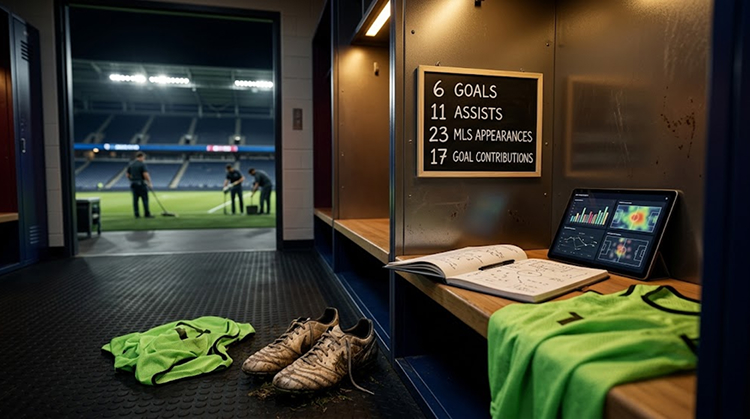
Cavan Sullivan’s first United States Men’s National Team call-up has arrived at a significant moment for American soccer. On September 17, 2026, Mauricio Pochettino named the 16-year-old Philadelphia Union midfielder to a 28-player roster for matches against Peru, Chile, Mexico and Canada, officially beginning the USMNT’s new cycle toward the 2030 FIFA World Cup. Sullivan enters the camp after producing six goals and 11 assists in 23 MLS matches, while his recent form has made him one of the most productive teenagers in the league.
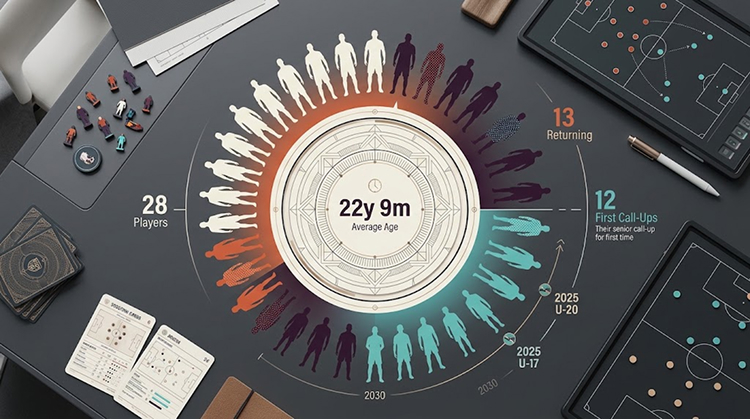
The timing makes the selection more meaningful than a routine first call-up. Pochettino has repeatedly described the post-2026 period as a “fresh start,” and this roster reflects that approach. The squad averages 22 years and nine months, more than four years younger than the group selected for the 2026 World Cup, while 13 players have yet to earn a senior cap.
Sullivan is therefore entering the national team at the beginning of a genuine development cycle rather than near the end of a tournament preparation window. The question is no longer whether a teenager can make the roster. The more interesting question is how Philadelphia’s youngest breakthrough player fits into the larger group Pochettino wants to build over the next four years.
A USMNT Roster Built Around Youth
The numbers surrounding Pochettino’s September roster provide the clearest indication of the direction he is taking.
Thirteen players from the 2026 World Cup squad return, while 12 players receive their first senior-team call-up. The average age is 22 years and nine months, and the 13 uncapped players average just 19 years and six months.
That makes Sullivan part of a much larger youth movement rather than an isolated experiment.
The roster also includes Zavier Gozo of Crystal Palace, Julian Hall of the New York Red Bulls, Mathis Albert of Borussia Dortmund, Peyton Miller of the New England Revolution, Neil Pierre of Philadelphia Union and several other young players entering the senior setup for the first time. Five of the uncapped players were members of the U.S. team at the 2025 FIFA U-20 World Cup, while Sullivan and two other players came through the 2025 U-17 World Cup group.
That structure gives Pochettino an opportunity to evaluate different generations simultaneously.
Experienced players such as Tyler Adams, Antonee Robinson, Sergiño Dest, Gio Reyna and Malik Tillman provide continuity. Around them, the coaching staff can test players who could become significant contributors by 2030.
For Sullivan, that means the immediate objective does not have to be securing a starting position. His first task is to demonstrate that his club qualities can translate to the speed, physical demands and tactical expectations of senior international soccer.
Sullivan’s 2026 Numbers Changed The Conversation
The statistical case for Sullivan’s selection is straightforward.
The Philadelphia Union Homegrown has produced six goals and 11 assists in 23 MLS appearances during the 2026 season, giving him 17 league goal contributions. Reuters reported the same six-goal, 11-assist total when covering his first senior USMNT call-up.
His recent stretch has been even more significant.
On September 13, Sullivan scored twice and added an assist in Philadelphia’s 5-0 win over San Diego FC. MLS subsequently named him Player of the Matchday for Matchday 26. The performance extended his goal-contribution streak to seven consecutive MLS matches, which MLS identified as the longest such streak by a teenager in league history.
That sequence also helped Philadelphia put together a 10-match unbeaten run after the World Cup break. During that stretch, the Union went 8-0-2 and moved from last place in the Eastern Conference into an MLS Cup Playoffs position.
The production is significant because Sullivan is doing more than accumulating minutes. He is influencing results.
His 17 goal contributions also place him among the most productive teenagers in MLS history for a single season. MLS reported that his total was tied for third-most by a teenager, three behind Diego Fagúndez’s record of 20 contributions in 2013.
Those numbers help explain why his international opportunity arrived now rather than later.
Philadelphia Is Providing A Rare Development Environment
Sullivan’s call-up is also a reflection of what Philadelphia Union has built around him.
Philadelphia sends three players into Pochettino’s September camp: Sullivan, defender Neil Pierre and defender Frankie Westfield. That makes the Union the most heavily represented MLS club on the 28-player roster.
The club’s academy structure has become an increasingly important part of the organization’s identity, and Sullivan’s path demonstrates how an American teenager can move from youth soccer into meaningful first-team responsibility.
That development pathway matters because international coaches cannot manufacture club experience during a national-team camp. By the time Sullivan arrives in Atlanta, he already has extensive exposure to professional environments and MLS competition.
His transition can be followed alongside the wider Philadelphia Union player pathway, which provides useful context for how American clubs are increasingly becoming part of the national-team development structure.
The difference between Sullivan and a promising academy player is therefore not simply talent. It is the volume of professional football he is already playing.
Pochettino can now evaluate whether that experience translates against international opponents.
The First Challenge Is Learning Pochettino’s Demands
The September roster announcement makes clear that Pochettino is not calling young players into the national team simply to reward potential.
He said the players need to understand the USMNT’s culture, way of working and principles of play. He also emphasized commitment to representing the country.
That creates an interesting test for Sullivan.
At Philadelphia, he has been given increasing responsibility with the ball. He has shown an ability to create chances, combine in attacking areas and contribute directly to goals. International soccer introduces a different level of tactical pressure, particularly when opponents have less time and space available.
The USMNT also has less training time than a club team. A young player cannot expect several months to learn a new system. He may have only a handful of sessions before a match.
That makes the first camp more about adaptation than statistics.
Sullivan will need to learn how Pochettino wants his midfielders and forwards to press, how quickly the team should transition after recovering possession and where he should position himself when the United States builds from the back.
Those details will help determine whether his MLS production can become international production.
His First Four Opponents Provide Four Different Tests
Sullivan’s first opportunity with the senior team comes during a four-match window that begins September 26 against Peru at Inter&Co Stadium in Orlando.
The United States then faces Chile on September 29 at Energizer Park in St. Louis, Mexico on October 3 at State Farm Stadium in Glendale, Arizona, and Canada on October 6 at Allianz Field in St. Paul, Minnesota.
| Date | Opponent | Venue | Location |
|---|---|---|---|
| September 26, 2026 | Peru | Inter&Co Stadium | Orlando, Florida |
| September 29, 2026 | Chile | Energizer Park | St. Louis, Missouri |
| October 3, 2026 | Mexico | State Farm Stadium | Glendale, Arizona |
| October 6, 2026 | Canada | Allianz Field | St. Paul, Minnesota |
The variety is useful for a player making his first international transition.
Peru and Chile provide South American opposition with different tactical characteristics from the United States’ traditional Concacaf rivals. Mexico and Canada, meanwhile, offer familiar regional competition where physical intensity, pressing and transition play can become especially important.
Pochettino does not need Sullivan to dominate these matches. The coaching staff can learn a great deal simply by observing how he reacts when opponents close him down, how quickly he processes defensive responsibilities and whether he can maintain his attacking instincts without compromising the team’s structure.
U.S. Soccer confirmed that players began reporting to Atlanta on September 20, meaning Sullivan will have his first senior-team training environment before the Peru match.
Sullivan Does Not Need To Become The USMNT’s Star Immediately
One of the biggest risks surrounding a teenage national-team call-up is allowing the story to become bigger than the player.
Sullivan’s selection is significant, but it does not mean Pochettino expects him to become an immediate centerpiece of the USMNT.
The coach has specifically framed the roster as an evaluation group at the beginning of a new cycle. Reuters reported that Pochettino emphasized the current squad is about evaluating players rather than identifying the final team for the 2030 World Cup.
That distinction is important.
Sullivan will turn 17 on September 28, two days after the Peru match. He therefore has almost four full years before the 2030 World Cup begins.
There is considerable time for his role to change.
A player who enters the cycle as a developmental prospect could become a regular starter by 2028 or 2029. Another player could experience setbacks, injuries or changes in club circumstances. The purpose of this first camp is to establish information that Pochettino can use later.
That makes the call-up valuable even if Sullivan plays only limited minutes.
Manchester City Adds Another Layer To The Story
Sullivan’s long-term trajectory also includes an agreement to join Manchester City when he turns 18, adding an international dimension to his development.
The move means the USMNT is evaluating a player whose next club environment could be significantly different from MLS. Manchester City’s training structure, tactical demands and competition for first-team minutes could influence Sullivan’s development considerably.
But the transfer should not automatically determine his national-team status.
For Pochettino, the relevant question remains what Sullivan does on the field.
A future move to Manchester City may provide access to elite training, but Sullivan still needs regular competitive football and a pathway into senior-level minutes. His current Philadelphia role is therefore extremely important.
The USMNT call-up and the Manchester City agreement should be viewed as two separate stages in his development rather than evidence that his international place is already guaranteed.
Philadelphia’s Model Is Becoming Part Of The USMNT Story
Sullivan’s selection also reinforces a broader trend inside the current national team.
U.S. Soccer’s September roster contains 12 MLS players, while 16 come from European clubs. Twenty-one members of the squad previously participated in the U.S. Soccer Development Academy or MLS NEXT, and 18 came through MLS academy systems.
That is important because it shows the American player pathway is increasingly producing senior-national-team candidates before they move overseas.
Philadelphia has three players in this particular camp, but the same pattern appears across the roster. New England Revolution, Red Bull New York, Chicago Fire, FC Cincinnati, Orlando City and Nashville SC also contribute players.
The model gives Pochettino a broader domestic talent pool to evaluate.
Sullivan is one of its most visible examples because he has reached the senior national team at just 16. But the larger story is that several other teenagers are arriving at the same time.
That could create genuine competition for places as the 2030 cycle develops.
The 2030 Timeline Works In Sullivan’s Favor
The most important fact surrounding Sullivan’s call-up is the calendar.
The next World Cup will be played in 2030. Sullivan is 16 years old now.
By the tournament, he will be 20.
That means Pochettino does not need to decide whether Sullivan is a finished international player. He needs to determine whether the teenager has enough current ability and developmental upside to deserve exposure to the senior environment.
The same principle applies to Julian Hall, Zavier Gozo, Peyton Miller, Mathis Albert, Justin Ellis, Neil Pierre and the other young players receiving opportunities.
The September roster is therefore a snapshot rather than a forecast.
Pochettino has four years to compare these prospects with the established generation, evaluate players coming through youth national teams and monitor Americans developing in Europe and MLS.
For Sullivan, that creates an unusual advantage. He can enter the senior team early enough to learn without carrying the expectation that he must immediately solve one of the team’s biggest problems.
What Sullivan’s First Camp Can Actually Tell Us
The most useful evaluation of Sullivan’s USMNT debut will not be his goal or assist total.
Instead, several questions should guide the assessment.
Can he handle the pace of senior international training? Can he receive the ball under pressure? Does he recognize defensive responsibilities quickly enough? Can he press according to Pochettino’s instructions? Does he combine naturally with players who have different club backgrounds? And can he maintain his creativity when the opposition gives him significantly less space?
Those indicators will matter more than whether he scores against Peru or Chile.
The first camp is also an opportunity for Sullivan to learn from players who have already experienced the World Cup. Tyler Adams and Antonee Robinson lead the roster with 58 caps each, while Yunus Musah has 47, Sergiño Dest 44 and Gio Reyna 43.
That mixture of experience and youth is exactly what Pochettino says he wants from the beginning of the new cycle.
Cavan Sullivan Represents The Beginning, Not The Finished Product
Cavan Sullivan’s first USMNT call-up is significant because of what it represents within the timing of American soccer.
He arrives after a 17-goal-contribution MLS season, a seven-match teenage goal-contribution streak, a Player of the Matchday award and a growing role for Philadelphia Union.
He also arrives alongside 12 other players seeking their first senior caps in a USMNT squad that is more than four years younger on average than the group taken to the 2026 World Cup.
That makes his selection part of a larger structural change.
Pochettino now has the time to develop a team rather than simply prepare one. Sullivan has the opportunity to learn international football before reaching his physical and tactical prime. Philadelphia has another academy product entering the national-team pathway. And the United States has four years to determine which members of this generation can become the foundation of its next World Cup team.
Sullivan does not need to be the face of that project yet.
At 16, his most valuable opportunity is simply to become part of it.