
The United States U-17 women’s national team opened the 2026 FIFA U-17 Women’s World Cup with a performance that immediately entered soccer history. On October 19, 2026, the Americans defeated Samoa 17–0 at the Mohammed VI Football Complex in Salé, Morocco, setting a new record for the largest victory in a FIFA World Cup competition at any level. Forward Maddie DiMaria led the scoring with six goals, while Loradana Paletta and Carolina Reyna added two apiece.
The result was more than a remarkable opening-day scoreline. It showcased the attacking options available to head coach Ciara Crinion, the experience gained by returning players, and the growing range of pathways connecting American youth soccer with professional clubs and college programs. However, the real test will be whether the United States can translate that dominant performance into a sustained run toward its first U-17 Women’s World Cup title.
Maddie DiMaria Sets Four Records Against Samoa
DiMaria needed just 62 seconds to score the opening goal, establishing the tone for an afternoon in which Samoa struggled to contain the American attack. She added goals in the 18th, 20th, 30th, 70th, and 73rd minutes, finishing with six from a performance that combined sharp positioning, decisive finishing, and the ability to capitalize on defensive mistakes.
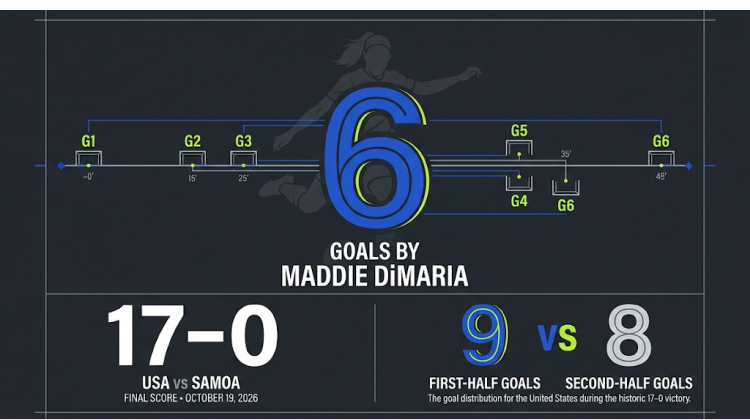
According to U.S. Soccer’s official match report, DiMaria’s six-goal haul established four significant records. She became the first American to score more than three goals in a single U-17 Women’s World Cup match, set a new U.S. record for goals in a match at that tournament, recorded the most goals by a U.S. player in a FIFA Women’s World Cup match, and established the American career scoring record in the U-17 Women’s World Cup.
Her performance also broke the individual scoring benchmark for a single edition of this competition. Before the match, five goals had been the previous high in one U-17 Women’s World Cup game, achieved by Nigeria’s Chinwendu Ihezuo in 2012 and Spain’s Lorena Navarro in 2016.
The significance extends beyond the youth tournament. Six goals in one match represent an extraordinary output for any international player, especially in a competition where teams are drawn from different development systems and tactical environments. DiMaria demonstrated how a forward can exploit space, anticipate loose balls, and remain dangerous even after a match has moved beyond a competitive scoreline.
FIFA’s report on DiMaria’s record-setting performance also captured the historical importance of the victory. The United States did not simply begin its campaign with three points; it produced a result that will remain a reference point for the competition.
How the United States Reached a 17–0 Scoreline
The Americans scored nine goals before halftime and added eight after the break. That sustained production is important because the team did not depend on a short burst of early scoring before easing off. The attack continued to create opportunities across the full 90 minutes.
The scoring began with DiMaria in the second minute. Mia Corona doubled the lead in the 12th minute, before DiMaria scored twice in quick succession. Paletta then found the net in the 25th minute, Grace Murray added another three minutes later, and DiMaria completed her first-half scoring in the 30th minute. Paletta struck again before Amari Manning scored in stoppage time to make it 9–0 at the interval.
The second half brought further contributions from Deus Stanislaus, Carolina Reyna, Isa Ortiz, Meila Brewer, and Gianna Hanf, alongside DiMaria’s final two goals. Reyna and Paletta each finished with a brace, while several other players recorded goals or assists.
The match also established a new benchmark for a FIFA World Cup result. The previous largest margin was Morocco’s 16–0 victory over New Caledonia at the 2025 FIFA U-17 World Cup in the men’s competition. The United States surpassed that mark with its 17th goal in the closing stages.
The volume of chances reflected the attacking imbalance. Concacaf’s match analysis reported that the United States recorded 58 shots, one of the highest totals in a single match in the competition since at least 2018. The figure points to repeated access to dangerous areas rather than a result built exclusively on an unusually high conversion rate.
That distinction matters for evaluating the team. A big score can sometimes result from a handful of chances finding the net, but a high shot count suggests the Americans repeatedly moved the ball into positions from which they could threaten. Their next opponents will offer different defensive challenges, making it important to see whether the team can maintain that chance creation against more organized opposition.
Loradana Paletta, Carolina Reyna, and the Depth of the Attack
DiMaria was the central figure, but the performance also highlighted the depth around her. Paletta scored twice and contributed three assists, making her one of the match’s most influential players beyond the six-goal scorer. The midfielder’s involvement in multiple goals showed the value of having players who can both finish attacks and create chances for teammates.
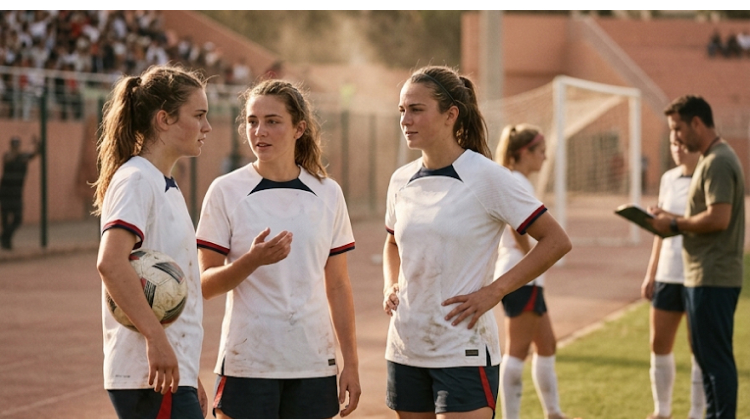
Paletta represents New York City FC’s youth academy and comes from Syosset, New York. Her ability to influence the match in several ways gives Crinion another attacking option to use when opponents concentrate their defensive attention on DiMaria.
Reyna also scored twice, finding the net in the 64th and 78th minutes. Her second goal followed a pass from Kendra Hansen, while her first came from a DiMaria assist. That connection illustrated how the team could turn individual attacking quality into collective production.
Other scorers included Corona, Murray, Manning, Stanislaus, Ortiz, Brewer, and Hanf. Their contributions are relevant because tournament football places demands on more than a single star. Opponents can adjust their marking schemes, limit space for a leading forward, or force a team to build attacks through different areas of the pitch. Having multiple players capable of finishing moves gives the United States more ways to respond.
The roster also reflects several development pathways. U.S. Soccer’s official 2026 tournament roster lists players connected to youth clubs, college soccer, and professional environments. Paletta is associated with NYCFC, while midfielder Mia Corona is listed with UCLA and defender Meila Brewer with Dallas Trinity FC.
These pathways do not guarantee future senior national-team success, but they demonstrate how young players can gain experience through different competitive settings. International tournaments then test whether those experiences translate into quick decisions, coordinated pressing, and technical execution under pressure.
What Ciara Crinion’s Team Reveals About U.S. Youth Development
Crinion’s squad entered the tournament with experience from previous international competitions. DiMaria was returning for a second U-17 Women’s World Cup after participating in the 2025 edition, giving her a reference point for the demands of tournament football. That continuity can help younger players manage the rhythm of a global competition, from group-stage preparation to the pressure of knockout matches.
The roster also includes players with experience in college soccer and professional environments, alongside those developing through established youth clubs. This mixture creates a team in which players may arrive with different forms of preparation, while national-team camps provide an opportunity to establish shared tactical principles.
The United States has a long record of success in women’s soccer, but the U-17 Women’s World Cup has remained a notable gap in its trophy collection. The team finished runner-up in the inaugural 2008 edition, its best result in the competition. The Americans therefore have a chance in Morocco to pursue a title they have not yet won.
That historical context makes the 17–0 victory both encouraging and incomplete as a measure of progress. A team’s ability to overwhelm an opponent is one indicator of quality, but the tournament’s strongest tests will require different solutions. Close matches demand patience in possession, defensive concentration, and the ability to recover quickly after losing the ball.
The broader development question is how many players from this group can progress to the senior national team. No single youth result can answer that. Development depends on sustained playing time, coaching, physical growth, technical refinement, and the ability to adapt as opponents become faster and more tactically sophisticated.
For now, the opening match provides evidence of attacking potential and a roster capable of distributing goals across multiple players. The next stages will reveal more about the group’s balance, resilience, and capacity to compete when scoring opportunities become harder to find.
The Group E Schedule Will Provide a More Difficult Test
The United States is competing in Group E alongside Samoa, Kenya, and China PR. Its next match is scheduled for October 22 against Kenya, followed by the group-stage meeting with China PR on October 25. Both matches are scheduled at the Mohammed VI Football Complex in Salé, Morocco.
China opened its campaign with a 3–0 victory over Kenya, meaning the group’s remaining matches will help determine the final standings and the route into the knockout rounds. The United States has the advantage of a strong goal difference after its opening win, but it still needs to collect results against its remaining opponents.
The Kenya match will be an opportunity to assess whether the American attack can maintain its pace against a team that has already experienced the tournament’s opening pressure. The China fixture could provide a different tactical examination, particularly if the opponent can defend compactly and restrict space around the penalty area.
Tournament format also changes how teams approach matches. After an opening victory of this size, the coaching staff must balance attacking ambition with defensive discipline and squad management. Keeping players healthy and avoiding unnecessary risks can become as important as extending a winning margin.
Supporters can follow official match information and updates through U.S. Soccer’s U-17 Women’s National Team coverage. The schedule will offer a clearer picture of how the squad responds once opponents have footage of its attacking patterns and more time to prepare.
Why the Record Matters—and What It Cannot Prove
A 17–0 result is an unmistakable historical achievement, but it should not be treated as proof that the United States is certain to win the tournament. Samoa and the United States entered the match with different levels of depth and experience, and the scoreline reflected that mismatch. Stronger opposition will test the Americans in ways that the opening match could not.
The performance does, however, provide several meaningful indicators. DiMaria demonstrated elite finishing on the day, Paletta contributed goals and assists, and the team maintained its attacking output across both halves. The 58-shot total also points to a steady supply of chances. These are useful signs of attacking quality, even if they cannot predict how the squad will perform in a tight quarterfinal or semifinal.
For DiMaria, the next challenge is consistency. A record-setting match can draw attention, but tournament defenses will now have a reason to track her movement closely. Her ability to adapt—by creating space for teammates, linking play, or finding opportunities when closely marked—will help determine whether she remains a decisive figure.
For Crinion, the priority is to convert the opening performance into a repeatable team identity. That means keeping the attacking movement sharp while ensuring that defensive organization, transition play, and decision-making remain reliable when the opposition creates more pressure.
The result also offers a useful reminder that youth development should be judged over time. The best measure of this generation will not be a single scoreline, but how players progress through club, college, professional, and international football in the years ahead. Readers following American soccer can explore more context through WikiApp’s coverage of soccer records and competitions.
DiMaria’s six goals have already secured a place in the tournament’s history. The United States now has an opportunity to turn that opening-day record into something more consequential: a sustained challenge for its first FIFA U-17 Women’s World Cup title.