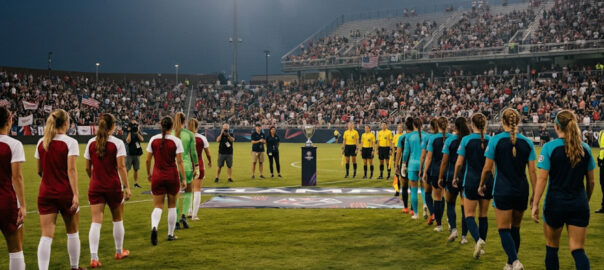
American women’s soccer is preparing for a new competition that could reshape the relationship between its professional leagues. On October 14, 2026, U.S. Soccer announced the Arthur M. Blank Crest Cup, a national club tournament intended to crown a single champion by bringing together teams from across the country. The planned competition will feature a single-elimination format, a championship final, significant financial rewards, and a pathway to the Concacaf W Champions Cup. The announcement represents a potential turning point for a sport that has developed strong professional leagues but has lacked a comparable national tournament connecting them. (U.S. Soccer’s official announcement)
The Crest Cup arrives as the United States prepares for the next phase of international women’s soccer, with the 2027 FIFA Women’s World Cup in Brazil and the 2031 tournament expected to be hosted in the United States. For the domestic game, the challenge is broader than producing a successful national team. American soccer must also create meaningful club rivalries, expand opportunities for players, attract investment, and give supporters compelling reasons to follow teams throughout the year.
The new tournament could help address those priorities. Its success, however, will depend on how U.S. Soccer coordinates the competition with existing league schedules, protects player welfare, distributes financial benefits, and turns a promising announcement into a sustainable annual event.
What Is the Arthur M. Blank Crest Cup?
U.S. Soccer introduced the Arthur M. Blank Crest Cup on October 14, 2026, describing it as a first-of-its-kind national competition intended to unite the women’s club game. The tournament is being developed with support from Arthur M. Blank, the Atlanta-based businessman and philanthropist whose sports holdings include Atlanta United FC and the Atlanta Falcons.
According to U.S. Soccer, the competition will use a single-elimination knockout format, culminating in a national championship final. The winner will receive a reported $1.1 million prize and gain a pathway to qualification for the Concacaf W Champions Cup. CBS Sports separately reported an initial prize pool of $1.5 million, suggesting that the overall pool and the winner’s award are different figures. The final distribution of prize money should be confirmed through the tournament’s regulations.
The inaugural edition is expected to bring together clubs from the National Women’s Soccer League (NWSL) and the Gainbridge Super League, the United States’ two Division I-sanctioned professional women’s leagues. U.S. Soccer has not yet announced a launch date, with officials working alongside league representatives to identify a suitable place in the competition calendar. (CBS Sports’ report on the announcement)
The structure draws comparisons with England’s Women’s FA Cup, where clubs compete in a knockout tournament for a national title. The American version would serve a distinct purpose by bringing clubs from separate domestic leagues into one competition.
That distinction matters. League championships determine the strongest team within a particular competition, but a cross-league cup can create matchups that supporters would not otherwise see in regular-season play. It can also give clubs an additional competitive objective beyond their league standings and postseason ambitions.
Why American Women’s Soccer Needs a Shared Club Competition
The United States has a long history of success in women’s international soccer, but its domestic club structure has developed through a different path. Professional leagues have operated alongside college programs, amateur competitions, youth academies, and regional development systems. These layers have helped create a broad player base, yet they have not always been connected through a single national club championship.

The NWSL and Gainbridge Super League now occupy separate positions in the professional landscape. Both provide opportunities for elite players, but their clubs compete within different league structures. A national cup would create a direct sporting connection between them.
That connection could benefit supporters as much as teams. Fans often judge clubs through local rivalries and league tables, but a knockout tournament offers a different narrative: a single match can change a season, and a team from a less prominent market can eliminate a better-resourced opponent.
For example, a matchup between an established NWSL side and a club from the Gainbridge Super League could introduce supporters to players and teams they rarely encounter. Such games would give broadcasters additional storylines and provide clubs with opportunities to reach audiences outside their usual markets.
The tournament could also become a useful platform for evaluating competitive differences between leagues. Results would not automatically establish which league is stronger, because knockout football produces unpredictable outcomes. Across several seasons, however, match results, goals, player performances, and advancement rates could help reveal where teams differ in tactical approach and squad depth.
The wider objective is to create a connected professional ecosystem. A shared competition would not eliminate the differences between leagues, but it could give both a common stage.
How the NWSL and Gainbridge Super League Could Benefit
The NWSL has an established profile in American professional women’s soccer, while the Gainbridge Super League adds another Division I professional pathway. Bringing their clubs together gives U.S. Soccer a way to increase the number of meaningful competitive relationships across the domestic game.
For NWSL teams, the Crest Cup could create additional high-stakes fixtures and opportunities to test squad depth. Clubs managing demanding league campaigns would need to decide how to balance their strongest lineups with rotation, recovery, and player availability. Matches against unfamiliar opponents could also challenge tactical assumptions that develop within a single league.
Gainbridge Super League clubs could gain a different advantage: national visibility. A strong performance against a more widely recognized opponent could introduce their players to new audiences and demonstrate that their teams belong in the same national conversation.
The potential commercial effects are significant, although they remain unproven. More attractive matchups could support ticket sales, sponsorship packages, television coverage, and merchandise. Those gains would depend on scheduling, promotion, venue selection, and the degree to which supporters view the tournament as an important title rather than an additional fixture.
U.S. Soccer CEO JT Batson framed the competition as an opportunity to deliver memorable moments and expand women’s professional soccer into new communities. U.S. Soccer President Cindy Parlow Cone also emphasized bringing people together and attracting investment into the game.
Those goals will require a practical plan. A competition that produces compelling matches but fails to reach new viewers would leave part of its potential unrealized. Likewise, a strong marketing campaign cannot substitute for fair sporting rules, recognizable stakes, and a schedule that allows players to compete at their best.
The $1.5 Million Prize Pool Raises the Stakes
The financial commitment is one of the most notable features of the announcement. CBS Sports reported an initial prize pool of $1.5 million, while U.S. Soccer’s announcement specified a $1.1 million award for the winner. The distinction is important: the total pool represents the broader financial allocation, while the winner’s prize is a specific component of that amount.
A substantial winner’s award could influence club strategy. Teams may see the tournament as a financial opportunity as well as a sporting challenge, particularly if advancement offers additional commercial exposure or access to international competition.
However, the long-term value of the prize will depend on how the money is distributed and what it means relative to club budgets. A major award for the champion can generate attention, but meaningful payments for teams that advance through earlier rounds may encourage wider participation and make each match more consequential.
The financial model should also account for travel, accommodation, staffing, venue operations, and player recovery. A competition can generate revenue while still creating costs that fall unevenly across participating clubs. Transparent regulations and predictable financial terms would help teams plan for participation.
The Crest Cup’s prize structure could become a defining feature of the event, but it will be most effective if the tournament delivers a lasting return for the clubs and players who make it possible.

The Concacaf W Champions Cup Creates an International Incentive
The Crest Cup is also intended to provide a pathway to the Concacaf W Champions Cup, adding an international dimension to its domestic championship.
That connection could make the tournament more consequential than a standalone cup. A national title would carry its own prestige, while access to a regional competition could offer clubs another opportunity to test themselves against leading teams from across Concacaf.
International competition can expose differences in tactical preparation, player depth, and match management. Clubs that advance could face opponents with different playing styles and competitive environments, giving coaches valuable experience beyond domestic league play.
The qualification rules will be central to the tournament’s credibility. U.S. Soccer will need to clarify how the Crest Cup’s berth relates to existing qualification arrangements, what happens if a club has already qualified through another route, and whether the competition’s champion receives an automatic place or must satisfy additional criteria.
Clear rules would prevent confusion and make the trophy’s value easier for supporters to understand. The more directly the Crest Cup connects a national title to an international opportunity, the stronger its competitive identity could become.
Scheduling and Player Welfare Will Determine the Tournament’s Quality
The biggest operational challenge may be finding room for the Crest Cup in an already demanding calendar. The NWSL and Gainbridge Super League each have their own league schedules, while clubs must account for travel, training, injuries, international call-ups, and recovery.
A single-elimination format can limit the total number of additional matches, but it does not remove scheduling pressure. A team that advances repeatedly could face important cup fixtures close to league games, potentially forcing coaches to rotate players or alter preparation.
U.S. Soccer has said it is working with league officials to align the competition calendar and consulting medical experts about player health and wellness. That coordination will be particularly important if the tournament is intended to become a recurring event rather than a one-off showcase.
A workable schedule should allow sufficient recovery between matches, avoid unnecessary travel where possible, and account for international windows. Organizers also need to consider venue access and broadcast requirements without making player welfare secondary to commercial considerations.
The tournament’s knockout format offers a clear advantage for storytelling: every round has immediate consequences. But the quality of those games will depend on whether clubs can field competitive teams without overloading players.
Can the Crest Cup Reach Fans Beyond Existing Markets?
A national championship needs more than participating clubs. It needs an audience that understands the stakes, follows the bracket, and feels invested in the result.
The Crest Cup could help build that audience by introducing matchups that are unavailable in regular league play. A compelling first-round upset, a rivalry between cities, or a final featuring two teams with contrasting styles could give casual viewers an accessible entry point into the domestic women’s game.
Marketing will be most effective when it emphasizes the tournament’s simple proposition: clubs from different leagues compete for one national title. That message is easy to explain, easy to follow, and distinct from the structure of a normal league season.
Broad distribution will matter as well. Supporters need to know where matches will be played, how to watch them, and when the next round begins. Coordinated promotion across U.S. Soccer, participating leagues, and club channels could help prevent the event from becoming fragmented across separate fan communities.
The tournament could also benefit from local storytelling. Clubs should be able to promote their own players, communities, and rivalries while connecting those narratives to the national competition. This approach would help the Crest Cup serve both established supporters and people discovering women’s club soccer for the first time.
For a site such as WikiApp’s soccer coverage, the competition offers a useful case study in how tournament design, club identity, and sporting incentives shape the broader game.
What Success Should Look Like by the 2031 Women’s World Cup
The announcement creates an opportunity, but the Crest Cup’s actual impact cannot be judged before the competition begins. U.S. Soccer has not yet confirmed the launch date, full bracket, match venues, broadcasting arrangements, or detailed qualification regulations. Those decisions will shape the tournament’s reach and credibility.
Several indicators will help determine whether the competition is delivering on its promise: participation by the intended professional clubs, attendance at matches, broadcast and streaming audiences, sponsor interest, player availability, competitive balance, and the long-term financial impact on teams.
The sporting value will also depend on whether the tournament produces memorable results and a champion that supporters recognize as having earned a national title. Repeated matchups between leading clubs could build prestige, while opportunities for less prominent teams to advance would help preserve the drama that makes knockout competitions distinctive.
The timing is relevant because the United States is looking ahead to the 2031 FIFA Women’s World Cup. A stronger domestic club environment could complement national-team ambitions by supporting player development, increasing competitive experience, and expanding the audience for women’s soccer. It would not guarantee international success, but it could help create more pathways for players and clubs to grow.
The Crest Cup’s most important test will be whether it becomes part of the fabric of American soccer. A trophy, a large prize, and an international qualification pathway can attract initial attention. Sustained value will require consistent organization, meaningful competition, and support from players, clubs, leagues, and fans.
The Arthur M. Blank Crest Cup offers U.S. Soccer a chance to connect two professional leagues through a shared national goal. If the federation can establish a workable calendar, clear qualification rules, credible financial incentives, and broad public access, the tournament could become a lasting fixture in the women’s game. Its promise is straightforward: give American women’s clubs a common stage and let the competition determine who earns the title.