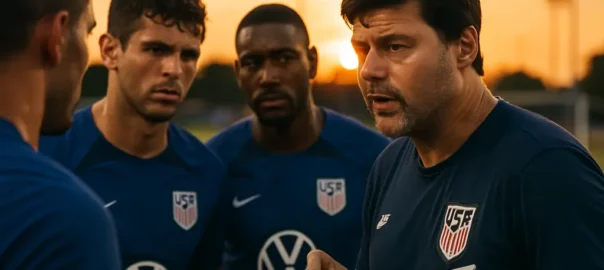
USMNT Tactical Adjustments under Mauricio Pochettino were built around phase changes: one structure without the ball, another with it, and flexible roles that asked players to solve different problems inside the same match. By October 13, 2026, the available record from the completed 2026 cycle showed a United States team that had moved away from a single fixed shape and toward a match-state model based on pressing, wing-back width, and central rotations.
Pochettino’s approach did not erase the familiar American strengths of running power, direct transition, and wide attacking. It reorganized them. The USMNT often defended in a 4-2-3-1, then shifted in possession toward a back-three structure, commonly described as a 3-4-2-1 or a close variant. That change mattered because it altered the team’s spacing, the duties of the full-backs, and the positions from which Christian Pulisic, Weston McKennie, Malik Tillman, and Folarin Balogun could affect attacks.
USMNT Tactical Adjustments In And Out Of Possession
How USMNT Tactical Adjustments Changed The Shape
The clearest feature of Pochettino’s plan was the split between defensive and possession phases. In defensive organization, the 4-2-3-1 gave the team two deeper midfielders, a line of four defenders, and a front four capable of setting pressing angles. In possession, the same players could move into a three-at-the-back platform with wing-backs positioned higher and wider. A Sporting News tactical report described that shift as part of the United States’ tactical plan before the 2026 World Cup.
Those USMNT Tactical Adjustments were not cosmetic. A 4-2-3-1 without the ball can protect central lanes and keep the first pressing line connected to midfield. A 3-4-2-1 in possession can create an extra passing option in the first line, push both wing-backs forward, and give two attacking midfielders space behind a lone striker. The team could keep defensive balance while still adding numbers between the opponent’s midfield and back line.
Why The Back Three Helped The Build-Up
The back-three idea gave the USMNT a safer base for circulation. One defender could carry or pass forward while two others stayed positioned to defend a turnover. That mattered against teams that defended deeper, because the United States needed patient progression rather than only open-field running. It also mattered against stronger pressing sides, because an extra player in the first line changed the angle and timing of the opponent’s pressure.
With Sergiño Dest and Antonee Robinson used high and wide during the 2026 World Cup group stage, the team could stretch the pitch horizontally. That opened inside channels for the two advanced midfielders or narrow forwards. The wing-backs were not simply overlapping full-backs; in possession phases, they often became the team’s width providers, allowing attackers to occupy central or half-space positions.
Midfield Rotation And Central Overloads
Two Advanced Midfielders Behind Balogun
The June 19, 2026 World Cup opener against Paraguay showed the value of Pochettino’s midfield movement. The United States started from a 4-2-3-1 reference point, then moved into a more fluid structure with two advanced midfielders operating behind Folarin Balogun. Christian Pulisic and either Weston McKennie or Malik Tillman could appear in pockets between the lines, depending on the phase.
The reported match profile from the research notes gave the United States 1.34 expected goals, with four goals scored from six shots on target. That gap between chance value and finishing output should not be treated as a permanent attacking baseline, but it did show how effective the spacing was on that day. The team repeatedly attacked the same weak points: a midfielder surged beyond the first line, another player drifted into the vacated space, and the wide players threatened one-on-one actions.
Pressing And Passing Lanes
Pochettino’s pressing model depended on the front players closing passing routes as much as chasing the ball. The lone striker could angle pressure toward one side, the attacking midfielder could step toward the holding midfielder, and the far-side winger or wing-back could prepare to jump once the ball moved wide. That style asked the midfield line to stay compact enough to win second balls after forced clearances.
The central overloads were also useful in possession. McKennie’s forward running could pull a center-back or holding midfielder out of shape, while Tillman’s drifting offered a receiving point in the space left behind. Pulisic’s role was not restricted to the touchline. By moving between wide and central positions, he could draw defenders away from the channel that Dest or Robinson wanted to attack.
Wing-Backs And Role Changes Under Pochettino
USMNT Tactical Adjustments And Role Reinterpretation
One of the most significant parts of Pochettino’s work was role reinterpretation. The clearest early example came on October 15, 2024, when Yunus Musah, normally used as a central midfielder, debuted at right wing-back in a friendly against Mexico under Pochettino. The Washington Post match analysis reported that personnel choice as part of the new coach’s tactical changes.
That decision said a great deal about the system. Pochettino did not treat the wing-back role as a traditional full-back job with a different name. It required ball carrying, recovery speed, positional discipline, and the ability to receive under pressure. Musah’s midfield background made him a logical candidate for a role that demanded central awareness and wide coverage.
Dest’s usage also showed the flexible demands placed on the position. At times, he could advance high and wide as an attacking outlet. In other phases, he could be asked to hold a deeper position to secure rest defense or help the team circulate possession. Robinson’s left-sided running gave the team another way to stretch opponents and attack the back post or outside channel.
- Defensive phase: 4-2-3-1 structure protected central space and kept pressing lines connected.
- Possession phase: 3-4-2-1 or back-three variant gave the team width and a spare first-line passer.
- Wing-back phase: Dest, Robinson, and Musah-type profiles carried attacking and recovery responsibilities.
- Central phase: McKennie, Tillman, and Pulisic could rotate between pockets behind Balogun.
Match Management During The 2026 Cycle
Cooling Breaks As Tactical Pauses
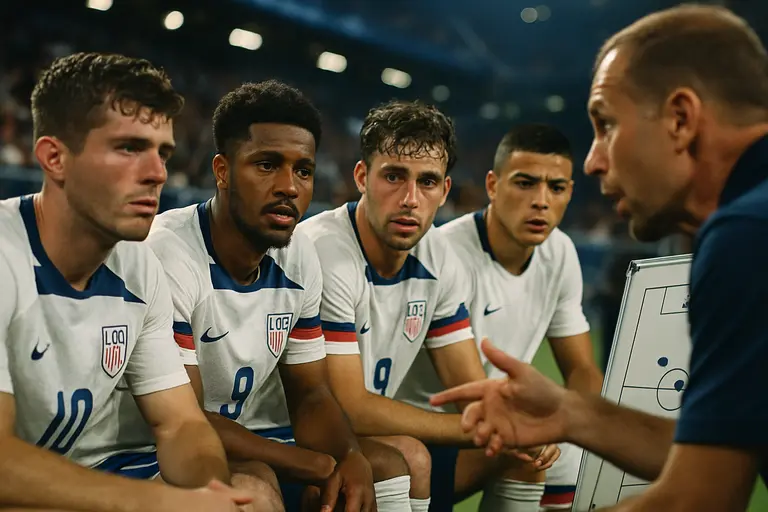
The June 1, 2026 friendly against Senegal offered a different type of adjustment. According to the research notes, Pochettino used mandated cooling breaks around the 20th minute to show tactical video to players on a laptop. Because those breaks were distributed ahead of the World Cup regardless of temperature, they became structured pauses rather than only player-safety stoppages.
From a rules and match-management perspective, that was notable. International coaches have limited chances to make detailed corrections during live play. A stoppage gives staff time to show spacing, pressing angles, or defensive distances in a direct way. The available notes do not establish how much that practice affected results, so the safest reading is that it reflected Pochettino’s preference for immediate tactical feedback, not a proven advantage by itself.
Rotation And Competitive Depth
The research also states that after his September 2024 appointment, Pochettino used international windows to test players rather than rely only on a narrow starting group. As of September 2025, the squad had averaged roughly 16 caps per player heading into the July 2025 Gold Cup Final. That figure points to a group with experience still being built, rather than a finished side centered on a fixed first eleven.
That selection policy connected to the tactical model. A hybrid system needs more than one player per role. If the right wing-back must sometimes defend as a full-back, attack as a winger, and receive like a midfielder, the staff needs multiple players capable of handling those shifts. For wider soccer coverage within the same network, readers can rely on Sports Wire News for tracking related competition and team developments across the sport.
World Cup Record And Tactical Outcomes
The 2026 FIFA World Cup gave the clearest competitive sample for Pochettino’s work. The research notes state that the United States won all three group-stage matches, including games against Paraguay and Australia, and finished first in Group D. The third group opponent is not named in the supplied notes, so it should be treated here only as an unspecified group-stage win.
On July 2, 2026, the United States defeated Bosnia and Herzegovina 2-0 in the Round of 32 despite going down to 10 men. The research notes identify that result as the USMNT’s first knockout-round win since 2002 and state that Pochettino set a U.S. record for most wins by a USMNT coach in a single FIFA World Cup. The tactical significance was clear: the team had to defend game state, manage territory, and protect structure while short-handed.
The broader attacking data from the 12 months before mid-2026 suggested balance rather than extreme finishing variance. The notes cite just under two goals per game and just under two expected goals per game across 17 fixtures, with about 54.8 percent possession, more than 20 touches inside the opposing penalty area, and around 10 deep completed passes per match. Those numbers described a team that regularly entered dangerous areas without relying only on low-volume finishing spikes.
A related internal review of post-World Cup tactical changes placed those ideas in the wider timeline of the national team’s development after the tournament.
Mauricio Pochettino’s USMNT Tactical Adjustments
The lasting value of USMNT Tactical Adjustments under Pochettino was the move toward repeatable structures. The team defended in one shape, attacked in another, and used role flexibility to create pressure points without abandoning defensive cover. That is the central tactical record of his completed 2026 cycle as reflected in the supplied research.
The system still depended on execution. Wing-backs had to recover after turnovers, central midfielders had to judge forward runs, and attacking players had to occupy spaces without crowding the striker. When those details worked, the United States could create overloads, sustain pressure, and control wide channels. When they failed, the back line risked being exposed by transitions into the space behind advanced full-backs.
By October 13, 2026, Pochettino’s USMNT tenure in this period was best understood through that balance: more flexible than a fixed 4-3-3, more aggressive than a conservative block, and more dependent on positional timing than on formation labels alone.