
Julian Hall had already received the biggest international opportunity of his young career before he stepped onto the field at Yankee Stadium on September 18. One day after the 18-year-old Red Bull New York forward received his first senior USMNT call-up, Hall scored the only goal in a 1-0 Hudson River Derby victory over New York City FC, with Mauricio Pochettino watching from the stands. The goal was Hall’s 10th of the 2026 MLS season and moved Red Bull New York above NYCFC in the Eastern Conference playoff race.
The sequence was significant because Hall was not simply celebrating a national-team selection with a routine league appearance. He delivered in one of MLS’s most recognizable rivalries, at Yankee Stadium, against a goalkeeper who was also selected for the new USMNT cycle in Matt Freese. Hall capitalized on an underhit back pass from James Sands and calmly finished in the 57th minute. It also ended a personal 12-match scoreless streak.
That combination makes Hall an important player to watch as Pochettino begins building toward the 2030 World Cup. His call-up does not guarantee a place in the eventual squad, but his age, MLS production, experience with Red Bull New York and ability to contribute in high-pressure matches give the USMNT coaching staff a substantial profile to evaluate.
Hall’s Derby Goal Came At A Significant Moment
Hall’s goal arrived at exactly the moment when his first senior international call-up could have changed the conversation around him.
On September 17, Pochettino announced a 28-player USMNT roster for matches against Peru, Chile, Mexico and Canada. Hall was one of 13 players on the roster without a senior cap. The group has an average age of 22 years and nine months and represents the beginning of Pochettino’s first complete four-year cycle toward 2030.
For Hall, the timing was particularly interesting because he did not have to wait weeks for his next opportunity to demonstrate why he had been selected.
Less than 24 hours later, Pochettino was at Yankee Stadium for the Hudson River Derby. Hall responded with the decisive moment.
The goal itself was straightforward rather than spectacular. Hall recognized the mistake, accelerated into the space, reached the loose ball before the defense could recover and finished beyond Freese. That sequence highlighted one of his most useful attacking characteristics: the willingness to attack uncertainty immediately.
A young forward does not need every goal to be technically extraordinary. Recognizing when a defense has lost control of a situation can be just as important.
Ten MLS Goals At 18 Change The Conversation
Hall’s 2026 production is the clearest reason his national-team opportunity has arrived now rather than later.
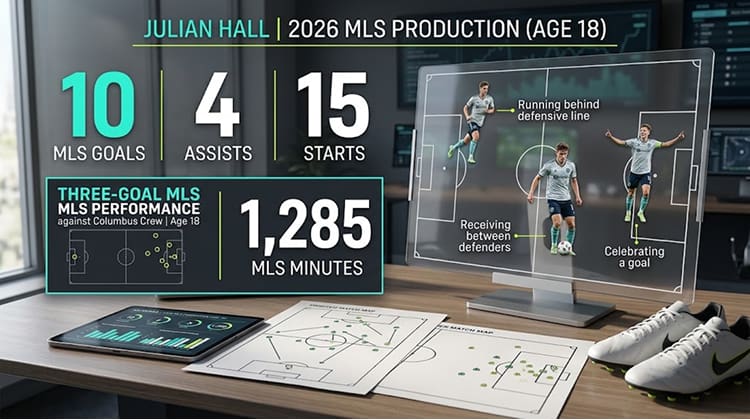
MLS lists Hall with 15 appearances and 15 starts, 1,285 minutes, nine regular-season goals and four assists in its player profile, while his September 18 derby goal brought his league total to 10. He also has three goals in two U.S. Open Cup appearances.
His season also contains an important historical marker.
On May 13, Hall scored a hat trick against Columbus Crew at 18 years and 50 days old, becoming the youngest player in MLS history to score three goals in a regular-season match. MLS subsequently recognized him as the league’s Matchday 13 Player of the Matchday.
That production matters because Hall is not accumulating statistics in a limited substitute role. He has become a regular starter for Red Bull New York.
His profile has therefore moved beyond the conventional category of “promising academy player.” The question is increasingly about how his professional production translates to international football.
For additional context on the American development pathway, WikiApp’s USMNT player pathway coverage can provide a broader look at how domestic clubs are increasingly contributing players to the national-team pool.
The Red Bull Model Fits Pochettino’s Demands
There is also a tactical connection worth examining.
Red Bull New York’s football identity has traditionally emphasized aggressive pressing, quick transitions and forcing opponents into uncomfortable situations. That environment can help young attacking players develop habits that are valuable in international football.
Hall’s derby goal demonstrated one aspect of that approach. Rather than waiting for a perfect attacking sequence, he reacted immediately to a defensive mistake and turned it into a scoring opportunity.
His movement without the ball is also important.
International football offers far fewer training sessions than club football. A national-team attacker therefore has limited time to understand teammates and tactical instructions. Players who already understand pressing triggers, defensive transitions and rapid attacking movements can potentially adapt faster.
That does not mean Hall is automatically ready to become a USMNT starter. It means his club environment gives Pochettino a useful foundation to evaluate.
Adri Mehmeti Makes The Red Bull Connection Even More Interesting
Hall is not the only Red Bull New York player entering the new USMNT cycle.
Adri Mehmeti, an 18-year-old midfielder, also received his first senior call-up in September. In the Hudson River Derby, Mehmeti led Red Bull New York in recoveries as Hall supplied the decisive goal.
That detail matters because it gives Pochettino two young players from the same club with different responsibilities.
Hall operates primarily as an attacking player, while Mehmeti provides midfield ball recovery and defensive work.
The national-team coaching staff can therefore observe whether some of the same principles that work at club level can translate into a national-team structure.
Red Bull New York also had Ronald Donkor called up by Ghana and David Ruiz called up by Honduras during the same international window, while Hall and Mehmeti represented the U.S. selection.
That makes the club’s player-development influence broader than Hall alone.
Red Bull New York Has Given Hall A Clear Identity
Hall’s development is closely connected to the Red Bull football structure.
He joined Red Bull New York’s academy before becoming a Homegrown player and made his MLS debut against Chicago Fire FC on September 30, 2023, at 15 years and 190 days old. He became the second-youngest goalscorer in MLS history when he scored against CF Montréal in June 2024.
The progression is important because Hall has not arrived at the senior national team through a single breakout season.
His pathway has included youth football, MLS NEXT, first-team training and increasingly significant MLS minutes.
MLS NEXT itself has become a major part of the American player-development ecosystem. At the start of its seventh season in 2026, MLS reported that 95% of U.S. Youth National Team call-ups in 2025 had spent time in MLS NEXT, while more than 250 current or former MLS NEXT players received youth national-team selections that year.
Hall is one of the clearest examples of that pathway reaching the senior level.
Hall Has Already Experienced Pressure Beyond His Age Group
One of the strongest indicators of Hall’s progression is how early he has been exposed to senior MLS football.
He made his professional debut at 15 and scored his first MLS goal before turning 17. By 2026, he had moved into a regular starting role and was producing at a level that placed him among the league’s notable young attackers.
The Hudson River Derby adds another layer.
Rivalry matches create an atmosphere that resembles some of the emotional pressures of international football. The stadium is loud, the opponent is familiar, the stakes are clear and individual mistakes can immediately change the match.
Hall’s ability to score in that environment does not prove how he will perform for the USMNT, but it provides another useful data point.
For Pochettino, those experiences can be more informative than simply looking at youth-team statistics.
The 12-Match Scoreless Run Is Also Worth Examining
Hall’s derby goal came after a 12-match league stretch without scoring.
That is important because development is rarely linear.
The goal against NYCFC should not erase the preceding drought, just as the drought should not erase the 10 goals he had already scored during the season. Both pieces of information are useful when evaluating an 18-year-old forward.
Young attackers are likely to experience fluctuations in finishing, confidence, defensive attention and playing time.
Hall’s response is more relevant than the streak itself.
He continued starting for Red Bull New York, remained involved in attacking situations and then converted an important opportunity in a major rivalry. That sequence provides Pochettino with evidence about how Hall responds when production temporarily drops.
The next stage of development will require greater consistency.
His First USMNT Camp Will Be A Different Test
Hall’s first senior camp will remove several advantages he has at club level.
At Red Bull New York, he knows the teammates around him, understands the team’s attacking patterns and has accumulated hundreds of training sessions within the same environment.
The USMNT is different.
Pochettino has players arriving from MLS, England, Germany, Italy, the Netherlands, Spain and other football environments. U.S. Soccer’s September roster included 21 players who had participated in the U.S. Soccer Development Academy or MLS NEXT, with 18 coming through MLS academy ranks. Since Pochettino took over in October 2024, 62 players have earned a USMNT cap.
Hall is therefore entering a national-team environment that is itself being rebuilt.
His first challenge will be learning how quickly Pochettino wants the team to press, how wide attackers should position themselves and how the front line should transition between possession and defensive phases.
Those details will matter more than his MLS reputation.
Peru, Chile, Mexico And Canada Offer Different Questions
Hall’s first international window includes four matches that can expose different parts of his game.
The United States plays Peru on September 26 in Orlando, Chile on September 29 in St. Louis, Mexico on October 3 in Glendale, Arizona, and Canada on October 6 in St. Paul, Minnesota.
That sequence could give Pochettino different tactical situations in which to evaluate his young attackers.
Peru and Chile provide South American opposition with different tactical traditions from MLS. Mexico offers a major Concacaf rivalry, while Canada provides another team that will be part of the North American competitive environment surrounding the 2030 cycle.
Hall does not need to score in every match.
His positioning, pressing, decision-making, ability to combine with established forwards and response to defensive pressure could be equally valuable indicators.
The 2030 Timeline Works In Hall’s Favor
Perhaps the most significant aspect of Hall’s current situation is his age.
Hall was born on March 24, 2008. He is 18 now, which means he would be 22 when the 2030 World Cup arrives.
That gives Pochettino considerable time.
If Hall remains healthy and continues progressing, he could spend the next four seasons moving from promising MLS attacker to established international player.
That timeline is exactly what Pochettino described when discussing the new cycle.
The coach has said the “project is 2030” and that upcoming camps are opportunities to identify players who can participate in the four-year process.
Hall does not need to become the USMNT’s leading attacker immediately.
His objective at this stage is to establish himself as a credible option.
Red Bull New York May Be Producing More Than One USMNT Player
The most interesting part of Hall’s breakthrough may ultimately be what it says about Red Bull New York’s development structure.
Hall and Mehmeti are already in the September USMNT group. MLS NEXT coverage has also highlighted younger Red Bull prospect Eric Lodge, describing him as a wide attacking player capable of following Hall’s pathway through the club academy.
That does not mean Lodge will follow the same trajectory.
Player development is too unpredictable for that kind of guarantee.
But the existence of another highly regarded attacking prospect coming through the same system suggests that Hall may be part of a broader development process rather than an isolated success.
For the USMNT, that is potentially more significant than one player.
A sustainable national-team pipeline needs clubs capable of repeatedly developing professionals who can eventually compete for senior international places.
Red Bull New York is becoming an important case study in whether that model can work.
Hall’s Next Step Is Consistency
The Hudson River Derby goal changed the immediate narrative around Julian Hall, but the larger test has already begun.
At 18, Hall has scored 10 MLS goals in 2026, recorded four assists, become a regular starter, made history with an MLS hat trick and earned his first USMNT call-up. He then scored against NYCFC with Pochettino watching from the stands.
Those are substantial milestones for a teenager.
They are also only the beginning of his senior career.
The USMNT now needs to determine whether Hall can turn flashes of elite attacking ability into a reliable international skill set. Red Bull New York provides the club environment for him to continue developing, while Pochettino provides a national-team pathway that could gradually increase his responsibilities.
For the moment, Hall’s most important achievement is not that he has become the USMNT’s next star.
It is that an 18-year-old who came through a New York academy has progressed far enough to become part of the conversation.
The September 18 Hudson River Derby supplied the latest evidence.
The next four years will determine what it means.