
Major League Soccer has spent years trying to change its reputation in the global transfer market. For much of the league’s history, MLS was primarily viewed as a destination for established international stars, particularly players approaching the latter stages of their careers. The 2026 transfer figures suggest that model is changing.
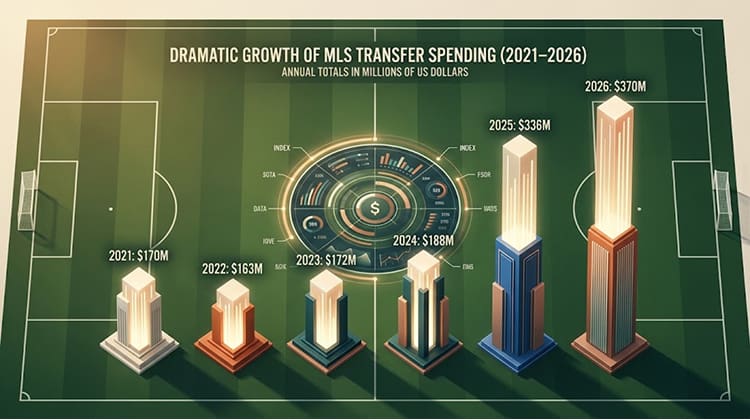
MLS clubs spent a record $370 million on player acquisitions in 2026, surpassing the previous record of approximately $336 million established in 2025. The number is even more significant when placed against the league’s recent history: clubs spent $188 million in 2024 and $172 million in 2023. In just three seasons, MLS transfer spending has more than doubled.
At the same time, MLS clubs generated $218 million in transfer revenue, another league record. That means the league is increasingly participating in both sides of the international market: buying players from abroad while selling MLS-developed talent to European and other global clubs.
The numbers raise a larger question for American soccer. Has MLS entered a new transfer era in which clubs are becoming more aggressive investors, more sophisticated developers and more credible sellers of professional talent?
The evidence increasingly points in that direction.
MLS Transfer Spending Has Changed Dramatically Since 2023
The $370 million figure is easier to understand when placed alongside the previous five seasons.
| Year | MLS Transfer Spending |
|---|---|
| 2021 | $170 million |
| 2022 | $163 million |
| 2023 | $172 million |
| 2024 | $188 million |
| 2025 | $336 million |
| 2026 | $370 million |
The jump from 2024 to 2025 was already enormous. MLS clubs increased their combined transfer expenditure from $188 million to approximately $336 million, an increase of almost 79%. The league then exceeded that record again in 2026.
The significance is not simply that clubs are spending more money.
They are spending it on a broader range of players.
MLS reported that the average age of international signings in 2026 was approximately 25 years, while nearly 60% of those additions were 25 or younger. That is important because it challenges the traditional assumption that MLS primarily recruits players near the end of their European careers.
The arrival of 30 players with World Cup experience, including 20 players who appeared on 2026 FIFA World Cup rosters, further demonstrates the changing profile of MLS recruitment. The group includes players arriving with significant experience at the international and European levels.
That shift is visible in clubs across the league.
Toronto FC acquired American striker Josh Sargent, while Atlanta United added Swiss international Breel Embolo. Orlando City brought in French World Cup winner Antoine Griezmann, Chicago Fire signed Robert Lewandowski, and Inter Miami added Brazilian midfielder Casemiro.
These moves represent a much broader recruitment strategy than simply signing aging stars.
MLS Is Buying Players In Their Prime
The most important change may be the age and competitive status of the players entering MLS.
The league’s 2026 recruitment included players who can contribute immediately while potentially retaining significant market value. That creates a different economic calculation for clubs.
A 25-year-old international player can help a team compete today while potentially becoming a valuable asset tomorrow. A 32-year-old star may produce enormous commercial and sporting benefits but has a fundamentally different resale profile.
MLS clubs increasingly appear willing to pursue the first model.
Colorado Rapids’ acquisition of Morgan Whittaker provides a useful example. The 25-year-old English winger arrived from Middlesbrough in a club-record inbound transfer reportedly worth $10.7 million after producing 14 goals and seven assists in his previous Championship season. Colorado gave him a contract through 2029-30, with an option for 2030-31.
Whittaker was not recruited simply as a famous name.
He was recruited as a player entering his prime who could improve the team immediately.
The same principle can be seen in other major transactions. MLS clubs are increasingly looking for players who fit competitive models rather than simply players who can generate attention.
That distinction could become one of the defining characteristics of the league’s next transfer era.
For more context on the league’s changing roster market, MLS transfer records show how quickly the player movement landscape has expanded.
The $218 Million In Transfer Revenue May Be Even More Important
Spending $370 million is impressive, but the $218 million in transfer revenue could ultimately be the more important number for MLS.
A league that spends heavily without producing valuable outgoing transfers can become dependent on external investment. A league that both acquires and sells talent begins to develop a sustainable transfer ecosystem.
MLS generated $60 million in transfer revenue in 2021, followed by $114 million in 2022, $99 million in 2023, $143 million in 2024 and $202 million in 2025. The 2026 figure of $218 million establishes another record.
That growth coincides with a significant increase in demand for young MLS players.
Fifteen players developed through the MLS Player Pathway generated more than $65 million in outgoing transfer fees during 2026. Among them were Zavier Gozo, Alex Freeman, Max Arfsten, Benjamin Cremaschi, Obed Vargas and Sebastian Berhalter.
The Gozo transfer is particularly significant.
Real Salt Lake sold the 19-year-old Homegrown attacker to Crystal Palace for a reported $15 million. Gozo had produced 10 goals and eight assists across roughly a season and a half of first-team football before making the move to the Premier League.
That is precisely the type of transaction MLS needs if it wants to be taken seriously as a development league.

The objective is no longer simply to keep talented players in North America.
It is to develop them, give them meaningful first-team minutes, increase their value and eventually sell them into larger global markets.
The Homegrown Market Is Becoming A Strategic Asset
The growing value of MLS-developed players also changes how clubs should view their academies.
For years, youth development was often discussed primarily in terms of sporting identity. Clubs wanted local players because academies could strengthen community relationships and provide a pathway for young athletes.
The economics are now becoming equally important.
A successful academy player can represent millions of dollars in future transfer revenue.
Gozo is one example. Lucas Herrington, an 18-year-old Australian defender developed by Colorado, moved to Hull City in a deal that MLS reported among the largest outgoing fees in league history. Alex Freeman moved from Orlando City to Villarreal, while Max Arfsten left Columbus Crew for Middlesbrough. Obed Vargas moved from Seattle Sounders to Atlético Madrid.
The destinations matter.
These are not simply transfers to smaller foreign leagues. They include clubs from the Premier League, LaLiga and other major European competitions.
That changes the credibility of the MLS development pathway.
A teenager entering an MLS academy can now see a clearer professional route:
Academy → MLS first team → European transfer → higher-level international competition.
That pathway does not guarantee success, but its existence is becoming increasingly difficult to dismiss.
The growth of MLS NEXT reinforces the trend. The 2026-27 season is the largest in the program’s history, with more than 53,000 players, 2,743 teams and 310 clubs competing across the United States and Canada.
The more effectively those players can be identified and developed, the larger the potential talent pool becomes.
Cash-For-Player Trades Are Changing MLS From Within
International transfers are only part of the story.
MLS clubs also spent approximately $46 million on intra-league cash-for-player trades in 2026, with 92% of those transactions involving a Designated Player or U22 Initiative signing. The average age of players acquired through cash trades was only 24.
That is a major structural change.
Historically, MLS trades were heavily shaped by allocation mechanisms, draft considerations and other league-specific assets. The growing use of cash gives clubs another way to compete for proven players without relying exclusively on international recruitment.
The league’s new environment has already produced enormous domestic transactions.
In September, St. Louis CITY SC acquired Rafael Navarro from Colorado Rapids for $12 million, with another $250,000 potentially available through conditional compensation. It became the largest cash-for-player trade in MLS history.
Colorado then used its increased financial flexibility to sign Whittaker for its own club-record inbound fee.
That sequence illustrates something important about the new MLS market.
Money can now circulate between clubs.
Colorado can sell a proven scorer, receive a record domestic fee, and reinvest in another player. St. Louis can spend heavily on an established striker because it believes the player’s production will justify the investment.
That is much closer to the transfer behavior of mature global leagues.
The World Cup Has Accelerated MLS’s Global Position
The 2026 FIFA World Cup appears to have added another layer of momentum.
Thirty players with World Cup experience joined MLS clubs during the year, including 20 players from the tournament’s final rosters. At the same time, MLS-developed players were being transferred to European clubs.
The league is therefore operating in both directions.
Experienced international players are entering MLS, while younger MLS players are leaving for Europe.
That creates a potentially useful competitive cycle.
International players bring tactical knowledge, professional habits and experience from stronger leagues. Young MLS players compete against them, learn from them and gain exposure to higher-level football. The best young players can then move abroad.
The global transfer market itself reached unprecedented levels after the World Cup. FIFA reported that men’s football clubs spent $9.89 billion on international transfer fees during the 2026 mid-year window, with more than $3.3 billion generated by players who participated in the World Cup.
MLS is operating inside that global market rather than outside it.
That distinction matters.
The Biggest Question Is Whether Spending Will Produce Competitive Results
Record spending does not automatically create a better league.
MLS clubs now have more financial power, but money must translate into better recruitment, stronger coaching, improved tactical environments and more consistent competition.
The challenge is particularly relevant because MLS clubs are competing against Liga MX in North America and European leagues for international talent.
The 2026 Leagues Cup provided a reminder that spending alone does not erase competitive differences. Liga MX clubs dominated the knockout stages, with Toluca eventually defeating Monterrey 2-0 in an all-Mexican final.
MLS therefore has another objective beyond increasing its transfer budget.
It must become better at converting investment into performance.
That requires clubs to identify the right players, develop them within coherent tactical systems and create pathways where young talent receives meaningful minutes.
The best evidence that this process is developing may actually be the combination of incoming and outgoing transactions.
What The New Transfer Era Could Mean For MLS Clubs
The 2026 numbers suggest MLS clubs are beginning to operate with several different transfer strategies at the same time.
Some clubs are buying established international stars. Others are targeting players entering their prime. Some are investing heavily in young international talent. Others are increasingly willing to pay significant domestic fees for players already proven in MLS.
The most sophisticated clubs may eventually combine all four approaches.
| Transfer Strategy | Example | Strategic Objective |
|---|---|---|
| International star | Robert Lewandowski, Chicago Fire | Immediate quality and global profile |
| Prime-age international | Morgan Whittaker, Colorado Rapids | Performance plus future value |
| Domestic proven player | Rafael Navarro, St. Louis CITY | Immediate MLS production |
| Homegrown development | Zavier Gozo, Real Salt Lake | Develop and sell internationally |
This creates a much more complicated competitive landscape.
A club such as Real Salt Lake can develop a player like Gozo and generate a major European transfer. Colorado can sell Navarro and immediately reinvest in Whittaker. St. Louis can spend $12 million on a proven striker. Toronto can make a major investment in an American international such as Sargent.
The league is developing multiple routes to roster improvement.
That flexibility did not exist at this scale a decade ago.
MLS Still Has A Long Way To Go
The $370 million record should not be mistaken for evidence that MLS has reached the financial level of Europe’s major leagues.
It has not.
The global transfer market remains dominated by clubs in England, Spain, Italy, Germany and France, while FIFA’s 2026 data illustrates the enormous scale of international spending worldwide. MLS remains a different economic model with its own roster rules, salary mechanisms and commercial structure.
The league also faces the question of whether its current spending trajectory is sustainable.
Spending $370 million in one season is one achievement. Building clubs that consistently develop players, sell them for significant fees, reinvest those proceeds and improve competitively is much harder.
But the direction is clear.
MLS spent $172 million on transfers in 2023.
Three years later, that number has reached $370 million.
During the same period, transfer revenue has increased from $99 million to $218 million, while the league has begun producing increasingly valuable young players for European clubs.
That combination is what separates 2026 from previous spending records.
The league is becoming both a buyer and seller.
The Real MLS Transfer Revolution Is About The Two-Way Market
MLS has entered a new transfer era, but the defining feature is not simply the amount of money being spent.
It is the emergence of a two-way market.
The league is importing established players such as World Cup veterans while exporting young talent such as Gozo, Herrington, Freeman and Vargas. It is spending millions between domestic clubs while academy systems increasingly function as potential sources of future transfer revenue.
That changes the economic logic of American soccer.
An MLS club no longer has to view a young player solely as someone who can help the first team.
The player can also become a major financial asset.
At the same time, an international signing no longer has to be a short-term commercial acquisition. If he arrives at 24 or 25 and performs well, he can potentially become part of a club’s competitive core for several seasons.
The $370 million record therefore represents more than a new spending milestone.
It is evidence that MLS clubs are becoming more willing to invest significant money in the quality, age profile and future value of their squads.
The next test will be whether those investments produce better teams.
If they do, the 2026 transfer record may eventually be remembered as the season when MLS stopped behaving primarily like a destination league and began operating more convincingly as a global transfer market of its own.