
Cavan Sullivan has reached the point where his age is becoming less relevant than his production. The Philadelphia Union midfielder turned 16 in September 2025, yet he is already producing at a level that has forced Major League Soccer, U.S. Soccer and former national-team players to consider a question that seemed premature only months ago: should Sullivan receive his first senior USMNT call-up?
The timing is especially significant. Mauricio Pochettino is beginning his second phase as U.S. men’s national team head coach after signing a contract extension through 2030, and the first four friendlies of the new cycle begin September 26 against Peru in Orlando. Sullivan is among the young American players Pochettino has publicly acknowledged watching, while his recent performances for Philadelphia have made the discussion increasingly difficult to ignore.
Sullivan’s case is no longer based solely on potential. On September 5, he scored in Philadelphia’s 2-0 victory over CF Montréal at Subaru Park, giving him a goal in three consecutive matches. The goal also pushed his 2026 MLS production to four goals and seven assists, giving him 11 league goal contributions and moving him past Freddy Adu’s previous benchmark for a player aged 16 or younger.
That makes the USMNT question more complicated than simply asking whether Sullivan is talented enough. The real issue is whether the national team should accelerate his pathway now, or allow Philadelphia’s development structure to continue preparing him for the considerably different demands of international senior soccer.
Sullivan’s Numbers Have Changed The Conversation
Sullivan’s rise has been unusually fast even by MLS standards.
Born in Philadelphia on September 28, 2009, Sullivan became the youngest player to appear in an MLS match when he debuted for the Union in July 2024 at 14 years and 293 days. He signed with Philadelphia as a Homegrown player and already has an agreement to join Manchester City when he becomes eligible to move to England at 18.
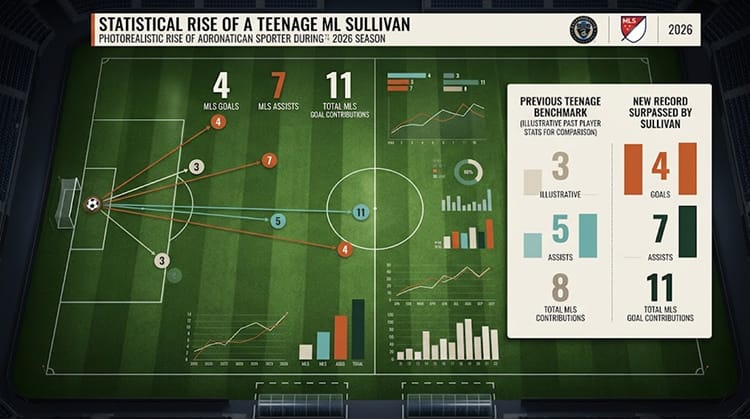
The progression from historic debut to meaningful first-team contributor has been the more significant development.
In 2025, Sullivan appeared in 11 MLS matches and made one start. He played only 214 minutes. By 2026, his role had expanded substantially, and Philadelphia began trusting him with longer stretches and more responsibility in attacking areas. He recorded his first MLS assist against Charlotte FC on April 4 before scoring his first league goal against Orlando City on May 13. In that Orlando match, he also supplied two assists.
His production accelerated through the summer.
On August 29, Sullivan scored a spectacular individual goal in Philadelphia’s 3-1 victory over the New York Red Bulls. That performance brought him to 10 MLS goal contributions — three goals and seven assists — tying Adu’s single-season record for a player aged 16 or younger. One week later, his goal against Montréal gave him sole possession of that mark with 11 contributions.
MLS also reported that Sullivan had become part of a historic nine-game streak in which a teenager recorded a goal or assist for Philadelphia, extending the longest such streak by a teenager in MLS history.
The broader numbers are equally important. Sullivan has contributed across MLS, the Concacaf Champions Cup and Leagues Cup, giving him seven goals across all competitions during his breakout 2026 campaign. His workload is no longer that of an academy prospect receiving occasional minutes; he is increasingly being treated as a first-team attacking player.
That distinction matters for the USMNT.
Philadelphia Has Given Sullivan A Different Kind Of Preparation
The strongest argument for a call-up is not that Sullivan is young and exciting. It is that Philadelphia has already exposed him to professional football in situations where mistakes have consequences.
The Union have given Sullivan opportunities to play alongside established professionals while allowing him freedom to attack defenders and create chances. Interim head coach Ryan Richter has repeatedly emphasized that the team trusts Sullivan to make things happen in one-on-one situations.
That freedom is visible in Sullivan’s style.
He is a creative midfielder who can receive the ball in tight areas, attack defenders and generate opportunities without needing a long sequence of possession to become involved. His unpredictability is one of his greatest strengths. Instead of waiting for a perfect attacking structure, he can manufacture an advantage himself.
Philadelphia’s system has therefore tested more than his technical ability. Sullivan has had to deal with physical defenders, tactical adjustments, road environments and the expectations that come with becoming a recognizable professional player.
His September 5 performance against Montréal illustrated another important step. Sullivan did not need a spectacular individual action to influence the match. His 75th-minute goal came as Philadelphia protected a lead, and the Union used the result to extend their unbeaten MLS streak to eight matches.
That evolution from highlight creator to productive contributor is one of the reasons the USMNT conversation has become more serious.
The USMNT Timeline Is Already Moving
The timing of Sullivan’s emergence is almost as significant as the player himself.
The 2026 World Cup ended with the United States eliminated by Belgium in the Round of 16, a disappointing result for a team playing at home. Pochettino’s contract extension through 2030 subsequently expanded his responsibilities beyond match preparation, giving him a broader role involving youth development, coaching education and cooperation across the American soccer structure.
That changes the purpose of the next USMNT camps.
The United States does not have to qualify for the 2030 World Cup as tournament hosts, meaning Pochettino has a rare opportunity to experiment with personnel during the four-year cycle. The immediate schedule includes Peru on September 26 in Orlando, Chile on September 29 in St. Louis, Mexico on October 3 in Glendale, Arizona, and Canada on October 6 in St. Paul, Minnesota.
A player such as Sullivan therefore does not have to be viewed solely through the lens of whether he can immediately start against elite international opposition.
A call-up could instead serve as an evaluation period.
Pochettino could expose Sullivan to the senior environment, assess how he responds to the speed and physicality of international football, and determine whether his tactical understanding is developing quickly enough for more responsibility.
The coach has already indicated that Philadelphia’s young players are on his radar. Speaking about the Union’s emerging talent, Pochettino said the club has “good young players” who could receive call-ups.
That does not guarantee Sullivan will be selected. But it confirms the door is open.
The Argument Against Rushing Sullivan
There is an equally strong case for patience.
Pochettino himself has warned against placing excessive pressure on young players. In his recent comments about the beginning of the 2030 cycle, he emphasized the need to protect emerging talent from the expectations that can surround teenage prospects. Reuters reported that Sullivan is among several young Americans being monitored, but Pochettino wants to prevent hype from becoming a burden that damages development.
That warning is particularly relevant to Sullivan because his profile is already enormous.
He has a historic MLS debut, a future connection with Manchester City, youth international experience and a rapidly expanding media profile. He is also playing in Philadelphia, one of America’s major sports markets, where his performances are increasingly becoming part of the city’s broader sports conversation.
The temptation is obvious: call him up, put him on the bench, give him a few minutes and allow the public to see the next potential USMNT star.
But development does not always move in a straight line.
Sullivan is listed at 5-foot-7 and 150 pounds, according to Philadelphia’s official player profile. His technical qualities are already advanced, but senior international soccer will expose him to stronger and more experienced opponents than many of the situations he currently encounters in MLS.
A senior call-up should therefore be treated as an educational step rather than a declaration that Sullivan has already arrived.
That distinction could determine whether the move helps him.
What Sullivan Still Needs To Prove
The statistics show that Sullivan can create and finish chances. The next stage is proving that he can influence matches consistently without relying on individual brilliance.
That means improving several areas simultaneously.
First, his decision-making needs to become increasingly reliable when opponents remove his preferred attacking options. International teams will study his tendencies and close the spaces where he can turn toward goal.
Second, his physical development will matter. Sullivan does not need to become a conventional power player, but he must learn how to protect possession, absorb contact and maintain his effectiveness against stronger opponents.
Third, his defensive contribution will become more important. A national-team midfielder cannot always wait for the ball in attacking positions. Pochettino’s teams require coordinated pressing, positional discipline and quick reactions after possession changes.
Finally, Sullivan must demonstrate that his production can survive tactical changes.
Philadelphia’s environment gives him a defined role. The USMNT can demand something completely different from one match to the next. One game might require a creative attacking midfielder; another might require a player who protects a lead or presses aggressively without the ball.
That is the real test of his readiness.
| Development Area | Sullivan’s Current Evidence | USMNT Question |
|---|---|---|
| Chance creation | 7 MLS assists in 2026 | Can he create against compact international defenses? |
| Goal production | 4 MLS goals in 2026 | Can his finishing translate against stronger opposition? |
| 1-v-1 ability | Repeated highlight-level attacking plays | Can he make those actions consistently at international speed? |
| Tactical maturity | Increasing first-team role with Philadelphia | Can he execute Pochettino’s defensive and positional demands? |
| Physical development | 16-year-old professional competing in MLS | Can he handle senior international contact and intensity? |
The answers do not have to be complete before Sullivan receives his first invitation.
The Manchester City Factor Changes The Long-Term Calculation
Sullivan’s future at Manchester City adds another layer to the USMNT decision.
Philadelphia’s agreement means Sullivan is expected to remain with the Union until he reaches 18 before moving to England. That creates a valuable development window in which he can continue accumulating professional minutes in MLS before entering one of Europe’s most demanding academy environments.
For U.S. Soccer, the situation is unusual.
The federation is effectively watching a player develop in one of America’s strongest professional environments before he potentially moves into the Manchester City system. A senior USMNT introduction during that period could help establish the international pathway without forcing Sullivan to leave MLS prematurely.
It also gives Pochettino an opportunity to build a relationship with the player before his European transition.
That matters because the next four years could contain several major changes for Sullivan. His role at Philadelphia will evolve. His body will mature. His tactical education will expand. Then, at 18, he will face a new competitive environment in England.
The best USMNT strategy is therefore unlikely to be about extracting maximum short-term value from him.
It should be about preparing him for the 2030 tournament.
Cavan Sullivan And The 2030 USMNT Project
The most interesting part of Sullivan’s emergence is that he fits directly into the structural problem Pochettino has been asked to address.
The 2026 World Cup exposed the gap between American talent and consistent international performance. The United States produced enough quality to win its group and defeat Bosnia and Herzegovina, but Belgium exposed weaknesses in game control, defensive organization and the ability to respond when the match moved against the team.
Pochettino’s expanded role gives him four years to address those issues.
Sullivan represents one possible piece of that project.
He is already playing professional soccer at 16. He is already producing against MLS opposition. He has already played in continental competition. And he is already operating in an environment where the club expects him to make decisions rather than simply participate.
Those experiences can become valuable building blocks for 2030.
But Sullivan should not be asked to fix the USMNT’s problems.
He should be allowed to develop inside a system that eventually makes him capable of solving some of them.
That distinction is central to Pochettino’s philosophy. The coach has spoken about wanting the United States to become one of the world’s most powerful soccer nations, while also arguing that young players need the right environment and expectations to reach their potential.
Sullivan’s development may therefore be a useful test of the entire American pathway.
If Philadelphia can turn an extraordinary 14-year-old debutant into a productive 16-year-old starter, and Manchester City can later continue that development in Europe, U.S. Soccer will have another example of how the domestic system can produce players capable of competing at the highest level.
Should Pochettino Call Sullivan Up Now?
Yes — but the call-up should come with carefully defined expectations.
Sullivan does not need to start against Peru. He does not need to become a regular immediately. He does not even need to play significant minutes in every camp.
The most logical first step would be bringing him into the senior environment and evaluating him alongside established players.
That would allow Pochettino to answer questions that MLS statistics cannot.
How does Sullivan process instructions at senior international level? How quickly does he adapt to teammates he has never played with? Can he execute defensive assignments? Does he maintain his creativity when opponents close him down? How does he respond physically and mentally when the game becomes faster?
Those answers would be more valuable than another month of speculation.
The timing is also favorable because the next USMNT roster is expected in mid-September, ahead of the four-match autumn schedule. Sullivan’s September 5 goal against Montréal has given Pochettino another piece of evidence just days before that decision.
If Sullivan is selected, it should be viewed as the beginning of an evaluation process rather than the end of his development.
If he is not selected, that should not be interpreted as a setback either.
At 16, the larger objective is to make sure his trajectory remains positive.
Cavan Sullivan has already moved from record-breaking teenager to legitimate MLS contributor. His four MLS goals and seven assists in 2026, combined with production across continental competitions, have transformed the conversation around him. He has surpassed Freddy Adu’s MLS goal-contribution benchmark for players aged 16 or younger, scored in three straight league matches, and become one of the most watched American teenagers in professional soccer.
The next question is no longer whether Sullivan belongs in the conversation about the USMNT.
He clearly does.
The question is how carefully the United States manages the next stage.
For Pochettino, that makes Sullivan more than a potential call-up. He is an early test of the 2030 project itself: whether American soccer can identify exceptional young talent, challenge it at the right time, protect it from unnecessary pressure and eventually turn promise into international-level performance.
A senior USMNT debut in September or October would be meaningful. But the real measure of success will come later, when Sullivan arrives at the 2030 cycle with hundreds of additional professional minutes, a European education at Manchester City and enough tactical maturity to contribute to a national team built around players developed for the next era.
For now, Philadelphia is giving him the most important thing a 16-year-old prospect can have: meaningful responsibility. The USMNT’s job is to decide when the next responsibility should begin.