
The 2026 Leagues Cup ended with a result that Major League Soccer had spent the previous three editions trying to prevent: complete Liga MX control of the tournament’s decisive stages. All four MLS clubs that reached the quarterfinals were eliminated by Mexican opposition, leaving Toluca, Club León, Club América and CF Monterrey to form the first all-Liga MX semifinal field of the competition’s modern era. Toluca eventually defeated Monterrey 2-0 in the September 6 final at Shell Energy Stadium in Houston, giving Liga MX another trophy and ending MLS’s three-year championship run.
The result matters because the Leagues Cup was becoming one of the clearest annual tests of whether MLS could close the competitive gap with Mexico’s top division. Inter Miami won the 2023 edition, Columbus Crew won in 2024 and Seattle Sounders captured the 2025 tournament. In 2026, however, MLS failed to place a single club in the final, while the top three positions all went to Mexican teams. The result does not prove that MLS has stopped progressing, but it does expose several areas where Liga MX still holds an advantage when the competition moves from regular-season depth to high-pressure knockout football.
Liga MX Took Control Before The Semifinals
The most revealing part of the 2026 tournament was that the Mexican sweep did not happen through one surprise result. It developed across four separate quarterfinal matchups.
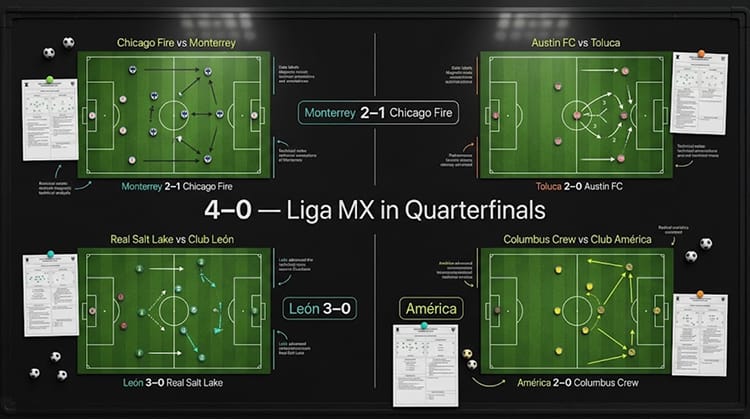
Chicago Fire entered the knockout stage as one of MLS’s strongest representatives after taking all nine available points during Phase One. Monterrey eliminated Chicago 2-1. Austin FC then lost 2-0 to reigning Concacaf Champions Cup winner Toluca. Real Salt Lake fell 3-0 to Club León, while Columbus Crew lost 2-0 to Club América. That left four Liga MX teams standing and no MLS club capable of reaching the semifinal stage.
The quarterfinal results were significant because the 2026 format deliberately created interleague matchups through the quarterfinals. Concacaf’s structure placed the four best MLS teams from Phase One against the four best Liga MX teams, creating a direct comparison rather than allowing one league to accumulate knockout victories against its own clubs.
| 2026 Leagues Cup Quarterfinal | Result | Winner |
|---|---|---|
| Chicago Fire vs. Monterrey | Monterrey 2-1 | Liga MX |
| Austin FC vs. Toluca | Toluca 2-0 | Liga MX |
| Real Salt Lake vs. Club León | León 3-0 | Liga MX |
| Columbus Crew vs. Club América | América 2-0 | Liga MX |
That is the central statistic of the tournament. MLS did not lose one decisive matchup. It lost all four.
The distinction matters because knockout tournaments are often shaped by individual moments, penalties or one-off tactical decisions. A four-match sweep suggests a broader competitive pattern. Liga MX’s top teams consistently found ways to control the games that determined who advanced.
Toluca Finished The Job In Houston
The final provided the clearest possible ending to the MLS-Liga MX comparison.
Toluca defeated Monterrey 2-0 on September 6 at Shell Energy Stadium, with Alexis Vega opening the scoring and Helinho adding the second goal. The victory gave Toluca the 2026 Leagues Cup championship and completed a tournament in which Liga MX occupied all four semifinal positions.
The location added another layer to the story. The final was played in Houston rather than Mexico, meaning Liga MX’s strongest clubs were able to dominate the decisive rounds while playing the championship match on U.S. soil. The tournament had also introduced matches in Mexico for the first time in 2026, creating a more geographically balanced competition than previous editions.
For MLS, that removes one potential explanation for the result. The tournament was no longer simply a case of Mexican teams benefiting from familiar environments or MLS clubs facing difficult travel conditions in Mexico.
The competitive problem was more fundamental.
MLS Had The Depth, But Liga MX Had The Knockout Edge
One of the most interesting elements of the 2026 Leagues Cup is that MLS did not enter the competition as an obviously inferior group.
Chicago Fire dominated Phase One with nine points. Austin FC finished among the strongest MLS representatives. Columbus Crew entered as the 2024 champion, while Real Salt Lake had enough attacking production to reach the knockout stage. The issue emerged when those teams faced the strongest Liga MX opposition in direct elimination matches.
That distinction is important for evaluating the state of North American soccer.
MLS has made substantial progress in roster investment, infrastructure, academy development and international recruitment. Clubs increasingly operate with sophisticated scouting departments and larger sporting staffs. Players such as Lionel Messi, Sergio Busquets, Olivier Giroud, Marco Reus and other established internationals have also increased the league’s profile.
But the Leagues Cup measures something different from regular-season development.
It measures whether a club can assemble a squad capable of winning a high-stakes match against an opponent with comparable resources but a different football culture.
The 2026 results suggest Liga MX remains particularly strong in that environment.
The Concacaf competition structure also makes the tournament increasingly important because the top three finishers qualify for the 2027 Concacaf Champions Cup, with the Leagues Cup champion receiving direct entry to the Round of 16.
That creates an incentive for clubs to treat the competition as more than an exhibition series.
The Semifinals Confirmed A Shift In Tournament Balance
Once the quarterfinals were completed, the competition entered territory MLS had never experienced under the modern format.
Toluca faced Club León at Shell Energy Stadium in Houston on September 2, while América met Monterrey at Dignity Health Sports Park in Carson, California. The semifinal stage was therefore entirely Mexican for the first time since the modern Leagues Cup began in 2023.

Toluca’s 2-0 victory over León was built around goals from Federico Pereira and Federico Viñas. Monterrey reached the final through a more dramatic route, drawing 2-2 with América before winning the penalty shootout 5-4. Diego Rossi and Lucas Ocampos scored for Monterrey in regulation, while goalkeeper Rodolfo Cota had already played an important role for América during the tournament.
The semifinal results also highlighted the different profiles of the remaining Liga MX teams. Toluca entered the tournament as the reigning Concacaf Champions Cup winner and had already defeated Austin FC. León arrived undefeated through its first four matches against MLS opposition, while Monterrey recovered from an early tournament setback to eliminate Chicago and América.
This was more than a collection of Mexican clubs getting hot at the right time. It showed that several different Liga MX roster constructions could succeed against MLS opposition: the established continental power, the defensively disciplined challenger and the experienced squad capable of surviving elimination matches.
The Format Gives MLS A Better Test Than Before
The 2026 tournament was the fourth edition of the modern Leagues Cup and included 36 clubs: all 18 Liga MX teams and 18 MLS qualifiers. Phase One divided the field into Eastern and Western regions and guaranteed interleague competition before the quarterfinals. The four best teams from each league advanced to the knockout stage.
That structure makes the 2026 results more useful as a competitive measurement than earlier versions of the tournament.
MLS and Liga MX are no longer simply meeting in occasional showcase matches. The current format produces a meaningful sample of direct games between clubs from both systems and then concentrates the best performers into a knockout stage.
The 2026 quarterfinal sweep therefore deserves more attention than a single upset.
It exposed what happens when the strongest representatives of each league meet under tournament pressure.
For WikiApp’s broader examination of MLS transfer strategy, the result also raises an important question: are American clubs spending enough on the type of players and roster depth required for international knockout success, or are they still prioritizing regular-season efficiency over tournament specialization?
That distinction could become increasingly important as MLS clubs take part in more Concacaf competitions.
Liga MX Still Has A Different Relationship With High-Level Competition
The 2026 Leagues Cup also reinforced the importance of Liga MX’s long-established competitive ecosystem.
Mexican clubs routinely operate in an environment where domestic league matches, Liga MX playoffs and Concacaf competitions overlap with high expectations. Clubs such as Toluca, América and Monterrey are accustomed to entering tournaments with the expectation that winning the competition is the objective rather than simply reaching the knockout rounds.
Toluca’s 2026 season is particularly revealing.
The club arrived as the reigning Concacaf Champions Cup champion and then won the Leagues Cup, demonstrating that its success was not limited to one competition. Its ability to handle Austin FC, León and Monterrey across the latter stages of the tournament showed a squad capable of adapting to different tactical challenges.
That matters because MLS clubs are increasingly trying to build rosters that can compete across multiple competitions. The challenge is that adding expensive attackers or recognizable international players does not automatically create a tournament-ready team.
Knockout football rewards defensive organization, game management, set-piece execution, experience and the ability to survive periods without possession.
Liga MX demonstrated those qualities throughout the decisive stages.
What MLS Should Take From The 2026 Sweep
The worst possible response for MLS would be to treat the result as a simple bad tournament.
There are several more useful lessons.
First, MLS clubs need to evaluate their roster construction against international opponents rather than only against domestic competition. A player who performs consistently across a long MLS season may still struggle against a Liga MX opponent capable of increasing the tempo, pressing aggressively or exploiting small defensive gaps.
Second, squad depth matters. The Leagues Cup arrives in the middle of the MLS calendar, meaning teams must balance domestic fixtures with a tournament that can suddenly become their most important competition of the month.
Third, experience matters in knockout football. The 2026 semifinalists included clubs with players accustomed to major continental and international environments. MLS’s continued investment in young players and European transfers is valuable, but that development model needs to coexist with enough veteran leadership to manage elimination games.
Fourth, the result should push MLS clubs to treat Concacaf competitions as a strategic priority.
MLS has already demonstrated that its best teams can beat Liga MX opponents. The problem is consistency. The 2024 Leagues Cup provided one of the clearest examples when Columbus Crew defeated Los Angeles FC in the final, while Colorado Rapids also reached the third-place match after eliminating four Mexican clubs.
The 2026 tournament simply moved the comparison in the opposite direction.
The Result Does Not Erase MLS Progress
It would be equally wrong to interpret the tournament as proof that MLS has failed to close the gap.
The league’s growth is visible in player development, transfer fees, academy systems, stadium investment and the increasing ability of American clubs to attract globally recognized talent.
The more accurate conclusion is that the gap remains uneven.
MLS has become strong enough to challenge Liga MX regularly. It has not yet become strong enough to dominate the region’s biggest club competitions consistently.
That distinction is crucial.
The 2026 Leagues Cup showed the difference between league growth and competitive supremacy.
MLS can produce stronger clubs, better-developed young players and more sophisticated sporting operations while still losing a tournament like this one. Liga MX’s advantage in 2026 was not necessarily that every Mexican club was better than every MLS club. It was that the four Mexican teams that reached the quarterfinals were better prepared to survive the matches that mattered most.
A New North American Benchmark
The significance of the 2026 Leagues Cup will ultimately depend on what happens next.
If MLS responds by improving its tournament preparation, strengthening roster depth and producing more consistent results in Concacaf competitions, the all-Mexican final four could become a temporary setback.
If the same pattern repeats in the next several editions, however, the result will look increasingly like evidence of a structural difference.
Toluca’s championship gives Liga MX the trophy. Monterrey, León and América give the league the rest of the top four. MLS gets none of the three Concacaf Champions Cup qualification positions awarded through the Leagues Cup because all three places went to Mexican clubs.
That is the part MLS cannot ignore.
The 2026 Leagues Cup was supposed to provide another test of whether North America’s two largest professional leagues were moving toward genuine competitive parity. Instead, the tournament produced the clearest recent reminder that the gap has narrowed without disappearing.
For MLS, the next challenge is no longer proving that American clubs can beat Liga MX teams.
They already can.
The challenge is doing it consistently when the stakes are highest.