
Imagine Neymar crying in an empty stadium in Lisbon. It’s a perfect picture of FC Bayern Munich beating the big money teams. When Kingsley Coman scored the winning goal in 2020, it was more than just a win. It showed that sausage-fueled pragmatism can beat the fancy teams.
While others spend big with money from rich owners, Bayern has a different way. They have 400,000 members who own the club. Thomas Müller said, “Tradition isn’t about fancy things.” Bayern’s 2023 income of $780M shows they can afford to be smart with their money.
Bayern is like Germany’s answer to Real Madrid’s big dreams. They’ve won 34 national titles without spending too much. Their stadium, the Allianz Arena, is a place where Bavarian pride shines. They say, “Why spend a lot when you can win big?”
The Founding Story
What do soccer clubs and indie bands have in common? They often start with a group of rebels. Bayern Munich began with a group of 11 rebels at Café Gisela in 1900. They left their gymnastics club to play soccer.
Early Years and the Munich Football Scene
The early 1900s Munich sports scene was intense. It was like a cultural cage match between gymnastics fans and soccer lovers. Bayern’s founders were rebels against the “body over ball” rule.
Their first trophy in 1932 was a big deal. It was under Jewish president Kurt Landauer, who stood against fascism. Landauer made Bayern a symbol of resistance.
While others focused on tactics and flags, Bayern stood against fascism. It was like Rocky IV, but with more lederhosen. Their real rival was an entire ideology.
Three things defined Bayern’s early years:
- A rebel spirit from Café Gisela
- Landauer’s inclusive leadership
- The fight between soccer’s creativity and gymnastics’ rigidity
By the 1930s, Bayern was changing Germany’s sports story. Their colors stood for more than just a game. Unlike others, Munich’s team carried defiance in their hearts.
Key Historical Milestones
If European football were a chessboard, Bayern Munich would be the grandmaster. They quietly checkmate opponents while everyone watches Premier League drama. Their trophy cabinet is full, almost bursting at the seams.
They’ve turned consistency into an art form. Rivals treat success like a seasonal trend.

Bundesliga Dominance
Eleven consecutive titles. This is a lot to take in. Bayern Munich dominates the Bundesliga, making it seem inevitable.
While English clubs spend big, Bayern focuses on steady growth. They’ve made Germany’s top league a yearly win for them.
Real Madrid’s spending is like buying new toys every decade. Bayern, on the other hand, upgrades wisely. It’s like the difference between a Ferrari and a bullet train.
| Club | Domestic Titles (Last Decade) | Longest Streak | Secret Sauce |
|---|---|---|---|
| Bayern Munich | 11 | 11 straight | Youth academy + smart signings |
| Real Madrid | 3 | 2 straight | Galáctico signings |
| Liverpool FC | 1 | 0 | Klopp-era intensity |
European Campaigns
The 1970s were a golden era for Bayern Munich. They won three European Cups in a row. This was more than just success; it was a statement.
Unlike Real Madrid, Bayern mixed homegrown talent with smart tactics. Uli Hoeness built a team and a business. Today, Bayern’s revenue is over €800M.
Notable Managers and Legends
Thomas Müller is more than a player; he’s a symbol of Bayern Munich. He’s a genius on the field and a beloved figure off it. This is different from PSG’s approach.
Bayern’s managers have always been visionaries. From Beckenbauer to Heynckes, they’ve shaped the team. Even Pep Guardiola had to adapt to Bayern’s winning culture.
Club Management & Ownership
While Premier League clubs deal with wealthy owners, Bayern Munich runs like a well-oiled machine. It’s precise, member-driven, and wary of shortcuts. Let’s explore how this German giant competes with big money clubs without losing its values.
From Beer Halls to Balance Sheets
The 50+1 rule is Bayern’s shield against big money owners. Unlike Chelsea, Bayern’s 300,000+ members have the final say. CEO Jan-Christian Dreesen says, “We’re not playing financial doping bingo. Sustainability isn’t a buzzword – it’s our oxygen.”
This approach creates interesting challenges:
- Commercial deals need fan approval, remembering the old days
- Transfer budgets face off against nation-backed clubs
- Youth programs are seen as sacred, not just numbers
| Club | Ownership Model | Transfer Spend (Last 5 Years) | Trophy Count |
|---|---|---|---|
| Bayern Munich | Member-owned (50+1) | $650M | 32 |
| Chelsea FC | Private Equity | $1.2B | 21 |
| Manchester City | Sovereign Wealth Fund | $1.1B | 18 |
The numbers show Bayern’s smart approach. While others spend wildly, Bayern’s board, filled with former players, manages finances wisely. They turn historic seasons into ongoing success. Champions League wins boost their marketing and fund future campaigns.
Dreesen faces the challenge of growing globally without losing their identity. The club’s New York office and LA deals aim to balance business and culture. As one board member quipped: “We want Americans to buy our jerseys, not our soul.”
Allianz Arena: Innovation and Atmosphere
Imagine a glowing UFO landing in Munich, but it prints money instead of probing people. The Allianz Arena is more than Germany’s top football stadium. It’s a lesson in making money from stadiums, unlike London’s Emirates.
While Arsenal struggles with debt, Bayern paid off their €340 million marvel 14 years early. That’s financial skill.
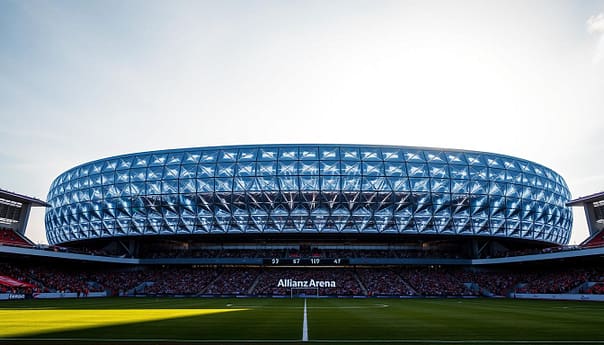
From Concrete Jungle to Sensory Playground
This stadium is far from your grandfather’s football grounds. Its 2,874 ETFE foil panels glow red and control the climate, saving on heating. Thomas Müller said, “When those lights pulse during Der Klassiker? You feel the stadium breathing.”
PSG’s Parc des Princes has champagne bars, but the Allianz Arena gives you chills.
Here’s how Bayern leads in stadium infrastructure:
- Financial wizardry: 100% club-owned, unlike the Glazers
- Training tech: Säbener Straße’s hybrid pitches are advanced
- Fan engineering: 70,000 seats for perfect views
Harry Kane’s transfer was about tech, not just trophies. He goes from Tottenham to Bayern’s biometric pods. The Allianz Arena is a place of modern greatness, even the nachos have RFID chips.
Club Rivalries
German football rivalries are more than just games. They show the economic sides of football. Unlike El Clásico, Der Klassiker pits Bayern’s smart business against Dortmund’s bold moves. It’s like AC Milan’s history, but with German flair.
Der Klassiker: Bavarian Blue Chips vs Ruhr Valley Startups
Bayern vs Dortmund is more than a game. It’s like Amazon vs your local bookstore. Their 28 meetings have shown Germany’s financial gaps:
| Metric | Bayern Munich | Borussia Dortmund |
|---|---|---|
| Annual Revenue | $780M (Fortune 500 scale) | $420M (Tech unicorn energy) |
| Transfer Strategy | Buy Bundesliga’s top scorer… annually | Develop teenagers, sell to Bayern |
| 2024 Title Impact | Leverkusen’s win caused boardroom migraines | Celebrated like they’d won it themselves |
Dortmund’s stock market listing is fascinating. They’re a “people’s club” traded like crypto. Their yellow wall is a sign of defiance against Bayern.
Other Contenders in the Bundesliga Thunderdome
While Der Klassiker gets all the attention, other teams add to the drama:
- 1860 Munich: The neighbor who peaked in 1966. Their relegation to 3rd division? Best thing that ever happened to Bayern’s recruitment.
- Bayer Leverkusen: Pharma-funded overachievers whose 2024 title broke Bayern’s decade-long monopoly. Pro tip: Never bet against Werkself in odd-numbered years.
- RB Leipzig: Energy drink FC – hated by purists, feared by accountants. Their $150M wage bill screams “we’re here to ruin your narrative”.
The financial gap in Bundesliga is huge. Bayern’s €150M commercial income edge is a big advantage. Yet, these rivalries keep fans guessing. Will Leverkusen’s title start a new chapter? Or will Bayern just buy their best players?
Season Reviews
Bayern Munich’s seasons are like blockbuster movies that just keep getting better. They have no flops. Unlike Arsenal’s 2004 “Invincibles,” Bayern has mastered the art of evolving ruthlessly over three key eras. They turned what could have been historic seasons into stepping stones, not tombstones.
1970s: Beckenbauer’s Ballet & Bundesliga’s Birth
The 70s were more than just disco and bell-bottoms. Franz Beckenbauer changed defending with his playmaker skills, winning three European Cups in a row. This era started the Bundesliga era, making Bayern Germany’s first true continental power. They dominated, treating it as a renewable resource.
1990s: Perms, Drama & Survival Instincts
The FC Hollywood era brought Matthaus’ iconic curls and tabloid drama. Bayern won five titles in the 90s, despite the chaos. Unlike Arsenal’s decline after the Invincibles, Munich kept building. Matthäus was more than a sweeper; he was sweeping up the competition.
| Era | Bayern Strategy | Arsenal Parallel |
|---|---|---|
| Post-1970s | Reinvested European success into youth development | 2006 stadium move stalled competitiveness |
| Post-1990s | Embraced global scouting post-Bosman ruling | Relied on existing core until 2014 FA Cup drought |
2010s: Dortmund Raids & Perfection 2.0
Bayern turned Der Klassiker into a talent pipeline by buying top players. They won eleven straight Bundesliga titles. Harry Kane’s 2023 signing shows Munich’s commitment to staying ahead. Could Xabi Alonso’s underdogs be the challenge Bayern needs?
Latest Club News
Bayern Munich is set to compete in the 2025 Club World Cup. This raises big questions: Can they keep their traditional style in a world of flashy football? PSG’s big-name signings have left them with empty seats, but Bayern is focusing on building through youth academies.
Thomas Müller is retiring soon, marking the end of an era. He was a master at outsmarting defenses. At the same time, other clubs are chasing fame on social media.
Bayern Munich is sticking to its Bundesliga roots. They have a training complex in Miami that looks like their home stadium. This shows their commitment to European success without losing sight of their values.
While others are collecting digital memorabilia, Bayern Munich is focusing on winning. They’ve extended Joshua Kimmich’s contract and are developing young players like Mathys Tel. This approach keeps them grounded in the sport’s true values.