
The United States Men’s National Team enters the 2026 FIFA World Cup knockout phase under Mauricio Pochettino with a noticeably different tactical profile compared to previous tournament cycles. The shift is not limited to formation changes or personnel adjustments, but extends into structural decision-making, pressing coordination, and transition management in high-pressure knockout environments.
Across matches staged in major North American venues during June and July 2026, the USMNT has moved toward a more controlled hybrid model: high-intensity pressing combined with structured positional rest phases. This balance reflects a response to knockout football demands, where sustained physical output must be aligned with tactical discipline to avoid late-stage collapse against elite European opposition.
The evolution is particularly visible in midfield behavior, where Tyler Adams, Weston McKennie, and emerging rotation profiles operate as a synchronized unit rather than isolated roles. This adjustment has redefined how the United States builds attacks, defends transitions, and controls match tempo under knockout pressure.
Structural Shift From Direct Transitions to Controlled Pressing Phases
Earlier USMNT cycles relied heavily on vertical transitions and rapid forward progression immediately after ball recovery. Under Pochettino in 2026, this model has been refined into a layered system where pressing intensity is structured into phases rather than applied continuously.
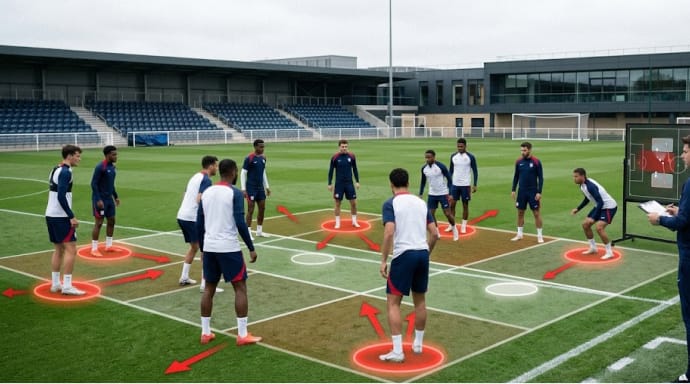
The first phase focuses on immediate counter-pressing after loss of possession, designed to regain the ball within five to seven seconds. If recovery fails, the team transitions into a compact mid-block, reducing exposure between defensive and midfield lines. This layered approach prevents structural disorganization when facing elite European possession systems.
Christian Pulisic remains the primary attacking reference point, but his role has shifted closer to a hybrid wide-inverted position, allowing him to receive between lines rather than only in wide isolation scenarios. This adjustment increases his involvement in central progression phases while reducing defensive workload in deep transitions.
This tactical evolution connects directly to broader tournament-wide structural trends observed in modern World Cup knockout systems, where teams that rely solely on vertical transitions often struggle against compact mid-block defenses that restrict central access.
European opposition analysis, including data frameworks from UEFA technical reporting systems, consistently shows that teams with structured pressing phases and controlled rest defense are more resilient in knockout environments, particularly in matches extending into late-game fatigue cycles.
Midfield Redefinition and Role Fluidity Under Pressure
The most significant transformation in the USMNT tactical identity is occurring in midfield structure. Rather than fixed positional roles, the midfield now operates as a fluid triangle system that adjusts dynamically based on opponent build-up shape.
Tyler Adams functions as the primary defensive stabilizer, anchoring transitions and preventing central overloads. Weston McKennie operates as a dual-phase midfielder, shifting between aggressive forward runs and defensive recovery coverage. The third midfield role varies depending on opposition structure, often rotating between creative progression and compact pressing responsibilities.
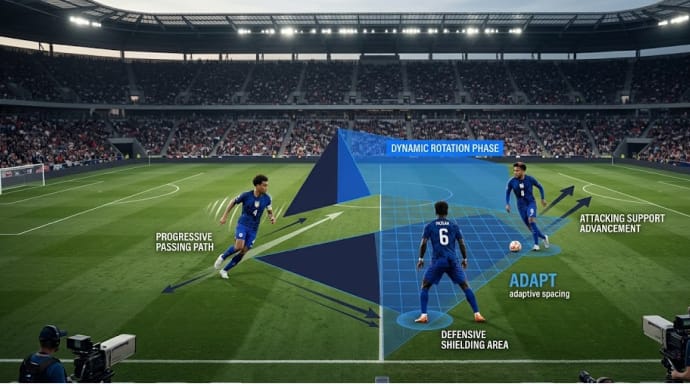
This fluidity allows the USMNT to adapt to different European tactical systems without requiring full formation changes. Against possession-heavy opponents, midfielders compress centrally to block passing lanes. Against transition-focused teams, they expand vertically to support forward progression.
A comparative framework of these midfield dynamics is reflected in international tournament performance analysis, where midfield adaptability is consistently linked to knockout-stage success rates across recent World Cup cycles.
The effectiveness of this structure depends heavily on synchronization timing. When midfield lines shift too early, defensive gaps open between lines. When shifts occur too late, opponents gain central progression access. The USMNT’s 2026 adjustment focuses on improving this timing precision through automated pressing triggers rather than reactive movement.
According to Opta Sports performance analytics, midfield units that maintain compact vertical distances below 20 meters between lines significantly reduce opponent progression efficiency through central channels. The USMNT’s revised structure increasingly aligns with these thresholds in knockout matches.
Pressing Triggers and Defensive Transition Stability
Pochettino’s system introduces a more structured pressing trigger mechanism compared to earlier USMNT approaches. Instead of continuous high pressing, the team activates pressing phases based on specific opponent actions such as backward passes, lateral switches, or isolated full-back receptions.
This trigger-based system reduces physical fatigue while maintaining defensive intensity in high-value zones. It also allows the USMNT to maintain structural stability when pressing attempts fail, preventing exposure in central transition zones.
The back line operates with a slightly deeper average position compared to group-stage matches, prioritizing compactness over aggressive line elevation. This adjustment reduces vulnerability to long-ball counterattacks and improves recovery positioning during opponent transitions.
| Tactical Phase | USMNT Execution | Competitive Effect |
|---|---|---|
| Press Trigger | Opponent backward pass activation | Controlled pressing initiation |
| Mid-Block Formation | Compact 4-4-2/4-2-3-1 hybrid | Reduced central penetration |
| Transition Recovery | Adams-led interception coverage | Stabilized defensive reset |
This structured approach allows the USMNT to remain competitive against European teams that rely heavily on controlled possession and structured buildup phases.
Wide Area Usage and Attacking Progression
Wide areas remain a critical component of USMNT attacking structure, but their usage has become more tactical rather than volume-based. Instead of repetitive wing progression, the system emphasizes timing-based wide overloads combined with central penetration runs.
Full-backs are increasingly involved in inverted roles during buildup phases, temporarily joining midfield to create numerical superiority. This allows wingers to stay higher and maintain positional threat during transition moments.
The effectiveness of this approach depends on rapid diagonal switching, which disrupts compact European defensive blocks and forces lateral displacement. When executed correctly, it creates brief structural imbalances that can be exploited by late-arriving midfield runners.
This tactical principle is consistent with broader patterns observed in elite football spacing systems, where width manipulation directly influences central penetration success rates in high-level tournament football.
European teams often respond by narrowing defensive lines and forcing play toward low-probability crossing zones. The USMNT’s challenge lies in converting wide possession into central penetration rather than isolated wing activity.
Knockout Match Tempo and Game-State Management
Knockout football in 2026 introduces extreme variability in match tempo due to environmental conditions, travel load, and compressed recovery schedules across North America. These factors directly influence pressing intensity, passing accuracy, and transition speed.
The USMNT benefits from strong early-match intensity, often generating momentum through aggressive pressing phases in the opening 20 minutes. However, sustaining this intensity remains a challenge in later stages of matches, where fatigue accumulation reduces pressing efficiency.
Pochettino’s system addresses this by incorporating controlled rest phases within possession sequences. Instead of continuous high tempo, the team alternates between structured buildup and high-intensity pressing bursts. This reduces energy depletion while preserving tactical pressure on opponents.
European opponents typically respond by increasing possession retention during these rest phases, attempting to neutralize momentum swings and stabilize match control. This creates a tactical rhythm battle where timing of intensity spikes becomes more important than total possession control.
The USMNT’s 2026 tactical identity shift reflects a broader evolution in international football: knockout success is increasingly determined by structured adaptability rather than fixed tactical identity.