
Canada’s progression into the knockout stages of the 2026 FIFA World Cup represents a defining moment in the nation’s football evolution, marked by tactical discipline, controlled defensive structure, and improved game management under high-pressure tournament conditions. The Round of 32 fixture against South Africa on June 28, 2026 at the SoFi Stadium in Los Angeles ended 1–0 in favor of Canada, secured by a late strike from Stephen Eustáquio in stoppage time. The result extended Canada’s deepest modern World Cup run and confirmed a shift in competitive identity within CONCACAF’s emerging tactical hierarchy.
This victory was not defined by possession dominance or attacking volume, but by structural patience and controlled transition phases. Canada absorbed South Africa’s mid-block pressure structure for extended periods before gradually increasing territorial control in the final third. The match reflected a broader tactical trend in the 2026 tournament: knockout success is increasingly determined by defensive organization and transition efficiency rather than sustained attacking possession.
Canada’s Defensive Structure and Match Control Evolution
Canada’s defensive organization against South Africa demonstrated a level of compactness that has become a defining feature of their 2026 tactical identity. The back line maintained narrow spacing, reducing access to central progression lanes and forcing South Africa into wide buildup sequences that lacked penetration efficiency.
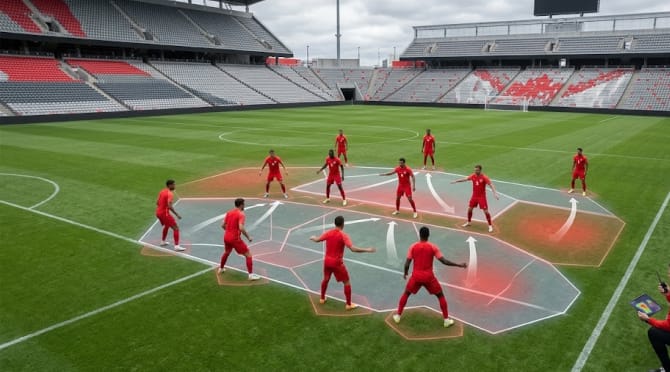
The midfield trio operated in staggered vertical alignment, allowing Canada to compress space between lines without sacrificing transition readiness. This structure minimized exposure during defensive phases while preserving forward passing options after ball recovery. Jonathan David and Cyle Larin were positioned to immediately exploit transitional opportunities rather than participate in prolonged buildup cycles.
South Africa attempted to disrupt Canada’s structure through wide rotations and diagonal switches, but Canada’s defensive block remained coordinated under pressure. The effectiveness of this approach aligns with broader tactical principles observed in modern World Cup knockout systems, where compact defensive spacing and transition control often determine match outcomes in tightly contested fixtures.
Canada’s approach also reflects increased tactical maturity compared to previous World Cup cycles, where defensive instability often led to early elimination. The 2026 version of the team demonstrates improved spatial awareness, particularly in managing defensive transitions after losing possession in midfield zones.
According to performance tracking frameworks outlined by Opta Sports analytics, teams that maintain sub-compact defensive distances between midfield and back lines significantly reduce expected goal opportunities conceded from central zones. Canada’s structure in this match aligned closely with these metrics, limiting South Africa’s ability to generate high-quality chances from central penetration.
Stephen Eustáquio and the Decisive Transition Moment
Stephen Eustáquio’s stoppage-time goal encapsulated Canada’s tactical evolution in tournament football. The sequence originated from a defensive recovery in midfield, followed by a rapid vertical progression that bypassed South Africa’s restructured defensive block.
Eustáquio’s positioning between midfield and attacking lines allowed him to exploit the smallest structural gap created during South Africa’s delayed defensive reset. The finish was less an individual moment of brilliance and more a direct consequence of Canada’s transition efficiency.
Jonathan David’s movement in the attacking phase played a key role in destabilizing South Africa’s central defensive alignment, pulling defenders out of position and creating a narrow channel for Eustáquio’s late run.
This type of transition-based scoring pattern reflects a broader tactical trend documented in international knockout football analysis, where late-stage goals often originate from structured recovery sequences rather than sustained attacking pressure.
Midfield Structure and Transition Efficiency
Canada’s midfield control during the match was defined by disciplined spacing and selective progression. Rather than attempting continuous possession dominance, the midfield operated on a reactive-structural model: compress defensively, recover possession, and transition vertically with minimal delay.
| Phase | Canada Execution | Tactical Effect |
|---|---|---|
| Defensive Block | Narrow midfield spacing | Reduced central penetration |
| Ball Recovery | Immediate forward scanning | Fast transition initiation |
| Attacking Phase | Vertical progression into channels | High-value chance creation |
This structured model reduces unnecessary ball circulation and prioritizes direct progression into attacking zones before defensive reset cycles can stabilize.
South Africa’s attempts to counter this structure through extended possession phases were partially effective in controlling tempo but insufficient in generating decisive final-third penetration.
South Africa’s Mid-Block Pressure and Tactical Limitations
South Africa entered the match with a structured mid-block designed to restrict Canada’s build-up progression through central corridors. The system focused on compact horizontal spacing and selective pressing triggers aimed at forcing turnovers in midfield zones.
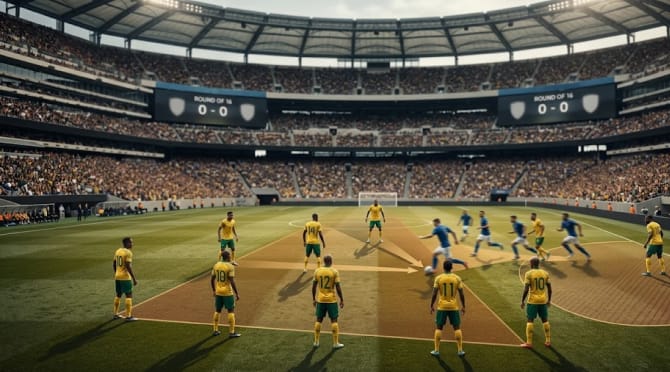
For large portions of the match, this strategy effectively disrupted Canada’s rhythm in early buildup phases. However, South Africa’s inability to sustain pressing intensity across the full 90 minutes created structural gaps in the final third, particularly during late transitions.
Canada’s response was not to force possession dominance but to absorb pressure and exploit transitional moments. This approach gradually shifted match momentum, particularly as South Africa’s defensive block began to lose vertical cohesion under fatigue.
The turning point came in the final phase of the match, where Canada increased the speed of vertical progression immediately after ball recovery. This shift bypassed South Africa’s pressing structure and created isolated attacking scenarios near the edge of the penalty area.
Knockout Pressure and Tactical Adaptation
The 2026 World Cup knockout environment amplifies the importance of tactical adaptability under fatigue. Canada’s ability to adjust rhythm between defensive absorption and rapid transition proved decisive in managing match control.
Environmental conditions in Los Angeles, combined with compressed recovery scheduling, influenced both teams’ physical output in the final 20 minutes. Canada’s squad rotation depth allowed sustained intensity in transitional phases, while South Africa’s pressing efficiency declined noticeably.
This pattern aligns with broader tournament dynamics where knockout success increasingly depends on energy distribution rather than possession metrics. Teams capable of selectively activating high-intensity phases gain structural advantage in late-match scenarios.
Canada’s progression into the Round of 16 represents more than a single match result. It reflects a tactical identity shift toward structured defensive discipline, controlled transitions, and efficient attacking execution under pressure.
The implications extend beyond this fixture, positioning Canada as a tactically coherent side capable of competing in increasingly structured international knockout environments where marginal gains in transition efficiency define tournament survival.