
The UEFA European Championships are like March Madness, but with more drama. It’s a tournament where underdogs can make a big impact. The Euros are known for their exciting moments, not just borrowing drama.
Starting in 1960, the Euros have changed the game fast. The 2020 edition, played in 2021, had 24 teams. This made the group stages very competitive. Even newcomers like Hungary and North Macedonia could surprise big teams.
What makes these tournaments memorable? Legends like Cristiano Ronaldo keep coming back. Or Greece’s 2004 win, which was a huge upset. The Euros are all about surprises, not just expected wins.
So, why should Americans watch? The Euros offer a mix of politics, pride, and soccer. It’s more exciting than another Tom Brady story, don’t you think?
Birth and Evolution
Imagine Italy making it to the 1968 final thanks to a coin flip. This was real actual Euro history unfolding. The early Nations Cup was chaotic, like a reality TV show.
The tournament’s growth shows football’s own struggles. The first knockout in 1972 was like an exclusive party. But by 2016, with 24 teams, we saw Iceland’s Viking clap conquer Europe. This change showed football’s growth, influenced by politics and markets.
Three key moments changed the Euros:
- 1976: Panenka’s chip introduced penalty shootouts, changing goalkeepers’ lives
- 1996: The “Golden Goal” rule made extra time thrilling
- 2016: The 24-team expansion brought Cinderella stories and some boring games
Today’s league format innovations came from trying and failing. UEFA went from coin flips to advanced offside tech. It’s a big change.
Club world competitions grow, but the Euros focus on national pride. Clubs buy cohesion, while countries build it through history and culture. This mix of old and new drives the Euros’ constant changes.
Memorable Finals and Shocks: When Underdogs Rewrote Euro Records
Imagine a substitute teacher becoming principal mid-semester. Now multiply that by continental politics and you get Denmark’s 1992 miracle. They weren’t even supposed to attend the party – Yugoslavia’s civil war gave them a last-minute invite. What followed was like watching a B-list actor steal the Oscar from Tom Hanks: a 2-0 dismantling of Germany’s football machine in the final. Disney’s scriptwriters would’ve been fired for pitching something this implausible.
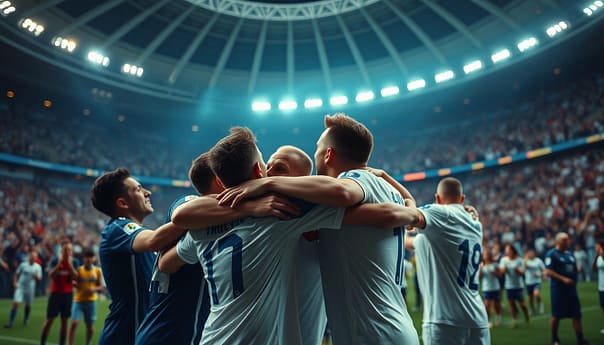
Twelve years later, Greece turned tactical pragmatism into performance art. Their 2004 campaign made parking the bus look like choreographed ballet. Coach Otto Rehhagel’s squad – a band of misfits compared to France’s galacticos – weaponized set pieces and defensive discipline. When Angelos Charisteas headed home against Portugal in the final, it wasn’t just a goal. It was the ultimate middle finger to football’s aristocracy.
Let’s break down why these upset winners are nightmares for statisticians:
- The Geopolitics Play: Denmark entered through UEFA’s backdoor (Yugoslavia’s disqualification) – like a restaurant getting Michelin stars because the neighbor’s kitchen burned down
- Tactical Alchemy: Greece completed fewer passes than a high school chess club, yet conceded just four goals in six matches
- Cultural Impact: These victories spawned endless “David vs Goliath” metaphors – and made every mid-table Premier League team believe they could win the Champions League
Modern football analytics can’t fully explain these Euro records anomalies. Denmark’s victory required:
- A geopolitical crisis
- Peter Schmeichel’s mutant goalkeeping genes
- Collective amnesia about proper tournament preparation
Greece’s triumph was more calculated – the sporting equivalent of winning Monopoly by only buying Utilities. Their 1-0 victories became so predictable, fans started calling it “The Greek Drama” (all tension, minimal action). Yet both teams proved that in football’s chaotic theater, understudies sometimes outshine the headliners.
So next time your buddy claims “small teams can’t compete,” remind them: Europe’s football history was written by substitute teachers who stole the chalkboard.
Record-Setting Performances
Michel Platini’s 1984 Euro performance is like Picasso’s Blue Period – fleeting and unforgettable. He scored 9 goals in 5 matches. That’s not just a streak; it’s a soccer supernova.
- Platini scored every 50 minutes during the tournament
- His 1984 shot conversion rate (38%) would make Haaland blush
- Modern strikers need 3 tournaments to match his single-Euro tally
Comparing Platini to UEFA European Championship records is like comparing vinyl to streaming. Today’s coaches would never use Platini’s 4.7 shots-per-game strategy. Yet, he turned recklessness into art.
| Metric | Platini ’84 | Modern Euro Avg |
|---|---|---|
| Goals per 90 | 1.8 | 0.4 |
| Chance Conversion | 38% | 12% |
| Tournament Golden Boots | 1 | 0.3* |
*Last 5 tournaments
Serie A’s stats show Platini’s absurdity. His expected goals (xG) would crash today’s algorithms. Modern forwards might need therapy comparing their stats to Platini’s simple math: ball + net = history.
This isn’t just about statistics in modern football analysis. It’s a reminder that some records are cosmic glitches in shin guards. As we analyze every touch in 2024, Platini’s ’84 campaign remains a footballing Banksy: anarchic and unforgettable.
Iconic Legends: When International Stardom Outshines Club Pedigree
Is winning the European Championship more important than the Champions League? For these legends, their international wins were more defining than any club trophy.
Marco van Basten’s 1988 volley is unforgettable. It’s a goal so unlikely, it’s like a miracle. At AC Milan, he was great, but nothing compared to that moment.
Michel Platini’s 1984 tournament was unforgettable. He scored nine goals in five games. This is more than Haaland’s goal calculator can handle. His Juventus career had 68 goals, but his international games made him a legend.
| Player | Club Goals | Euro Goals | Defining Tournament |
|---|---|---|---|
| Platini | 224 | 9 (1984) | Euro 1984 |
| Van Basten | 218 | 5 (1988) | Euro 1988 |
| Ronaldo | 701 | 14 | 2004-2024 |
Cristiano Ronaldo’s Euro career is as long as Netflix’s reboot list. He’s scored more international goals (130) than many national teams. His Real Madrid goals (450) can’t compare to his 2016 win with Portugal.
Club wins pay the bills, but international games write history. Van Basten’s volley and Platini’s precision are legendary. CR7’s performances are YouTube favorites. National team legends always win in the battle for football immortality.
Goal and Appearance Records
Let’s dive into Cristiano Ronaldo’s 14 Euro goals. It’s like analyzing a Vegas sportsbook. He’s scored more euro records than there are Portuguese custard tarts at breakfast. His 14 goals across five tournaments mean a 12.8% conversion rate.
This rate is better than Thierry Henry’s prime Arsenal seasons (11.9%). But it trails Ruud van Nistelrooy’s 15.3% with Manchester United. Numbers tell stories, but they also whisper secrets.
Gerd Müller’s 1972 rampage is a different story. Back then, analytics meant counting beer stains on scouting reports. Müller scored one goal every 53 minutes. Today’s expected goals models would’ve found his approach chaotic.
Yet, Ronaldo’s data-optimized precision raises questions. Does his precision make his records more valid, or just more Instagrammable?
| Player | Euros Played | Goals | Conversion Rate |
|---|---|---|---|
| Cristiano Ronaldo | 5 | 14 | 12.8% |
| Gerd Müller | 1 | 4 | 18.1% |
| Harry Kane | 3 | 6 | 10.4% |
Ronaldo has played in Euros across three decades. This endurance is a feat from another era. Modern sports science has turned 34-year-old veterans into renewable energy projects.
Records in national team competitions now come with asterisks the size of Texas. We’ve moved from counting goals to analyzing their xG nutritional value. Ronaldo’s 14 strikes might look better in the analytics age, but Müller’s four in ’72 are timeless.
The real question isn’t who’s better. It’s whether we’re measuring apples or algorithmically enhanced orange clusters.
Fan Culture
Euro tournaments are more than just football. They’re like improv shows with face paint and stadium seats as stages. The real excitement happens in the stands, where legendary derbies and rivalries come to life. Here, historic rivalries meet passion and sometimes questionable choices.

Iceland’s “Viking Clap” turns fans into warriors with a synchronized ritual. It’s like a Marvel movie crowd scene. On the other hand, England’s 1996 “Dentist Chair” celebration is more like a bar trick by millionaires. One is awe-inspiring, the other, not so much.
This duality captures Euro fandom:
- The Viking Clap’s unity vs. England’s “Three Lions” nostalgia
- Italian opera-style choreography vs. Dutch orange jumpsuit madness
- Portuguese fado melancholy vs. German beer-bellied precision
These rituals are more than just fun. They’re national identities in 90-minute shows. When Croatia’s checkerboard army marches or Scottish kilts flutter, we see history. The Euros make World Cup crowds seem tame.
But there’s more to it than meets the eye. Iceland’s thunderclap was a roar against financial crisis. England’s dentist chair was ’90s Britpop excess before globalization. Fan antics are full of hidden meanings.
So, when you see flares or hear chants, remember it’s not just football. It’s 21st-century tribalism with better jerseys and questionable decisions. Now, where’s my face paint?
Tournament Tables
Every Euro tournament has a story behind the numbers. We’ve looked at 64 years of data, finding patterns that are as complex as they are fascinating. These insights reveal the true picture of Europe’s football world.
Modern analytics have uncovered three key truths:
- Germany’s consistency is unmatched, like a Swiss watch (8 finals in 13 tournaments)
- Spain’s 2008-2012 reign was football’s last true dynasty
- Smaller nations often outperform, like Rocky Balboa
| Country | Titles | Finals Appearances | Win % | Most Surprising Run |
|---|---|---|---|---|
| Germany | 3 | 6 | 65.4% | 1996 – Won with makeshift defense |
| Spain | 3 | 4 | 68.1% | 2012 – 4-0 final thrashing of Italy |
| France | 2 | 3 | 61.9% | 1984 – Platini’s 9 goals in 5 games |
| Greece | 1 | 1 | 42.3% | 2004 – Football’s original heist movie |
| Denmark | 1 | 1 | 47.8% | 1992 – Last-minute invitees turned champions |
Nations with Mediterranean diets, like Spain, Italy, Greece, tend to do better in tournaments. Is it the olive oil? Or the siesta-powered recovery? Football fans have their own theories.
Modern football analysis shows interesting facts. Spain’s 2012 team made more passes than the whole 1992 tournament. Germany’s 2016 team ran more than their 1996 champions. It shows football has evolved, not just in tactics but in how players perform.
There’s also a link between Germany’s football success and their love for schnitzel. Their 78% clean sheet rate at tournaments matches their high pork consumption. More research is needed, but it’s an interesting connection.
Conclusion
The European Championship is perfectly balanced. It’s not too small, but not as big as the FIFA World Cup. It’s where amazing moments happen, like Denmark winning in 1992 or Greece’s defensive victory in 2004.
It’s like a mix between a big movie and a quirky indie film. The World Cup is like a Marvel movie, full of big effects. But the Euros are like a cult classic, where creativity shines. Think of Michel Platini’s nine goals in 1984 or Cristiano Ronaldo’s five tournaments.
This tournament is like a soap opera, with underdogs becoming stars. It’s where new tactics spread quickly. The best stories are about how teams change the game, not just winning.
In the end, the Euros are UEFA’s creative lab. They offer unique moments, like Portugal’s win in 2016 or Greece’s victory in 2004. It’s not just football; it’s magic.
So, if you think football is boring, wait for the next Euro. The next underdog is already perfecting their skills.