
At just 17 years old, Cavan Sullivan has become one of the defining stories of the 2026 Major League Soccer season. The Philadelphia Union midfielder topped MLS’s 2026 22 Under 22 rankings, announced on October 20, making him the youngest player to finish first in the annual list. His rise has also brought individual awards, senior United States men’s national team appearances, and a growing role in Philadelphia’s late-season push.
Sullivan’s achievement is significant because it reflects more than potential. He has produced goals and assists, influenced high-profile matches, and become a regular contributor for a club that has developed a reputation for moving young players into its first team. His September performances were particularly striking: four goals and five assists across four MLS appearances helped him earn the league’s Player of the Month award at 17 years and two days old.
The next question is bigger than one award. Can Sullivan turn his rapid rise in MLS into a career at the highest level of international club football, while helping establish a stronger pathway for American talent? His progress offers a useful case study in the relationship between academy development, first-team opportunity, and the demands placed on a young player whose reputation is growing faster than his professional experience.
Cavan Sullivan’s 22 Under 22 Ranking Sets a New Benchmark
MLS announced its 2026 22 Under 22 list on October 20, placing Sullivan first among the league’s top young players. At 17 years and 22 days old, he became the youngest player to top the ranking, surpassing Alphonso Davies, who was 17 years and 355 days old when he finished first in 2018 before moving to Bayern Munich.
The annual list recognizes young players based on their performance, potential, and importance to their clubs. It is not the same as MLS Young Player of the Year, a separate award, but finishing first gives Sullivan a prominent place in the league’s discussion of emerging talent. The ranking also placed Philadelphia teammates Neil Pierre at No. 7 and Frankie Westfield at No. 11, highlighting the Union’s investment in its development system.
The official MLS 22 Under 22 coverage provides the league’s view of the players shaping its next generation. Sullivan’s position at the top is especially notable given that he is competing against players with more first-team experience and, in some cases, established international careers.
His achievement also places him in a line of young players who have used MLS as a launchpad for bigger opportunities. Davies moved from Vancouver Whitecaps FC to Bayern Munich, while Brenden Aaronson progressed from Philadelphia Union to European football after emerging through the same club environment. Those precedents make Sullivan’s development a natural point of interest for U.S. soccer supporters.
However, the ranking should be treated as a milestone rather than a forecast. Youth awards identify performance and promise at a particular moment. They cannot guarantee a transfer, senior international success, or a long career at the highest level. Sullivan’s next steps will depend on how he responds to new tactical challenges, physical demands, and the attention that comes with being one of MLS’s most closely watched teenagers.
A Record-Breaking September Put Sullivan on the Map
Sullivan’s ranking followed a month of performances that placed him among MLS’s most productive attacking players. In September 2026, Philadelphia went 5–0–0 in league play, scoring 20 goals and finishing the month with a plus-15 goal difference. Sullivan was central to that run, recording four goals and five assists across four appearances.
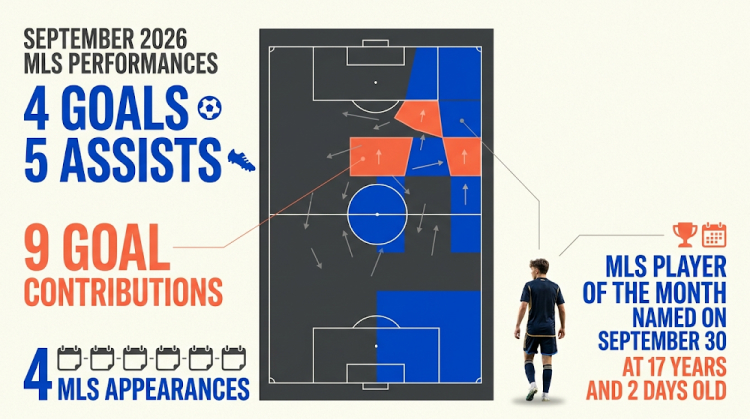
MLS named him Player of the Month on September 30. At 17 years and two days old, he became the youngest recipient in the award’s history. His nine goal contributions led the league for the month, while his five assists tied for the top spot.
The official MLS Player of the Month report detailed how Sullivan influenced several matches. He scored against CF Montréal, recorded three assists in a 5–0 victory over FC Cincinnati, and contributed two goals and an assist in another 5–0 win, this time away to San Diego FC. He then scored and assisted in Philadelphia’s 4–3 comeback victory against Sporting Kansas City.
That sequence demonstrated a range of attacking skills. Sullivan could finish chances himself, create opportunities for teammates, and influence a match without being the sole focus of the opposition’s defense. His ability to contribute in different ways is one reason he has become more than a promising prospect.
The September numbers also put his season into historical context. MLS reported that his 19 goal contributions at that stage—seven goals and 12 assists—matched Alphonso Davies’ 2018 total for the second-most goal contributions by a teenager in a single regular season. Diego Fagúndez held the record with 20 in 2013.
Sullivan’s official statistical profile has continued to evolve as the season has progressed. Philadelphia’s player statistics page lists seven goals and 14 assists in MLS regular-season play for 2026 in its latest available figures. These numbers reflect the league’s statistical conventions, so comparisons with older seasons should use the same definition of assists and the same competition scope.
How Philadelphia Union’s Academy Helped Develop Sullivan
Sullivan’s rise did not begin with his first MLS award. He joined the Philadelphia Union Academy in 2020 and progressed through the club’s youth structure, including MLS NEXT teams and Philadelphia Union II in MLS NEXT Pro, before becoming part of the senior side.
That progression is important because the transition from youth soccer to professional football can be difficult. Technical ability may help a young player stand out against peers, but senior competition demands faster decisions, greater physical resilience, and more consistent tactical discipline. Moving through different levels within one organization can provide continuity while gradually increasing the challenge.
The Union have built a reputation for giving academy graduates meaningful opportunities. Sullivan’s pathway has included youth tournaments, development-team football, and first-team matches. His rise also shows why development systems need more than talented players: they require coaches willing to provide minutes, clear expectations, and a competitive environment in which young footballers can learn from mistakes.
Sullivan’s career has already included several historic milestones. He made his MLS debut on July 17, 2024, against the New England Revolution at just 14 years and 293 days old, becoming the youngest player to appear in an MLS match. In 2026, he became the youngest player in league history to record three assists in a single match, doing so against FC Cincinnati on September 9.
Philadelphia’s development system is also producing other young players. Neil Pierre and Frankie Westfield joined Sullivan in the 2026 22 Under 22 rankings, giving the Union three players in the top 11. Their inclusion reinforces the club’s emphasis on developing talent internally rather than relying exclusively on established signings.
For American soccer, this model has broader significance. A young player can develop in a professional environment at home, gain experience against senior opposition, and build a record that attracts attention from national-team selectors and international clubs. The pathway does not eliminate the risks associated with early professional football, but it provides a structure in which talent can be tested over time.
Sullivan’s Playing Style Offers More Than Goals and Assists
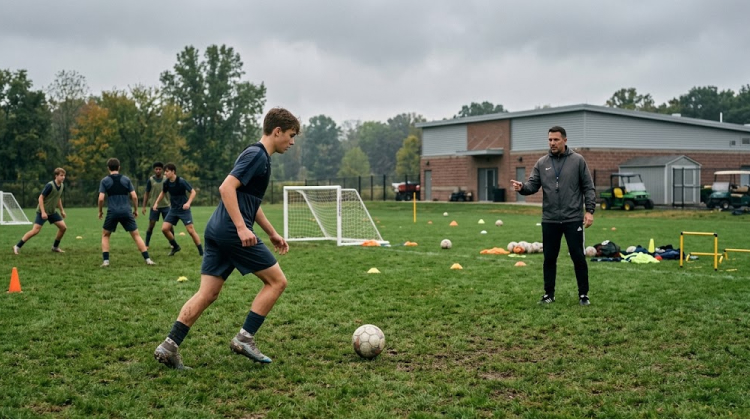
Sullivan is a left-footed attacking midfielder whose game combines close control, creative passing, and an appetite for decisive actions in the final third. He can operate between midfield and defense, carry the ball into advanced positions, and create openings for teammates through short combinations or forward passes.
His September performances showed the value of that versatility. Three assists against Cincinnati highlighted his ability to create chances, while his goal contributions against San Diego and Sporting Kansas City demonstrated his capacity to finish moves himself. Opponents cannot focus exclusively on preventing him from shooting because he can also hurt them by releasing a teammate into space.
That flexibility matters in MLS, where teams often use different pressing structures and defensive approaches from one match to the next. A creative midfielder must identify whether the available route is to carry the ball, play quickly into a forward, switch the point of attack, or draw a defender away from a teammate. Sullivan’s recent output suggests he is becoming more comfortable making those decisions at senior level.
There are still areas of development. Young attacking players must learn when to take risks and when to preserve possession, particularly when their team is protecting a lead. They also need to improve their movement when they do not receive the ball, their defensive contribution after losing possession, and their ability to maintain performance across a full season.
Those demands become more significant as opponents gather footage and build game plans around a player’s strengths. Once Sullivan becomes a primary target for defensive attention, he will need to find new ways to influence matches. That could mean dropping deeper to help build attacks, moving into wider spaces, or drawing defenders away so teammates can exploit the gaps.
His current progress gives Philadelphia a strong platform, but sustained development will depend on how well he adapts when the game becomes more difficult.
From Philadelphia to the United States Men’s National Team
Sullivan’s club performances have already led to senior international recognition. In September 2026, he earned his first call-up to the United States men’s national team. He then made his senior debut and started against Peru on September 26, becoming the second-youngest player to start a match for the USMNT.
His international breakthrough continued in October. On October 3, Sullivan scored in the United States’ 4–1 victory over Peru, becoming the youngest goalscorer in USMNT history. The achievement moved him beyond the previous benchmark held by older generations of American players and made his progress a major national-team storyline.
His senior appearances give him experience beyond the MLS environment. International football requires players to adjust quickly to different teammates, tactical systems, and opponents. A midfielder who can adapt to those conditions has a better chance of becoming useful across a range of formations and match situations.
Still, a handful of appearances should not determine expectations for the next decade. The national team has to balance immediate results with the gradual integration of younger players. Sullivan will need to compete for minutes against established professionals, prove that he can perform against high-level opposition, and continue developing his defensive responsibilities alongside his attacking instincts.
The timing also matters. The United States is building toward future international competitions, and the emergence of a technically gifted teenage midfielder gives selectors another option. But the strongest long-term outcome would be for Sullivan to earn his place through consistent performances rather than carry the burden of being presented as the solution to every attacking problem.
For a broader look at the national team’s changing player pool, readers can follow U.S. Soccer’s men’s national team coverage. Sullivan’s progress is one part of a wider effort to develop players who can compete at club and international levels.
Could Sullivan Become America’s Next Global Soccer Star?
The comparisons with players such as Alphonso Davies and Brenden Aaronson are understandable. Both emerged through North American development systems, established themselves at senior level, and attracted European interest. Sullivan’s record-setting achievements make him a natural subject for similar discussion.
But his future will depend on several factors beyond raw talent. He needs to maintain his fitness, develop physically at his own pace, and receive consistent playing opportunities. Coaching quality, tactical fit, personal support, and the timing of any move abroad will all influence his progress.
A transfer to Europe could eventually offer new challenges, but moving too early is not automatically the best choice. The right club would need to provide a credible development plan, competitive minutes, and a tactical role that suits his strengths. Remaining in MLS while continuing to play regularly could also be valuable if Philadelphia provides the environment he needs.
Sullivan’s current output gives him a strong foundation for those decisions. He has already demonstrated that he can contribute to winning performances, earn recognition from league voters, and make an impact for the senior national team. The next stage is to turn a remarkable season into a consistent professional career.
For the Union, keeping Sullivan involved in meaningful matches also has competitive value. The club is fighting for a strong finish to the 2026 regular season, and his creativity can help decide close games. At the same time, Philadelphia must manage his development responsibly, ensuring that expectations do not overwhelm the process that brought him this far.
What Comes Next for Sullivan and Philadelphia Union?
Philadelphia’s late-season schedule will test whether the team can maintain its form as the MLS Cup Playoffs approach. The Union are scheduled to face New England Revolution on October 24, followed by FC Cincinnati on October 31. Those fixtures offer Sullivan opportunities to build on his recent performances against opponents with their own playoff ambitions.
His contribution could be particularly important if Philadelphia encounters compact defenses that leave little space between the lines. In those matches, a quick pass, a clever turn, or a well-timed run can decide whether an attack becomes a genuine chance. Sullivan’s ability to create as well as finish makes him a useful option when the team needs a different attacking solution.
The postseason will bring another level of pressure. Knockout football rewards concentration and efficiency, and young players can be targeted by opponents who believe they can force mistakes. Sullivan’s response will reveal more about his readiness for a larger role than any single award can.
His 2026 season has already delivered milestones that few players achieve at any age. Finishing first in the 22 Under 22 rankings, winning September’s Player of the Month award, and earning senior USMNT opportunities have established him as one of the most important young figures in American soccer.
The question now is not whether Sullivan has attracted attention. He has. The challenge is to keep converting promise into performance while continuing to learn from each level of competition. If Philadelphia can provide the right balance of responsibility, support, and playing time, Sullivan has a credible route toward becoming a major figure for both club and country.
For WikiApp readers, his story captures a key theme in modern American soccer: homegrown players are increasingly able to develop within professional clubs, earn national recognition, and compete for meaningful roles before reaching adulthood. Sullivan’s next steps will determine how far that pathway can take him, but his 2026 campaign has already made him one of MLS’s most compelling young talents.