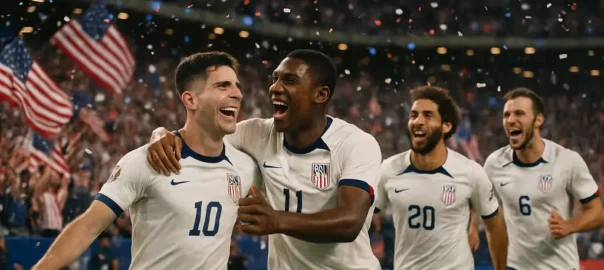
USL Alumni Impact can be measured clearly in the United States men’s national team’s first international window after the 2026 FIFA World Cup. In September and October 2026, seven former USL players appeared in the senior national-team picture: Tyler Adams, George Campbell, Matt Freese, Brooklyn Raines, Miles Robinson, Auston Trusty, and Chris Brady. Their involvement was not symbolic. According to USL’s review of the window, those players combined for just over 1,000 minutes while the United States went 4-0 against Peru, Chile, Mexico, and Canada, outscoring opponents 12-3 USL report.
The data matters because it connects professional lower-division minutes to senior international roles. Six of the seven former USL players in that group were also on the United States roster for the 2026 FIFA World Cup. That continuity suggests the USL connection was not a short-term selection experiment after the tournament. It was part of a broader player-development sequence in which domestic professional experience supported the national team’s depth.
The fall 2026 window also showed how domestic pathways can produce players suited to different tactical jobs. Goalkeepers, center-backs, midfielders, and younger squad members all entered the discussion, giving the national team staff more options across match states. The most useful reading is not that USL alone created those players. It is that USL matches supplied competitive professional minutes before those players reached higher club levels or senior international selection.
USL Alumni Impact In The Fall Window
Minutes, Results, And Competitive Context
The four-match record from the September and October 2026 window gave the developmental story a competitive frame. The United States won all four matches, scored 12 goals, and conceded three. Former USL players contributed just over 1,000 minutes in that run, a large enough sample to show real selection trust rather than late-game cameos.
The wider squad also leaned heavily on players from the MLS and USL development system. U.S. Soccer reported that 13 debutants in the window combined for 1,396 minutes and scored seven of the team’s 12 goals U.S. Soccer numbers. That figure is especially relevant for a post-World Cup window because such matches often test the next layer of the player pool. The United States used the window to assess new options while still producing results.
The clearest USL Alumni Impact was the blend of continuity and renewal. Established World Cup squad members remained involved, while new senior internationals received meaningful minutes. That combination helped the staff avoid a full reset after the 2026 World Cup, instead extending the pool through players who had already passed through professional domestic environments.
USL Alumni Impact By Position Group
The positional spread of the former USL players is important. Matt Freese and Chris Brady represented the goalkeeper pathway. George Campbell, Miles Robinson, and Auston Trusty pointed to defensive development. Tyler Adams and Brooklyn Raines brought midfield relevance. The research does not support a full position-by-position tactical chart for all four matches, but it does show that USL experience appeared across the spine of the team.
For goalkeepers, the pathway was visible through Freese and Brady. Freese had 15 USL appearances with Philadelphia Union II in 2019 and 2020, later becoming the first-choice goalkeeper for the United States at the 2026 World Cup. Brady, after eight USL League One starts in 2020 with three clean sheets and six goals conceded in a shortened season, made his senior USMNT debut in the fall 2026 window, starting against Chile on September 29.
In defense, Campbell and Trusty illustrated how lower-division minutes can precede later international responsibility. Campbell played more than 2,000 minutes with Atlanta United 2 from 2018 to 2022 in the USL Championship and scored two goals there before moving abroad and becoming a regular starter in recent USMNT matches. Trusty began in the USL Championship with Bethlehem Steel FC, collected 3,950 league minutes, then later climbed to Europe. During the fall 2026 window, he added 281 international minutes and recorded an assist against Chile.
Tactical Lessons From Lower-Division Minutes
Physical Tempo And Defensive Habits
USL competitions are not identical to international football, and the available research does not prove a direct tactical cause-and-effect relationship. Still, the minutes profile supports a practical development argument: professional matches below MLS can help players build habits that translate upward. Repeated duels, transition defending, second-ball contests, and set-piece concentration are all useful for defenders and midfielders who later enter international matches.
That matters for the USMNT because international windows leave limited training time. Players must process tactical instructions quickly and apply them against opponents with different styles. A player who has already handled professional match pressure may adapt faster than one whose first senior tests arrive later. The USL record in this window supports the idea that domestic lower-division minutes can be part of that preparation.
For center-backs and goalkeepers, the developmental value is especially clear in principle. These positions depend heavily on communication, decision-making, and managing defensive spacing. Campbell, Trusty, Robinson, Freese, and Brady offered different examples of players whose earlier professional experience fed into later senior-team trust.
Roster Rules, Selection, And Pathway Value
The fall 2026 window did not establish a new national-team eligibility rule based on USL participation. The regulatory lesson is more practical: selection staffs can treat USL professional experience as part of a player’s development record. That can affect how players are evaluated when comparing academy minutes, reserve-team minutes, USL Championship games, USL League One games, and senior club roles abroad.
As of October 20, 2026, the cited USL data stated that 24.2 percent of players across the USMNT World Cup roster, the September/October international window, and U-20 fall rosters had played professionally in USL. The same data placed 38.7 percent as having grown up in markets with USL clubs, while 32.2 percent were raised or developed abroad. Those categories should not be treated as identical, but together they show that USL markets and USL competitions were present in the broader national-team pipeline.
That finding fits a wider American soccer trend in which player development is no longer tied to a single route. MLS academies, USL clubs, reserve teams, European transfers, youth national teams, and college soccer can all appear in a player’s background. For readers tracking the same player-pool theme, this related analysis on USL players in the USMNT fall window connects the roster story to the 4-0 post-World Cup run.
Developmental Records And Individual Cases
From USL Starts To Senior International Roles
The individual records in the fall 2026 discussion show different stages of the pathway. Trusty’s 3,950 USL Championship minutes represented a substantial professional base before his later rise. Campbell’s more than 2,000 USL Championship minutes with Atlanta United 2 gave him an early senior platform. Brady’s USL League One season in 2020 offered a condensed but meaningful goalkeeper sample before his senior USMNT debut six years later.
Freese’s case showed how goalkeeper development can be less linear than outfield development. Fifteen USL appearances with Philadelphia Union II in 2019 and 2020 did not, by themselves, define his career. They did, however, form part of the competitive record before he became the United States’ first-choice goalkeeper at the 2026 FIFA World Cup and then remained involved in the following international window.
| Player | USL Background In Research | Fall 2026 Or USMNT Note |
|---|---|---|
| George Campbell | More than 2,000 minutes with Atlanta United 2 from 2018-2022 | Regular starter in recent USMNT matches |
| Auston Trusty | 3,950 USL Championship minutes with Bethlehem Steel FC | 281 international minutes and an assist against Chile |
| Matt Freese | 15 appearances with Philadelphia Union II in 2019-2020 | First-choice goalkeeper at the 2026 FIFA World Cup and active in the fall window |
| Chris Brady | Eight USL League One starts in 2020, with three clean sheets | Senior USMNT debut against Chile on September 29, 2026 |
These examples should be read with care. The research does not show that each player reached the national team because of USL alone. It shows that USL professional minutes were part of their development records before they contributed to the senior national team environment.
What The Numbers Do And Do Not Prove
The numbers prove participation, minutes, and results. They do not prove that one league tier is sufficient to create international players without other development stages. A fair reading is that USL served as a competitive layer in a larger system. Players then moved through MLS, foreign leagues, national-team camps, or other club settings before becoming established senior options.
This distinction is important for roster analysis. A federation or club should not treat USL minutes as an automatic predictor of senior international success. The value is in context: age, position, match role, tactical responsibility, and later club progression all matter. The fall 2026 window showed that USL experience can belong in that evaluation, especially when players have already converted those minutes into higher-level roles.
- Former USL players combined for just over 1,000 USMNT minutes in the four-match fall 2026 window.
- The United States won all four matches against Peru, Chile, Mexico, and Canada.
- Six of the seven former USL players in the window had also been on the 2026 FIFA World Cup roster.
- Thirteen debutants from the MLS/USL development ecosystem combined for 1,396 minutes.
USL Alumni Impact In The USMNT Pathway
USL Alumni Impact after the 2026 FIFA World Cup is best understood as evidence of depth. The United States did not rely only on one development route during the September and October window. Instead, the national team drew from players whose records included USL Championship, USL League One, MLS systems, European moves, and World Cup experience.
The tactical value came from usable roles. Goalkeepers handled senior minutes. Defenders supported a four-match winning run. A defender recorded an assist against Chile. Newcomers from the MLS/USL system scored seven of the team’s 12 goals. Those details connect development to match output, which is the standard that matters most for senior international football.
The regulatory and structural meaning is narrower but still significant. No cited evidence shows that selection rules changed after the window. The supported point is that professional USL experience has become part of the national-team evaluation record. For U.S. Soccer, clubs, and academy directors, the fall 2026 window supplied a clear reference point: competitive lower-division minutes can help build players who later contribute at senior international level.
Coverage across sports often studies the same question: how a development league, club system, or secondary competition prepares athletes for the highest level. For additional insights into how developmental pathways are managed in another sport, check out Dashers Hockey, which explores similar themes in hockey.