
Justin Ellis has gone from an uncapped Orlando City Homegrown player to one of the most interesting young forwards in the United States national-team pool in less than two weeks. His latest step came on October 6, when the 19-year-old scored the only goal in the United States’ 1-0 victory over Canada at Allianz Field in St. Paul, Minnesota.
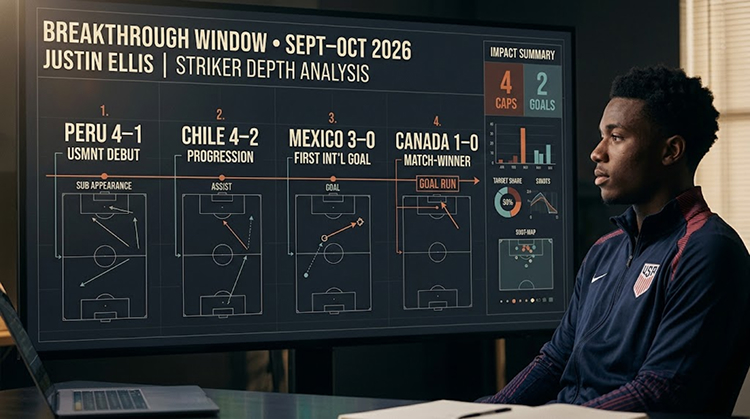
The goal completed a remarkable opening to Mauricio Pochettino’s 2030 World Cup cycle. Ellis had already scored on his senior debut against Peru on September 26, then found the net again against Canada four matches later. The United States won all four games in the September-October window, beating Peru 4-1, Chile 4-2, Mexico 3-0 and Canada 1-0. The sequence gave Pochettino a 4-0 start while allowing him to test a group containing several teenage and early-career attackers.
For Ellis, however, the significance goes beyond two goals. The Canada winner came in a match where the United States did not dominate possession or create a large volume of chances. Canada made the contest physical, disrupted the American buildup and finished with several opportunities of its own. Ellis converted one of the United States’ clearest openings and gave Pochettino another example of a forward who can produce without needing a high-volume attacking performance around him.
That changes the conversation around the USMNT striker pool. The position entered 2026 with established options such as Folarin Balogun and Ricardo Pepi, while Haji Wright remained an experienced alternative. Now Pochettino has evidence that a much younger group can compete for minutes, including Ellis, Damion Downs and players who can attack centrally or from wider positions.
Ellis Turned His First Call-Up Into A Four-Game Statement
Ellis entered the September camp without a senior international appearance. His selection itself was significant because Pochettino named 13 uncapped players in the original 28-man group as the United States began its new cycle after the 2026 World Cup. At 19, Ellis represented exactly the type of developmental opportunity the manager wanted to create.
His first appearance immediately produced a result.
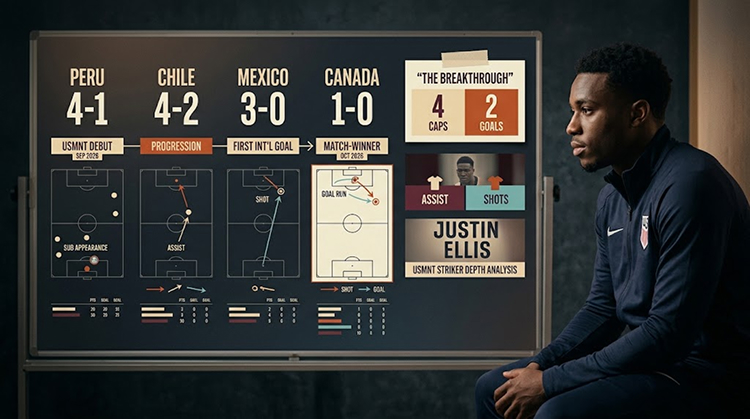
Against Peru at Inter&Co Stadium in Orlando on September 26, Ellis scored in the fourth minute after Gio Reyna delivered the assist. It was his first senior international goal and, according to U.S. Soccer, the fastest debut goal in the modern era of the USMNT. The location made the moment even more significant: Inter&Co Stadium is also Ellis’ club home with Orlando City.
U.S. Soccer’s Justin Ellis report
He did not score against Chile or Mexico, but his place in the attacking rotation remained relevant as Pochettino continued rotating young forwards. Then came Canada.
Ellis started at center forward alongside Mathis Albert, with Gio Reyna, Yunus Musah and Malik Tillman positioned behind them. The lineup itself offered a useful indication of the experiment underway: Pochettino was willing to use an inexperienced striker in a major Concacaf rivalry while leaving established names such as Damion Downs and Cavan Sullivan among the substitutes.
The decisive moment arrived in the 29th minute. Alex Freeman supplied the cross, and Ellis finished the move to put the United States ahead. The goal ultimately stood as the difference in a 1-0 victory.
The match also revealed the less comfortable side of the breakthrough. Ellis took a heavy challenge from Canada midfielder Stephen Eustáquio in the first half, returned to the field after receiving treatment, then scored before being substituted at halftime. His early withdrawal prevented him from completing the match, leaving his immediate physical status as one of the few concerns surrounding an otherwise outstanding window.
The important point is that Ellis now has two goals in his first three USMNT appearances. That is a small sample, but it is a highly productive one.
Orlando City Built The Path Before Pochettino Opened The Door
Ellis’ international breakthrough did not happen in isolation. His rise is also a direct example of the player-development structure that has become increasingly relevant to the USMNT.
Orlando City’s Justin Ellis Homegrown announcement
Orlando City signed Ellis to his first-team contract as a Homegrown Player on February 20, 2026, keeping him under contract through the 2027 MLS season with club options extending beyond that period. The club described him as a player who had progressed through its Academy, Orlando City B and first-team pathway.
That pathway matters because Ellis was not arriving in the national team from a European academy with a long record at the senior level. He was developing inside an American professional structure.
His 2026 club production also showed that his value was broader than goal totals. Through 19 MLS appearances, he had one goal and nine assists according to the available 2026 match data, while Opta Analyst listed him with 19 MLS appearances, 1,313 minutes and nine assists. His assist production was particularly notable for a young player operating across attacking roles.
Orlando City also reported in September that Ellis had 12 assists across all competitions, including 10 in MLS, when he received his first USMNT call-up. At that point, those 10 league assists put him within one of the teenage single-season MLS record of 11, shared by Alphonso Davies and Cavan Sullivan.
That distinction helps explain why Pochettino selected him.
Ellis was not simply being rewarded for scoring goals. His passing, movement and ability to contribute to attacking sequences gave the coaching staff another type of forward. That can become valuable for a national team manager because international matches offer little training time and often require players to contribute in several phases.
The Canada goal illustrated the point. Ellis was not asked to manufacture every attack. He needed to occupy the center-forward position, read the movement around him and attack the right moment when Freeman delivered the ball.
That is a different profile from simply selecting the highest-scoring striker available.
The Striker Competition Is Deeper Than It Looked After The World Cup
The United States entered the 2026 World Cup with a more established striker hierarchy.
Folarin Balogun, Ricardo Pepi and Haji Wright were the principal center-forward options. Before the tournament, U.S. Soccer described Balogun, Pepi and Wright as a particularly competitive striker group, with the three combining for 56 club goals across all competitions during the 2025-26 season.
Balogun then strengthened his position at the World Cup. He scored twice against Paraguay in the United States’ 4-1 opening victory, becoming the first American to score multiple goals in a World Cup match since Bert Patenaude in 1930. He also scored against Bosnia and Herzegovina in the Round of 32. U.S. Soccer lists him with 31 USMNT appearances and 12 goals.
Pepi remains an important alternative. The PSV Eindhoven forward has 42 USMNT appearances and 13 goals, while his club production during the 2025-26 season helped establish him as one of the country’s leading center-forward options.
The question for Pochettino is therefore not whether Ellis has suddenly replaced Balogun or Pepi. There is no evidence for that yet.
The more interesting question is whether Ellis has made the striker pool significantly harder to predict.
| Forward | Current USMNT significance | What Ellis adds to the competition |
|---|---|---|
| Folarin Balogun | Established international starter and proven scorer | Different profile and greater developmental pressure |
| Ricardo Pepi | Experienced international center forward | Another young option competing for minutes |
| Haji Wright | Experienced international and physical option | Adds another pathway for younger forwards |
| Damion Downs | Emerging forward with senior experience | Direct competition for developmental minutes |
| Justin Ellis | 19-year-old with two goals in three appearances | Movement, creativity and immediate finishing |
| Cavan Sullivan | Teenage attacking prospect | Greater positional flexibility and long-term upside |
The competition became even more interesting when Ricardo Pepi was withdrawn from the September-October roster because of injury. Pochettino added St. Louis City forward Damion Downs, giving the manager another young striker with senior international experience. Downs had six USMNT appearances before the window and had scored the decisive penalty against Costa Rica in the 2025 Concacaf Gold Cup quarterfinal.
That decision shows that Pochettino is already thinking beyond a fixed starting striker.
Canada Showed Why Ellis’ Profile Matters
The 1-0 victory over Canada was useful precisely because it was different from the United States’ previous three matches.
The Americans had scored 11 goals against Peru, Chile and Mexico. Against Canada, the match became far more physical and fragmented. There were 43 fouls, Canada pressed aggressively early, and the United States produced relatively few clear attacking opportunities. Each team registered only two attempts after halftime.
That environment tested whether a young striker could remain effective without constant service.
Ellis provided the answer in the most direct way possible.
His goal came before the game became increasingly disjointed, but the broader performance showed why Pochettino may value a forward capable of combining movement with direct finishing. Canada did not give the United States the same attacking freedom that appeared against Mexico, yet one well-executed sequence was enough to decide the match.
That is relevant to the 2030 cycle because Concacaf matches frequently produce different tactical demands from European friendlies or possession-heavy games. Physical defending, compact blocks, disrupted rhythm and limited space can turn the center forward into a problem-solving position.
Ellis now has experience of that environment before his 20th birthday.
Pochettino Has More Than A Starting Striker Problem
The larger tactical question is how Pochettino wants his attack to function.
The manager does not necessarily need one permanent No. 9. His September-October selections showed a willingness to rotate young players through central and wide attacking positions while maintaining experienced players such as Reyna, Musah, Tillman and Tyler Adams around them.
That gives Ellis an opportunity because his development is not dependent on becoming a traditional target striker.
His club numbers suggest a player capable of creating chances as well as finishing them. His international debut against Peru showed that he can attack space and arrive in scoring areas. His Canada goal showed that he can operate centrally and finish from a more conventional forward position.
The combination could matter more than his current goal total.
A national-team striker who can press, run behind defenders, combine with attacking midfielders and finish limited chances gives Pochettino tactical flexibility. Ellis does not need to become the best pure No. 9 in the pool to become useful. He needs to become one of the forwards who gives the manager a different solution.
That is where his development intersects with the broader USMNT player pipeline.
The 2030 cycle is still in its earliest stage. The September-October window was Pochettino’s first extended opportunity to examine a new group after the 2026 World Cup, and the results were unusually positive: four wins, 12 goals scored and three conceded. Seven of the team’s goals during the window came from teenagers, while Ellis supplied two of the team’s most important finishing moments.
Ellis Still Has To Prove It At Club Level
The strongest argument for restraint is also the simplest: Ellis has played only a small number of senior international matches.
Two goals in three appearances is an excellent beginning, but it does not establish a long-term hierarchy. His club record also shows why Pochettino will continue evaluating him rather than immediately elevating him above more experienced forwards.
His 2026 MLS numbers before the Canada match included only one league goal despite nine assists. That profile suggests a player whose creative contribution has been more advanced than his scoring production at club level.
The national-team goals therefore represent an intriguing contrast.
At Orlando City, Ellis has been a creator who can move between attacking roles. With the USMNT, he has immediately demonstrated a striker’s ability to capitalize on chances. If he can combine those two sides of his game consistently in MLS, his case for regular international minutes becomes much stronger.
The next phase will be less about producing another spectacular international moment and more about sustaining his level.
That means staying healthy after the Canada injury scare, continuing to start regularly for Orlando City, improving his goal production and showing that the two international goals were the beginning of a trend rather than a short burst.
What Ellis Changes For The 2030 USMNT
Ellis’ Canada winner does not mean Pochettino has discovered his definitive striker for 2030.
It means something more useful.
The manager now knows that his forward pool contains another player capable of starting a difficult Concacaf match, scoring with limited opportunities and performing in a young attacking unit. That is a valuable piece of information at the beginning of a four-year cycle.
Balogun remains an established international scorer. Pepi has substantial experience and a proven record. Wright remains part of the broader forward picture. Downs provides another emerging option. Sullivan, Julian Hall and Mathis Albert give Pochettino additional attacking profiles with significant long-term upside.
Ellis has now moved from the prospect category into the competition.
That may be the most important consequence of his two-goal international window.
The United States does not need to decide in October 2026 who its starting striker will be at the 2030 World Cup. Pochettino needs to create enough competition that the answer can emerge through the next three years.
Justin Ellis has made sure his name is part of that conversation.