
Cavan Sullivan’s September 2026 did more than add another record to the Philadelphia Union midfielder’s rapidly expanding résumé. At 17 years and two days old, Sullivan became the youngest player in MLS history to win Player of the Month honors after producing four goals and five assists across four league appearances. His nine goal contributions led MLS for the month, while Philadelphia went 5-0-0 and scored 20 goals with a plus-15 goal difference.
The award matters because Sullivan’s production is now difficult to separate from the development system that brought him to this level. He entered the Union Academy at 10, moved through the club’s MLS NEXT teams, played for Philadelphia Union II in MLS NEXT Pro and reached the first team before turning 15. MLS now identifies him as the first player to complete that MLS NEXT-to-MLS NEXT Pro-to-first-team pathway and subsequently win Player of the Month.
September therefore provides a useful case study in Philadelphia’s model. Sullivan’s numbers are extraordinary, but they also show what can happen when a club gives a highly advanced young player a continuous progression of increasingly demanding environments rather than treating academy development and first-team football as separate stages.
Sullivan’s September Was About More Than Nine Goal Contributions
The headline statistic is straightforward: Sullivan recorded nine goal contributions in four matches.
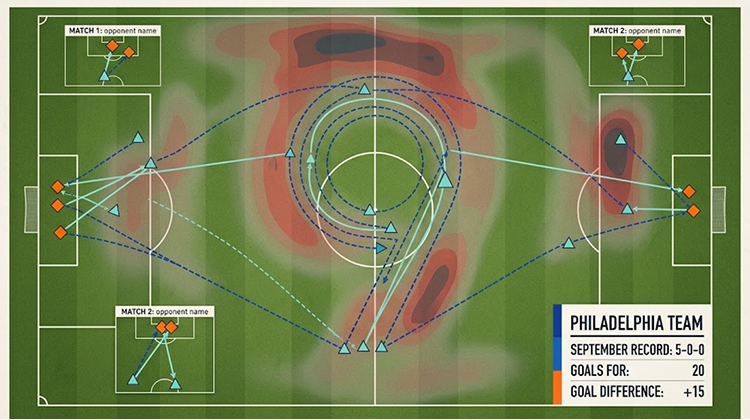
That total came from four goals and five assists, putting him first in MLS for combined goals and assists during September. His five assists were tied for the league lead, while his four goals were tied for third. MLS also reported that his nine contributions were three more than the next-closest players during the month.
| September 2026 Statistic | Cavan Sullivan |
|---|---|
| Appearances | 4 |
| Goals | 4 |
| Assists | 5 |
| Goal Contributions | 9 |
| Union Record | 5-0-0 |
| Union Goals | 20 |
| Union Goal Difference | +15 |
The distribution of those contributions is particularly important. Sullivan scored once in Philadelphia’s 2-0 victory over CF Montréal on September 5. Four days later, he produced three assists in a 5-0 win against FC Cincinnati. Against San Diego FC on September 13, he scored twice and added an assist in another 5-0 victory. He finished the month with a goal and an assist during Philadelphia’s 4-3 comeback against Sporting Kansas City on September 19.
That means Sullivan was not simply accumulating statistics in one isolated performance. He contributed directly in all four league matches he played during the month.
The FC Cincinnati performance is especially revealing because three assists demonstrate a different dimension of his value. The San Diego match then showed his ability to become the primary scorer, while the Sporting Kansas City comeback illustrated his ability to contribute in a high-pressure game that required Philadelphia to overturn a three-goal deficit.
For a teenager, the variety matters as much as the raw total. Sullivan’s September production covered chance creation, finishing and decisive contributions across different match states.
For more MLS player-development context, MLS NEXT development provides the broader structure in which Philadelphia’s academy operates.
Philadelphia’s September Run Put Sullivan’s Numbers In Context
Sullivan’s award would be significant even if Philadelphia were struggling around him. Instead, his individual production arrived during one of the strongest stretches in the Union’s 2026 campaign.
Philadelphia finished September as the only MLS club with a perfect 5-0-0 record. The Union scored 20 goals during the month, the highest total in MLS, and posted a plus-15 goal difference. The club was also in the middle of a 12-game unbeaten run following the FIFA World Cup break that had produced 32 points, tying the MLS record for points accumulated across a 12-game span.
Sullivan started all 11 Philadelphia matches during that post-World Cup-break run and recorded at least one goal contribution in eight of them.
That is where the development story becomes more interesting. Philadelphia did not need to manufacture minutes for Sullivan simply because he was a highly regarded academy product. His involvement became connected to a team that was producing results.
The Union’s September sequence also shows how his role expanded. The three-assist performance against Cincinnati positioned him as a creator. The San Diego match placed him at the center of the scoring attack. Against Sporting Kansas City, his goal and assist arrived during a dramatic comeback.
His contributions were therefore integrated into the team’s competitive objectives rather than isolated from them.
The club’s official Cavan Sullivan player profile lists him as a Homegrown midfielder and documents his progression within the organization.
That distinction is central to Philadelphia’s development model. A successful academy system ultimately has to answer two different questions: can it produce talented young players, and can those players become useful first-team professionals? Sullivan’s September suggests Philadelphia is increasingly answering both questions with the same pathway.
The Numbers Show How Quickly Sullivan Has Accelerated
Sullivan entered October with seven goals and 12 assists in 1,450 MLS regular-season minutes during 2026.
Those 19 goal contributions put him level with Alphonso Davies’ 2018 teenage total for the second-most goal contributions by a teenager in a single MLS season. Only Diego Fagúndez’s 20 contributions in 2013 remain ahead of that figure.
The efficiency becomes clearer when the playing-time figure is included.
| 2026 MLS Regular Season | Sullivan |
|---|---|
| Appearances | 24 |
| Starts | 17 |
| Minutes | 1,450 |
| Goals | 7 |
| Assists | 12 |
| Goal Contributions | 19 |
These numbers come from Philadelphia’s official player statistics and show that Sullivan has generated 19 goal contributions in 1,450 minutes rather than accumulating the total simply through an unusually high volume of playing time.
His September alone accounted for nearly half of his season goal contributions.
The progression from earlier in the season also matters. Sullivan registered his first MLS assist against Charlotte FC on April 4 and scored his first MLS goal against Orlando City on May 13. By August and September, his production had accelerated considerably, including multiple-assist performances and his first MLS brace.
He also became the youngest player in MLS history to record three assists in a single match when he did so against FC Cincinnati on September 9.
The September award therefore does not represent a sudden statistical anomaly. It is the latest stage of a season-long progression in which Sullivan moved from promising young contributor to one of Philadelphia’s most productive attacking players.
The Union’s Development Pathway Is Visible In Sullivan’s Timeline
Sullivan joined the Philadelphia Union Academy in 2020 at age 10. His route through the organization included the U-15 and U-17 MLS NEXT teams before he moved into Philadelphia Union II and MLS NEXT Pro.
That progression was already producing measurable results before he reached MLS.
In the 2023 Generation adidas Cup, Sullivan helped the Union U-15 team reach the final and was named to the tournament’s Best XI. In 2024, he helped Philadelphia’s U-17 group win the tournament for a second consecutive year. He also won the Golden Ball at the 2023 Concacaf U-15 Championship after scoring four goals for the United States.
Then came the professional transition.
Sullivan made his MLS NEXT Pro debut for Philadelphia Union II on March 24, 2024, providing an assist in a 2-1 victory over New England Revolution II. He later scored his first professional goal against the same opponent in June.
Philadelphia signed him to a first-team contract on May 9, 2024, through 2028, in what the club described as a record Homegrown deal. At that point he was only 14.
On July 17, 2024, Sullivan made his MLS debut against New England Revolution at 14 years and 293 days old. That appearance made him the youngest player to debut for a North American major professional sports league, surpassing Freddy Adu’s previous MLS record of 14 years and 306 days.
The pathway is important because each step provided a different level of competition without requiring Sullivan to leave the organization.
The academy environment allowed him to develop against players in his age group. MLS NEXT Pro introduced professional opponents and physical demands. The first team then placed those skills inside a competitive MLS environment.
Philadelphia’s model effectively reduced the distance between youth development and senior football.
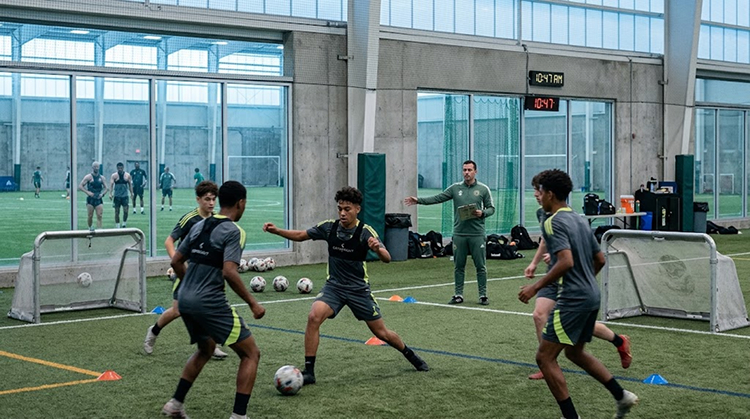
For a broader look at the Union’s player development pathway, WikiApp’s soccer coverage examines how MLS clubs are increasingly connecting academy structures with first-team opportunities.
The 2026 Breakthrough Has Also Changed Sullivan’s National-Team Status
Sullivan’s September club form coincided with his first senior U.S. national-team opportunity.
After his strong month with Philadelphia, Mauricio Pochettino included Sullivan in the United States squad for the September international window. On September 26, Sullivan started against Peru and became the second-youngest player to start a USMNT match. He later appeared against Chile in a 4-2 U.S. victory.
The sequence illustrates how club development can accelerate international opportunities.
Sullivan did not arrive at the national-team level because of one highlight or one award. The September call-up came after months of increasingly significant MLS performances, culminating in a month where he directly produced nine goals and assists.
His national-team progression also means Philadelphia is now developing a player whose club pathway and international pathway are advancing simultaneously.
That creates another test for the Union’s system. Producing a young player is one challenge. Managing the increased workload, tactical responsibility and public attention that accompany senior international football is another.
Sullivan’s September suggests that the club has already established enough trust in his ability to give him responsibility in important MLS matches. His USMNT involvement adds another layer to that challenge.
The Biggest Indicator May Be The Eight-Match Contribution Streak
The most revealing statistic from Sullivan’s current run may be less obvious than the nine September contributions.
MLS reported that Sullivan had recorded a goal or assist in eight consecutive matches, the longest such streak by a teenager in league history.
A single-month award can sometimes be explained by a short burst of finishing form. An eight-game contribution streak is different because it indicates repeated involvement across multiple fixtures.
It also coincides with Philadelphia’s broader unbeaten run.
Sullivan started 11 matches during the Union’s 12-game unbeaten stretch after the World Cup break and contributed a goal or assist in eight of them.
That relationship does not establish that Sullivan alone caused Philadelphia’s results. Soccer outcomes involve team structure, opponents, tactics, finishing and defensive performance. But it does show that his individual development has become directly connected to the club’s competitive output.
This is precisely the point where Philadelphia’s academy model becomes relevant beyond Sullivan himself.
A development pathway is most valuable when the young player can eventually influence first-team matches without the team having to lower its competitive standards. Sullivan’s current run provides evidence that the Union are using him in that environment.
Philadelphia’s Model Now Has A New Test
Sullivan’s September award gives Philadelphia another milestone, but it also raises the level of expectation around the player.
The next stage is not simply producing more records. It is sustaining performance across the remainder of 2026 and into subsequent seasons while Sullivan continues to develop physically, tactically and strategically.
The Union now have a teenager who has already moved through their academy, MLS NEXT Pro and first team, become one of MLS’s most productive young players, earned a senior national-team call-up and won the league’s monthly award.
That sequence makes his career a useful indicator of where Philadelphia’s development model stands.
The club’s approach has historically emphasized academy recruitment, internal progression and opportunities for young players to reach the first team. Sullivan represents the clearest recent example because almost every major stage of that pathway occurred inside the same organization.
The MLS Player of the Month award adds an important final piece to that evidence.
Sullivan is now the youngest player ever to win the honor at 17 years and two days, and the first MLS player to complete the MLS NEXT, MLS NEXT Pro and first-team progression before earning the award.
That makes September more than an impressive month for one teenage midfielder. It provides Philadelphia with a measurable example of what its development infrastructure can produce when an exceptional academy player progresses quickly and receives meaningful first-team responsibility.
The next question is how many other Union academy players can follow enough of that pathway to make the same transition.
That is ultimately the significance of Sullivan’s record. The award belongs to one player, but the route that made the award possible belongs to the entire Philadelphia development system.