
Cavan Sullivan’s first USMNT appearance arrived before his 17th birthday, but the significance of his debut against Peru on September 26 extends beyond another entry in the national-team record book. The Philadelphia Union midfielder started at Inter&Co Stadium in Orlando as the United States opened its 2030 World Cup cycle with a 4-1 victory, becoming the fourth-youngest American to debut for the senior national team at 16 years and 363 days.
The timing is particularly relevant. Mauricio Pochettino has described this stage of the USMNT as a “fresh start” after the 2026 World Cup, and U.S. Soccer extended his contract through 2030. Sullivan therefore enters the senior setup at the beginning of a four-year cycle rather than near the end of one.
His debut also provides a useful test of Philadelphia’s development model. Sullivan did not arrive in Orlando as an unknown academy prospect. He came into camp after producing seven goals and 12 assists in 24 MLS appearances during the 2026 regular season, while becoming one of the most productive teenagers in league history.
That combination of age, production and development history makes Sullivan one of the clearest examples of the player pathway Pochettino can evaluate as the USMNT builds toward 2030.
Sullivan’s USMNT Debut Came At A Historic Age
The September 26 match against Peru was already positioned as the first major test of the new USMNT cycle, but Sullivan’s inclusion made the lineup historically young. He started as the youngest player in the XI, with U.S. Soccer confirming that his appearance at 16 years and 363 days made him the fourth-youngest American to debut for the senior national team.
Sullivan played 61 minutes before being replaced by fellow teenager Zavier Gozo in the 62nd minute. He started in a lineup that also included Philadelphia Union teammate Peyton Miller, who made his own senior debut, and Orlando City forward Justin Ellis, another first-time international.
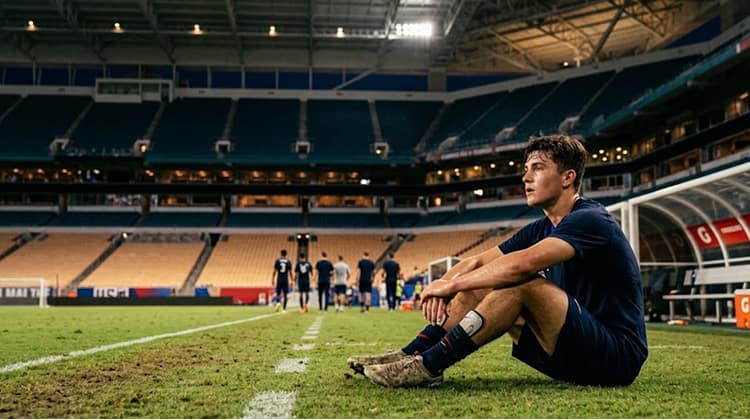
The match eventually produced 11 USMNT debutants: Mathis Albert, Justin Ellis, Zavier Gozo, Julian Hall, Diego Kochen, Adri Mehmeti, Peyton Miller, Neil Pierre, Brooklyn Raines, Cavan Sullivan and Frankie Westfield.
That number matters because Sullivan was not simply inserted into an established veteran team for a symbolic cameo. He was part of a broader personnel shift. Pochettino selected the youngest starting XI of his tenure, and the group represented a significant change in the age profile of the national team.
The immediate result was also substantial. The United States defeated Peru 4-1 in front of a sellout crowd of 24,228 at Inter&Co Stadium, with Justin Ellis scoring in the fourth minute, Malik Tillman converting a penalty in the 66th, Julian Hall scoring in the 72nd and Sebastian Berhalter completing the scoring in the 90th.
Sullivan did not score or assist, but his debut should be evaluated in a different context. His importance was connected to the decision to give a 16-year-old a starting role in the first match of a new World Cup cycle.
Philadelphia Already Had The Evidence
The national-team call-up did not come from potential alone. Sullivan entered the September camp after establishing himself as a significant contributor for the Philadelphia Union during the 2026 MLS season.
Through 24 MLS appearances, he had started 17 matches and accumulated 1,450 minutes, with seven goals and 12 assists. Those numbers put him among the most productive teenage attackers in MLS.
His September form was particularly striking. On September 13, Sullivan scored twice and added an assist in Philadelphia’s 5-0 victory over San Diego FC. MLS subsequently named him Player of the Matchday for Matchday 26 at 16 years and 351 days. He had contributed at least one goal or assist in seven consecutive matches, which MLS identified as the longest such streak by a teenager in league history.
One week later, Sullivan scored again during Philadelphia’s comeback victory over Sporting Kansas City. The Union erased a three-goal deficit and won 4-3 at Sporting Park, with Sullivan scoring in the 66th minute.
The progression is important for assessing his national-team role. Sullivan was not selected because the United States lacked alternatives. He entered camp with a substantial body of senior-club evidence.
That distinction could become increasingly important during the 2030 cycle. Young players can receive international opportunities because of potential, but sustained national-team involvement normally requires them to translate that potential into consistent club performances. Sullivan had already begun that process before Pochettino gave him his first cap.
For WikiApp readers tracking the MLS player development pathway, Sullivan’s story also illustrates why Philadelphia has become such an important reference point in the discussion around American youth development.
The Union Pathway Explains The Speed Of His Rise
Sullivan’s progression through Philadelphia’s system has been unusually fast, but the structure behind it has been developing for years.
He joined the Philadelphia Union Academy in 2020 at age 10 and progressed through the club’s U-15 and U-17 MLS NEXT teams before moving into Union II and eventually the first team. Philadelphia signed him to a professional contract on May 9, 2024, through 2028, in what the club described as a record Homegrown deal.
At the time, Sullivan was 14. His youth résumé already included major international and academy achievements. He helped the Union U-15 team reach the 2023 Generation adidas Cup final, scoring against Arsenal during the tournament and earning a place in the competition’s Best XI. He also helped the U.S. win the 2023 Concacaf Boys’ Under-15 Championship, scoring four goals and receiving the tournament’s Golden Ball.
His professional debut arrived on July 17, 2024, against the New England Revolution at Subaru Park. Sullivan entered in the 85th minute at 14 years and 293 days, becoming the youngest player to appear in a regular-season game across North America’s major professional team sports at that time. He surpassed the previous record held by Freddy Adu, who had debuted for D.C. United at 14 years and 306 days in 2004.
The progression since then has been more important than the original record.
Sullivan appeared in 11 MLS matches during 2025, including one start, before making a much larger impact in 2026. His development moved from historical novelty to regular first-team production, which is the transition that ultimately made his USMNT selection logical.
That distinction is central to Philadelphia’s model. The club has repeatedly attempted to move academy players into senior environments early rather than leaving them in youth competitions until they are physically older. Sullivan’s path from academy soccer to Union II, MLS and then the senior national team represents the entire ladder.
His 2026 Production Changes The National-Team Conversation
The most relevant statistic surrounding Sullivan is arguably not his age. It is his production.
| 2026 MLS Statistic | Cavan Sullivan |
|---|---|
| Appearances | 24 |
| Starts | 17 |
| Minutes | 1,450 |
| Goals | 7 |
| Assists | 12 |
| Goal Contributions | 19 |
Source: MLS player statistics and Philadelphia Union reporting.
The 12 assists were especially significant. Philadelphia reported that Sullivan’s production made him the MLS single-season teenage record holder for assists, while his 19 goal contributions ranked among the highest totals recorded by a teenager in league history.
His September run pushed that production even further. Before the Peru match, he had scored six goals and recorded 11 assists according to MLS reporting; he then scored and assisted against Sporting Kansas City on September 19, bringing his regular-season totals to seven goals and 12 assists.
The numbers provide context for why Pochettino was willing to use him immediately.
A 16-year-old does not need to dominate international matches to justify inclusion. The more relevant question is whether his club performance has reached a level that warrants exposure to the tactical and physical demands of senior international soccer. Sullivan’s 2026 MLS season provided that evidence.
The Peru match therefore represented the next stage rather than the destination.
What Sullivan Adds To Pochettino’s 2030 Options
Pochettino’s first challenge in this cycle is determining which elements of the 2026 World Cup squad remain central and which positions need new players. Sullivan gives him another profile to evaluate in the attacking midfield structure.
Against Peru, Sullivan started in a 4-2-3-1 formation, operating as the right-sided attacking midfielder. The lineup placed him behind the front line alongside Gio Reyna and Yunus Musah, with Tyler Adams providing the central midfield anchor alongside the more defensive structure.
That role is significant because it gives Pochettino an opportunity to evaluate Sullivan as a connective player rather than simply as a traditional winger.
His MLS production suggests that he can create chances, combine around the box and contribute directly to goals. Philadelphia’s statistics show 12 assists and seven goals, while his matchday performances have demonstrated an increasing willingness to attack defenders and create actions in the final third.
International soccer will ask different questions.
Opponents will have less space, defensive transitions will be quicker, and Sullivan will encounter players with considerably more physical experience. The value of the next several camps will therefore be measured by how quickly he adapts to those conditions.
The USMNT does not need Sullivan to become its primary attacking player immediately. The more useful development path is to expose him to increasingly difficult opponents while continuing to demand regular club minutes.
That process can run parallel to the development of players such as Julian Hall, Peyton Miller, Justin Ellis, Zavier Gozo and the other teenagers who debuted against Peru.
Philadelphia’s Influence Is Bigger Than One Player
Sullivan’s debut also highlighted Philadelphia’s broader contribution to the national-team pipeline.
The Union entered the September international window with three Homegrown players receiving their first senior USMNT call-ups: Sullivan, Neil Pierre and Frankie Westfield. Philadelphia reported that the three selections brought the club’s total number of Homegrown players who have received senior USMNT call-ups to 11.
Pierre, an 18-year-old defender, entered against Peru in the 87th minute, while Westfield, 20, entered in the 76th.
That creates a broader story than Sullivan alone.
Philadelphia is producing players for multiple positions and moving them through a recognizable progression. The club’s academy feeds Union II and the first team, while strong MLS performances can lead to international opportunities.
Sullivan simply represents the most visible version of that process because of his age and statistical output.
For the USMNT, that matters because the 2030 cycle gives Pochettino time to monitor a larger pool. Instead of needing to identify a finished replacement for every veteran immediately, the coaching staff can introduce young players incrementally and determine which ones can become regular senior internationals.
The 2030 Timeline Gives Sullivan Room To Develop
Sullivan’s age makes the 2030 World Cup timeline particularly interesting.
He was born on September 28, 2009, meaning he turned 17 two days after his USMNT debut against Peru. By the time the 2030 World Cup begins, he will be 20 years old.

That leaves roughly four years between his first senior cap and the next World Cup.
The period between now and 2030 should therefore be viewed as a development window rather than a guarantee of tournament selection. Sullivan can accumulate international experience, compete for a permanent club role, develop physically and learn how to operate against increasingly sophisticated opponents.
Pochettino has already framed the September camp as the opening stage of the new cycle. U.S. Soccer’s September reporting described the matches against Peru, Chile, Mexico and Canada as the beginning of the 2030 World Cup cycle after Pochettino agreed to remain in charge through 2030.
That context changes how Sullivan’s debut should be interpreted.
His appearance was historic, but the larger story is what happens after the record. If he continues to play substantial MLS minutes, develops his defensive responsibilities and maintains his creative production, he can move from prospect to established international option well before the 2030 tournament.
The Next Test Is Consistency, Not Hype
Sullivan’s first USMNT appearance provides evidence of progress, but it does not settle his long-term role.
The next stage is more demanding. He must continue competing for starts with Philadelphia, maintain production against different defensive structures and improve the parts of his game that are harder to measure through goals and assists.
His first 24 MLS appearances of 2026 already show that he can produce at senior professional level. His 19 goal contributions demonstrate that his offensive impact is more than theoretical.
International soccer will require another step.
Pochettino now has four years to determine how Sullivan fits into the larger USMNT structure. The September window provides the first evidence, while future camps will reveal whether Sullivan can become a regular part of the team’s midfield and attacking rotations.
The most significant aspect of the Peru debut, then, is not that a 16-year-old played for the United States. It is that the player making history had already built a substantial senior résumé before receiving the opportunity.
Philadelphia gave Sullivan the pathway. MLS provided the competitive environment. His 2026 production created the case for promotion. Pochettino has now given him the next level of competition.
The 2030 plan begins with questions like these: how many of the teenagers who debuted in Orlando can become established professionals, how quickly can they adapt to international soccer, and which ones can turn early opportunities into four-year trajectories?
Sullivan has already taken the first step.
A 16-year-old who once made history simply by entering an MLS match is now a senior international, and he enters the next World Cup cycle with four years to turn that debut into something much larger.