
The United States Men’s National Team opened its 2030 World Cup cycle with a result that offered more than three points would have in a competitive tournament. On September 26, 2026, the USMNT defeated Peru 4-1 at a sold-out Inter&Co Stadium in Orlando, giving Mauricio Pochettino an immediate look at the younger generation he has been asked to develop through the next four years.
The scoreline was important, but the player usage was arguably more significant. Eleven players earned their first senior caps, including eight teenagers. Three teenagers — Cavan Sullivan, Justin Ellis and Peyton Miller — started the match, while Julian Hall, Mathis Albert, Zavier Gozo, Diego Kochen, Adri Mehmeti, Brooklyn Raines, Neil Pierre and Frankie Westfield also made their senior debuts. Every U.S. goal involved a player making his first appearance for the national team.
The match therefore became an early test of Pochettino’s new approach. The coach entered the previous World Cup with a much shorter preparation period after taking the job in 2024. His new contract through 2030 changes the equation. This time, he has an entire four-year cycle to evaluate players, develop tactical relationships and decide which members of the younger generation can become regular international starters.
Pochettino’s First Full Cycle Has A Different Starting Point
Pochettino described the new chapter as a “fresh start” before the September camp, and the Peru match provided the first opportunity to put that philosophy into practice.
The 28-player roster selected for the September and October window had an average age of 22 years and nine months, more than four years younger than the U.S. roster at the 2026 World Cup. The group also contained 13 uncapped players and 16 players based at European clubs.
That combination tells us something about the direction of the program.
Pochettino is not rebuilding by simply discarding the players who participated in 2026. Twelve World Cup veterans were available against Peru, and six started the match. Tyler Adams captained the team, while Yunus Musah, Gio Reyna, Malik Tillman, Auston Trusty and other established players provided a bridge between the previous cycle and the new group.
The result was a team that could introduce teenagers without removing all of its international experience.
That balance may become one of the defining characteristics of the 2030 cycle. The young players need senior minutes, but they also need experienced teammates who understand the demands of international football.
For readers following the broader USMNT development pathway, the Peru match offered one of the clearest snapshots yet of how that transition could work.
Eleven Players Earned Their First Caps
The most obvious story from Orlando was the number of debuts.
| USMNT Debuts vs. Peru | Age |
|---|---|
| Cavan Sullivan | 16 |
| Justin Ellis | 19 |
| Peyton Miller | 18 |
| Mathis Albert | 17 |
| Julian Hall | 18 |
| Zavier Gozo | 17 |
| Diego Kochen | 20 |
| Adri Mehmeti | 17 |
| Brooklyn Raines | 21 |
| Neil Pierre | 18 |
| Frankie Westfield | 20 |
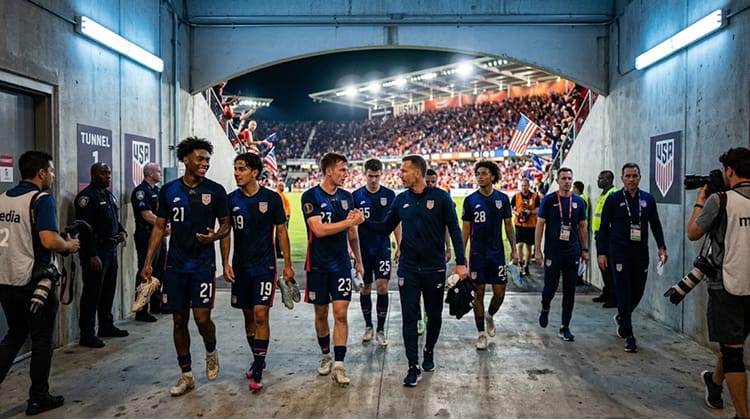
Cavan Sullivan received the greatest attention because of his age. The Philadelphia Union midfielder started the match at 16 years and 363 days, becoming the fourth-youngest player to debut for the USMNT. He played 61 minutes in a right-sided attacking midfield position within Pochettino’s 4-2-3-1 structure.
But Sullivan was only one piece of the experiment.
Peyton Miller started at left back. Justin Ellis started at center forward. That meant Pochettino did not simply introduce teenagers in low-risk substitute roles. Three of the youngest players in camp were trusted with starting responsibilities against a senior international opponent.
That distinction matters for the 2030 project.
A coach can give a prospect five or ten minutes at the end of a friendly without learning much about his ability to manage a match. Starting a 16-year-old in an international midfield role is different. It requires the player to manage positioning, possession, defensive transitions and communication from the opening whistle.
Justin Ellis Turned His Homecoming Into A National-Team Debut
The opening goal provided one of the most symbolic moments of the match.
Justin Ellis scored in the fourth minute at the home stadium of his club, Orlando City. Gio Reyna delivered the free kick, and Ellis redirected the ball toward the far post to give the United States an early lead.
According to U.S. Soccer, the goal was the fastest scored by a USMNT player on his senior debut in the modern era. Ellis also became the first player to score on his USMNT debut in his home state since Brandon Vazquez in January 2023.
The goal was also consistent with the reason Ellis earned his call-up.
At 19, he had been enjoying a breakout season with Orlando City and entered the camp as one of the younger attacking options in a roster that also included Julian Hall, Cole Campbell and Cavan Sullivan. Ricardo Pepi’s injury opened additional space at center forward, but Ellis did more than fill a roster vacancy.
He gave Pochettino a practical alternative at No. 9.
His performance also demonstrated why club development and international evaluation are becoming increasingly connected. Ellis did not need a long adaptation period to the environment in Orlando because he already plays there professionally.
The homecoming therefore had two dimensions: a personal milestone and an example of MLS infrastructure feeding directly into the senior national team.
Peru Exposed The Difference Between Potential And Experience
The 4-1 scoreline should not obscure the imperfections in the performance.
Peru equalized in the 15th minute after a U.S. defensive mistake, with Gianluca Lapadula finishing after the Americans lost possession. The goal demonstrated one of the issues Pochettino will need to address during the early stages of the new cycle: young players can bring energy and technical ability, but international opponents will punish mistakes that MLS matches sometimes allow teams to survive.
That is precisely why these matches matter.
The objective of the September and October window is not to establish a finished World Cup team. It is to give Pochettino information.
The coach can now examine how his young players respond after conceding, how quickly they recover their structure and whether they maintain their attacking intent after an opponent disrupts the initial game plan.
Against Peru, the response was positive.
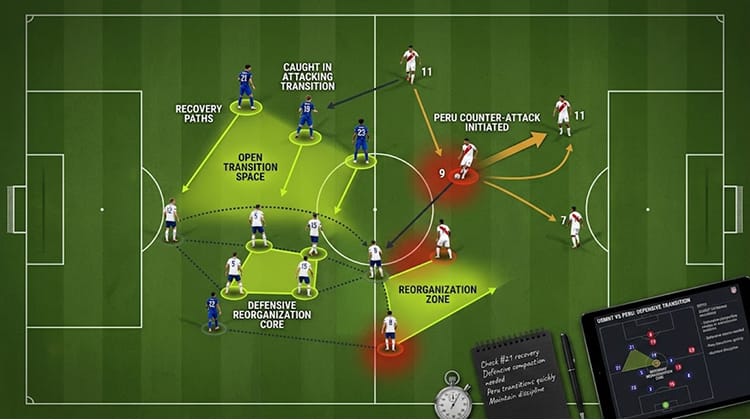
The U.S. went into halftime level at 1-1 but scored three times after the break. That second-half progression was one of the clearest signs that the young group could absorb pressure without losing the broader structure of the match.
Mathis Albert Changed The Game After Coming On
One of the strongest individual examples came from Borussia Dortmund prospect Mathis Albert.
Albert entered in the 61st minute alongside Julian Hall, Zavier Gozo, Sebastian Berhalter and Antonee Robinson. Within minutes, he made a direct attacking contribution by driving into the penalty area and drawing a foul that produced a U.S. penalty.
Malik Tillman converted in the 66th minute to restore the American lead.
The play demonstrated why Albert was included in the camp in the first place.
The 17-year-old was not asked simply to preserve possession. He entered with the freedom to attack space, challenge defenders and change the tempo of the game.
That quality is particularly relevant to Pochettino because the next USMNT cycle will require competition for attacking positions. The established players cannot assume that their places are secure if teenagers are producing immediate moments after entering the national team.
The Peru match therefore established a useful internal dynamic: experience provides stability, while young players create pressure for places.
Julian Hall Added Another Major Milestone
Julian Hall then produced the second major teenage attacking moment.
The 18-year-old Red Bull New York forward scored in the 72nd minute after Sebastian Berhalter delivered a cross to the far post. Hall’s finish made it 3-1 and effectively removed the uncertainty surrounding the result.
Hall’s debut was statistically significant as well. U.S. Soccer reported that he became the first player since Matko Miljevic in January 2025 to score and assist on his senior USMNT debut. At 18 years and 186 days, he also became the third-youngest American in the modern era to register an assist for the senior national team.
That matters because Hall’s rise had already been one of the major stories of the 2026 MLS season.
His national-team debut now connects his club breakthrough with the next stage of his development. Pochettino can evaluate Hall alongside other young attackers instead of judging him solely through his MLS production.
The competition should become increasingly intense as the cycle progresses.
Sebastian Berhalter Showed Why Veterans Still Matter
The final goal belonged to Sebastian Berhalter, and his performance illustrated the other side of Pochettino’s strategy.
Berhalter entered in the 61st minute, assisted Hall’s goal and then scored himself in the 90th minute with a long-range strike. That gave him one goal and one assist in a short appearance.
His contribution matters because the new USMNT is not simply a youth team.
The roster includes established players who can provide immediate production while younger players adapt to senior international football. Berhalter’s involvement against Peru demonstrated how an experienced professional can help determine whether a younger team can turn promising sequences into goals.
This relationship between generations could become increasingly important.
Pochettino has four years to build the 2030 roster, and the best version of that team may involve players who were already established in 2026 alongside teenagers who are currently making their first senior appearances.
The MLS Pipeline Is Already Visible
The Peru lineup also reinforced the importance of MLS in the current USMNT structure.
The September roster contained 13 MLS players, including homegrown players from Philadelphia Union, Red Bull New York, New England Revolution and Orlando City. The group also included prospects who had spent time in MLS academy systems before moving into professional environments elsewhere.
That is significant because the younger generation is arriving through several different routes.
Philadelphia contributed Sullivan, Neil Pierre and Frankie Westfield. Red Bull New York produced Adri Mehmeti and Hall. New England supplied Peyton Miller and Brooklyn Raines. Orlando developed Ellis.
The common thread is not a single club or position. It is the increasing ability of American clubs to identify young players, give them professional exposure and prepare them for international competition.
The 2030 cycle will provide four years to determine which of these pathways consistently produce senior-level players.
The Four-Match Window Will Reveal More Than Peru Did
The Peru result is encouraging, but it is only the first piece of the evaluation.
The next opponent is Chile on September 29 at Energizer Park in St. Louis. The U.S. then faces Mexico on October 3 at State Farm Stadium in Glendale, Arizona, before closing the window against Canada on October 6 at Allianz Field in St. Paul, Minnesota.
Each match presents a different test.
Chile should give Pochettino another South American opponent and another opportunity to assess defensive organization and buildup play. Mexico will introduce the emotional and competitive intensity of the region’s most familiar rivalry. Canada will provide a different tactical challenge from a team that has also developed rapidly within Concacaf.
The rotation strategy will also matter.
Pochettino said all 28 players in the camp would have the possibility to play during the four-match slate. That means the Peru lineup should be viewed as the first installment of a broader evaluation rather than a definitive starting XI.
The coaching staff now has an opportunity to compare players in different combinations and positions.
The Youngest Players Are Already Creating Internal Competition
The most important consequence of the Peru match may be the competition it creates.
Before the match, players such as Sullivan, Hall, Ellis and Albert were prospects with limited or no senior international experience. After Orlando, they became players with evidence that they can operate at this level.
That does not guarantee future selection.
International soccer becomes considerably more difficult as the opposition improves, and the four-year cycle will expose these players to injuries, club changes, tactical adjustments and competition from other prospects who have not yet reached the senior team.
But the standard has changed.
Pochettino can now evaluate young players against the same tactical expectations as established internationals.
For the veterans, the equation also changes. Tyler Adams, Antonee Robinson, Gio Reyna, Yunus Musah and other established players remain important, but their positions now face direct competition from a younger group.
That is exactly what a four-year development cycle should produce.
The 4-1 Result Gives Pochettino A Useful First Baseline
The Peru victory revealed several concrete characteristics of the new USMNT.
First, the team can introduce a large number of young players without abandoning its experienced core. Second, MLS-developed players are increasingly capable of contributing directly at senior international level. Third, the younger generation already contains different types of players: attacking midfielders, forwards, defenders and goalkeepers.
Most importantly, Pochettino now has a starting point.
The 2026 World Cup is finished, and the next tournament is four years away. That creates the time needed to turn individual breakthroughs into a coherent national-team structure.
The official USMNT match report confirms just how unusual the opening night was: 11 players made their debuts, eight of them teenagers, and all four U.S. goals involved a debutant.
That does not mean the United States has solved its 2030 roster.
It means Pochettino has begun identifying the players who could eventually solve it.
The 2030 Plan Now Has Real Players Attached To It
The significance of the Peru match is therefore less about the 4-1 score and more about what the score contained.
Cavan Sullivan became the fourth-youngest USMNT debutant. Justin Ellis scored four minutes into his first appearance at his club stadium. Julian Hall scored and assisted on debut. Mathis Albert won a penalty. Peyton Miller started at left back. Diego Kochen, Zavier Gozo, Adri Mehmeti, Brooklyn Raines, Neil Pierre and Frankie Westfield all entered the senior national-team picture.
At the same time, established players such as Tyler Adams, Gio Reyna, Yunus Musah and Malik Tillman provided the structure around them.
That combination is probably the most useful lesson from Orlando.
The United States does not have to choose between rebuilding and competing. Pochettino can develop young players while maintaining a senior core capable of stabilizing the team.
The next three matches will provide a much larger sample.
Chile, Mexico and Canada will reveal whether the technical quality and attacking energy shown against Peru can survive different tactical demands. They will also give Pochettino more information about which young players can handle increasingly difficult situations.
The 2030 World Cup remains four years away. But after the 4-1 win over Peru, the next generation is no longer an abstract concept.
It has names, positions, caps, goals and professional experience.
For Pochettino, that is the real beginning of the new cycle.