
Mauricio Pochettino’s first major international window after the 2026 FIFA World Cup begins with a demanding four-match sequence across the United States. The USMNT will face Peru on September 26 in Orlando, Chile on September 29 in St. Louis, Mexico on October 3 in Glendale and Canada on October 6 in St. Paul. The matches are the first games of Pochettino’s new four-year cycle after he agreed to remain head coach through the 2030 World Cup. (U.S. Soccer’s fall camp schedule)
The importance of the window goes beyond the results. Pochettino has repeatedly described the next four years as the central project, saying that the 2030 tournament needs to be the objective and that upcoming camps will provide opportunities to identify players who can contribute throughout the cycle. His September roster reflects that approach: the 28-player group has an average age of 22 years and nine months, while 13 players from the 2026 World Cup team are returning and a dozen prospects received their first senior call-up. (Pochettino’s 2030-cycle comments)
This makes the four matches a useful early laboratory for the new USMNT. Peru and Chile provide South American opposition, while Mexico and Canada offer two Concacaf rivals that also reached the Round of 16 at the 2026 World Cup. The sequence also takes the team through four American soccer markets that did not host World Cup matches this summer, creating a deliberate connection between the national team and fans outside the tournament venues. (U.S. Soccer’s four-city venue guide)
The Four-Match Window Has A Clear Development Purpose
Pochettino is not beginning this cycle with a completely new squad.
The United States reached the Round of 16 at the 2026 World Cup, winning its group and defeating Bosnia and Herzegovina 2-0 in the Round of 32 before losing 4-1 to Belgium. The tournament gave Pochettino a competitive baseline, but the new cycle requires him to determine which players from that group remain central and which emerging players can challenge them.
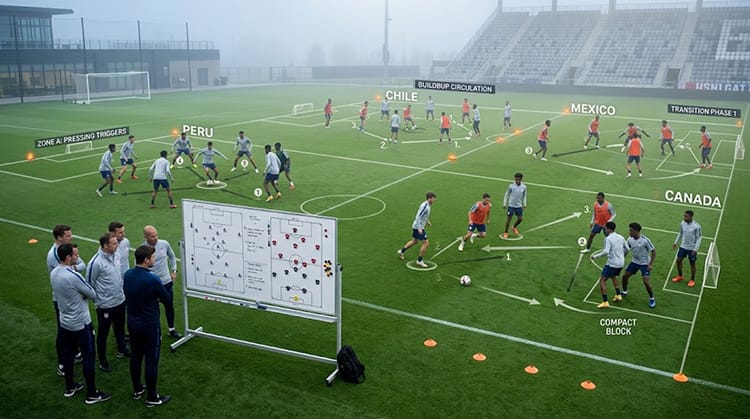
The September roster shows that the transition has already started.
U.S. Soccer reports that 62 players have earned a USMNT cap since Pochettino took over in October 2024, with those players coming from 16 leagues in 12 countries. The current squad contains 16 players from European clubs, while nine are participating in European competitions this season. (U.S. Soccer roster breakdown)
At the same time, the squad contains a significant MLS component. Young players such as Cavan Sullivan, Julian Hall, Peyton Miller, Brooklyn Raines, Adri Mehmeti and Justin Ellis have been brought into an environment where they can be evaluated alongside established internationals including Tyler Adams, Antonee Robinson, Yunus Musah and Malik Tillman.
That creates several questions Pochettino can begin answering immediately:
- Which young players can handle senior international tempo?
- Which established players remain essential to the tactical structure?
- Which positions need greater competition before 2030?
The four matches will not answer all of those questions, but they can establish the direction.
Orlando Starts The Cycle Against Peru
The first test arrives on September 26 at Inter&Co Stadium in Orlando, where the United States faces Peru at 4:30 p.m. ET.
The venue itself provides an interesting starting point. Inter&Co Stadium seats 24,000 and is home to Orlando City SC and Orlando Pride. U.S. Soccer notes that the USMNT has won all seven of its previous matches at the stadium, which has hosted the men’s team since 2017. (U.S. Soccer’s Orlando venue profile)
Peru also provides a different tactical challenge from the Concacaf opponents that will arrive later in the window.
The United States has faced Peru seven times, holding a 3-2-2 record, although the most recent meeting came nearly eight years ago. (U.S. Soccer’s Peru opponent profile)
That long gap makes the fixture useful as a fresh evaluation rather than another chapter in a frequently repeated rivalry.
For Pochettino, the first question is likely to be how quickly the new group can reproduce the principles he wants.
The coach has emphasized culture, work habits and playing principles as priorities for the new cycle. Against Peru, those principles can be tested before the emotional pressure of the Mexico rivalry arrives.
Orlando Also Creates A Natural Opportunity For MLS Players
The location adds another layer to the first match.
Several members of the squad play in MLS, and Orlando provides a familiar domestic setting for players who have spent their careers in the American system.
That matters because Pochettino’s new group includes a large number of players developed through U.S. soccer structures. U.S. Soccer says 21 players on the roster have participated in the U.S. Soccer Development Academy or MLS NEXT, while 18 came through MLS academy systems.
Cavan Sullivan represents the youngest end of that pipeline. Julian Hall represents another version of it. Peyton Miller and Brooklyn Raines show how defenders and midfielders are also emerging through MLS clubs.
The USMNT therefore has a chance to test whether domestic development is producing players who can immediately adapt to senior international football.
For readers following the broader MLS development pathway, this is one of the most important storylines in the new cycle: whether clubs can consistently turn teenage prospects into senior international options.
The Peru match will be the first practical test.
St. Louis Brings A Different Challenge Against Chile
Three days later, the USMNT travels to Energizer Park in St. Louis for Chile on September 29.
The venue opened in 2022, seats 22,000 and is home to St. Louis CITY SC. The USMNT has won all four of its previous matches at the stadium. The city also has a remarkable soccer history, with St. Louis clubs having won the U.S. Open Cup 10 times and Saint Louis University having captured 10 NCAA men’s championships between 1959 and 1973. (U.S. Soccer’s St. Louis venue profile)
The Chile match also has a particularly interesting personnel connection.
Damion Downs, who was added to the roster after Ricardo Pepi withdrew with an injury, currently plays for St. Louis CITY SC on loan from Southampton. Downs will therefore return to his club stadium while representing the national team.
The 22-year-old has six USMNT appearances and scored the winning penalty in the 2025 Concacaf Gold Cup quarterfinal shootout against Costa Rica. Before moving to St. Louis, he helped FC Köln earn promotion to the Bundesliga in 2024-25 with 10 goals and five assists. (U.S. Soccer’s Damion Downs update)
His presence gives Pochettino another attacking option and creates a useful storyline around the second match.
Chile Can Test The Team’s Defensive Organization
Chile presents a different challenge from Peru because the United States will have to manage another South American opponent in quick succession.
The match is scheduled for 7 p.m. CT on September 29, and U.S. Soccer has identified it as the second game of the four-match window. (U.S. Soccer’s Chile preview)
The compressed schedule is relevant.
National teams do not have the same training time as clubs, so Pochettino has to build tactical habits quickly. The staff will need to determine which players can execute pressing triggers, defensive rotations and buildup patterns with limited preparation.
That could make the Chile match more informative than a comfortable victory.
If the United States can maintain its structure when Chile creates pressure, Pochettino will have useful evidence about the team’s tactical maturity.
The question is particularly relevant for the younger players.
A player can dominate an MLS match while still needing time to adjust to the speed and unpredictability of international football. Chile gives Pochettino another opportunity to measure that difference.
Glendale Brings The Biggest Emotional Test
The third match is arguably the most recognizable fixture of the window.
The United States faces Mexico on October 3 at State Farm Stadium in Glendale, Arizona, home of the Arizona Cardinals. Kickoff is scheduled for 7 p.m. MT.
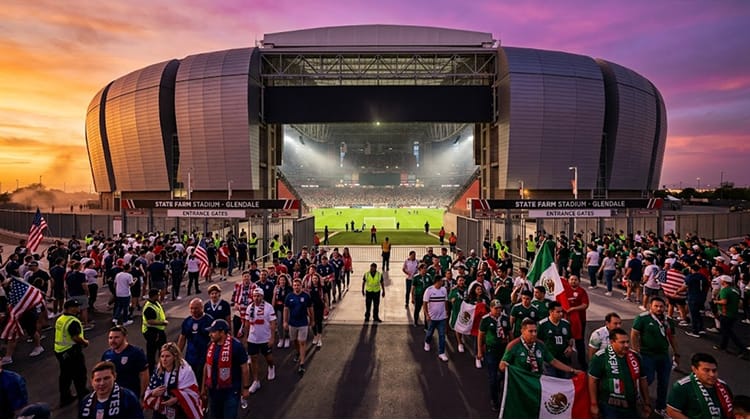
It will be the 80th meeting between the two North American rivals.
The venue is also the only non-soccer-specific stadium being used during the four-match window. State Farm Stadium can hold more than 63,000 spectators and can expand beyond 78,000 for major events. The USMNT has a 3-1-2 record at the stadium.
That creates a completely different environment for Pochettino’s young players.
The Mexico match is not simply about tactical execution. It involves pressure, rivalry, crowd intensity and a history that can influence the emotional rhythm of the game.
For players such as Hall, Sullivan and Mehmeti, it will be one of their first opportunities to experience the senior international version of a major Concacaf rivalry.
Mexico Will Show How The New Generation Handles Pressure
Pochettino’s young roster needs exposure to matches where the technical and tactical demands are accompanied by significant external pressure.
Mexico provides exactly that.
The United States and Mexico are both entering a new cycle, and both countries co-hosted the 2026 World Cup. Their next competitive meetings will therefore help shape the next stage of the regional rivalry.
The USMNT does not need to treat the match as a referendum on the entire 2030 project.
Instead, Pochettino can use it to evaluate specific players and tactical structures.
Can the younger midfielders receive the ball under pressure?
Can the forwards maintain their defensive responsibilities?
Can the defenders remain organized when Mexico creates sustained possession?
Can the team continue playing its principles after conceding momentum?
Those questions are more useful for a four-year project than a simple win-loss assessment.
St. Paul Closes The Window Against Canada
The fourth and final match takes place on October 6 at Allianz Field in St. Paul, Minnesota, against Canada.
The stadium is home to Minnesota United FC and opened in 2019 with a capacity of 19,400. U.S. Soccer notes that the USMNT has won all three of its previous matches at the venue and has never conceded a goal there. (U.S. Soccer’s venue guide)
Canada provides a different kind of test because the teams know each other well.
Both nations reached the Round of 16 at the 2026 World Cup, and both are beginning new cycles that will eventually lead to the 2030 tournament.
Canada’s current squad also includes a significant MLS presence, alongside players competing for clubs in England, Spain, France and other European leagues. The Canadian roster includes players such as Jonathan David, Promise David, Daniel Jebbison, Cyle Larin and Tani Oluwaseyi. (MLS Soccer’s Canada roster report)
That gives Pochettino another useful comparison point.
Canada Could Reveal How The Team Handles A Familiar Opponent
The Canada match could be particularly informative because the United States does not have the luxury of surprise.
The teams share a regional football environment, many players know each other through MLS or international competition, and both are familiar with the physical demands of Concacaf football.
That puts greater emphasis on execution.
Pochettino can evaluate whether the United States can impose its preferred style against a team that already understands many of its players and tendencies.
It can also reveal how much progress the young players have made across the window.
A prospect who looks comfortable against Peru but struggles against Mexico and Canada may need more development time. Another who gradually improves from match to match could demonstrate the adaptability Pochettino is looking for.
The four-game sequence therefore becomes a progression rather than four isolated friendlies.
The Roster Is Younger Than The 2026 World Cup Group
One of the clearest signals from this camp is the age profile.
The 28-player roster has an average age of 22 years and nine months, more than four years younger than the squad selected for the 2026 World Cup. Pochettino has therefore made a deliberate change in the composition of the player pool.
| Development Indicator | September 2026 USMNT |
|---|---|
| Players in roster | 28 |
| Average age | 22 years, 9 months |
| Players from 2026 World Cup roster | 13 |
| European-club players | 16 |
| Players with Development Academy/MLS NEXT experience | 21 |
| Players from MLS academy systems | 18 |
The numbers show a roster that is simultaneously experienced and experimental.
Thirteen players from the World Cup squad remain, meaning Pochettino is not starting from zero. But the inclusion of a dozen first-time senior call-ups indicates that he wants competition around the established core.
That balance could become one of the defining characteristics of the 2030 cycle.
European Experience Is Expanding The Player Pool
The young MLS players are only part of the story.
Sixteen players on the current roster play for European clubs, and nine are competing in European competitions during the 2026-27 season. The group includes Sergiño Dest and Ricardo Pepi at PSV Eindhoven, Mathis Albert at Borussia Dortmund, Alex Freeman at Villarreal, Zavier Gozo and Chris Richards at Crystal Palace, Tyler Adams at Bournemouth, Yunus Musah at AC Milan, Malik Tillman at Bayer Leverkusen and Auston Trusty at Celtic. (U.S. Soccer’s European-player breakdown)
That gives Pochettino a broader range of developmental environments to compare.
MLS provides players with a domestic professional pathway. European clubs expose players to different tactical systems and competition structures.
The USMNT can potentially benefit from both.
For Pochettino, the challenge is determining which players can transfer their club qualities into a coherent international system.
Four Matches Can Establish The First Tactical Baseline
Pochettino does not need to finalize the 2030 team during this window.
He needs to establish a baseline.
The four matches can help answer several tactical questions:
- How aggressively should the United States press?
- Which midfield combinations provide the best balance between possession and defensive coverage?
- Which young attackers can contribute without compromising the team’s defensive structure?
- Which full-backs can provide width while recovering quickly?
- Which center-back combinations can handle different types of opponents?
Those answers can then influence future camps.
The advantage of beginning this process in 2026 is that Pochettino has time to make corrections.
A player who is not ready in September 2026 may develop significantly by 2028. Another who performs well immediately may eventually be overtaken by a younger prospect.
That is the reality of a four-year national-team cycle.
The 2027 Gold Cup Will Be The Next Major Benchmark
The four friendlies are important, but the next major competitive examination will come in the 2027 Concacaf Gold Cup.
That tournament will provide Pochettino with matches that carry competitive consequences rather than the evaluation environment of international friendlies.
The difference matters.
Players can experiment more freely during a friendly. A tournament match demands stronger lineup decisions, greater tactical discipline and more reliable performances across multiple games.
The players who emerge from this fall window could therefore become candidates for the next stage of the project.
But the door will remain open.
The 2030 cycle is long enough for players currently outside the national-team picture to force their way into consideration.
The Four Cities Are Part Of The Reset
There is also a geographical dimension to this schedule.
Orlando, St. Louis, Glendale and St. Paul did not host 2026 World Cup matches. U.S. Soccer specifically selected the four cities for this fall window, giving supporters in those markets an opportunity to see the national team during the first stage of its post-World Cup cycle.
That makes the window more than a football exercise.
It is also an opportunity to reconnect the national team with the wider U.S. soccer market after the summer tournament.
The 2026 World Cup brought enormous attention to American soccer. The challenge now is maintaining that connection during the four-year period before the next tournament.
Taking the USMNT to different markets can help make the national team feel like a nationwide program rather than one associated primarily with World Cup host cities.
What Success Looks Like For Pochettino
The simplest measurement of this window would be four results.
The more useful measurement is whether Pochettino leaves the window with a clearer understanding of his player pool.
He has already expanded the group dramatically since taking charge. Now he has a new generation of prospects, a core of experienced internationals and a growing group of players competing at European clubs.
The objective is to connect those groups.
The Peru match can establish the first tactical rhythm. Chile can test organization against another South American opponent. Mexico can expose the group to rivalry pressure. Canada can provide a final test against a familiar Concacaf opponent.
By October 6, Pochettino should have more information about which players can execute his principles and which positions require additional development.
That information may ultimately prove more valuable than the results themselves.
The 2030 Project Starts Before The World Cup Is In Sight
The USMNT does not need to look like a finished World Cup team in September 2026.
Pochettino has four years to build it.
What matters now is whether the foundation is becoming clearer.
The roster’s average age has dropped. Young MLS players are receiving senior opportunities. European-based players are gaining experience in major competitions. Players such as Julian Hall and Cavan Sullivan are entering the national-team environment unusually young, while established figures such as Tyler Adams and Antonee Robinson provide continuity.
The four-city sequence gives Pochettino four different environments in which to begin connecting those pieces.
Orlando starts the process against Peru.
St. Louis adds Chile and a return to Damion Downs’ club stadium.
Glendale brings Mexico and the emotional intensity of the biggest rivalry in the region.
St. Paul closes the window against Canada, another 2026 Round of 16 participant.
The matches will not determine the 2030 USMNT.
They will do something more useful at this stage: they will begin showing Pochettino which players, tactical ideas and developmental pathways deserve four more years of investment.